Another Word for Capacity: 30 Synonyms With Examples
The closest everyday alternatives to capacity are ability and capability when you mean the power to do something, and volume or room when you mean how much a container or space can hold. For a limit, maximum works. For a job or position, role works. No single word fits every sense, because capacity covers several different meanings.
The right choice depends on what you are describing. A stadium has seating capacity (a number). A person has the capacity to learn (an ability). A factory has production capacity (output). Someone can also act “in the capacity of” a manager (a role).
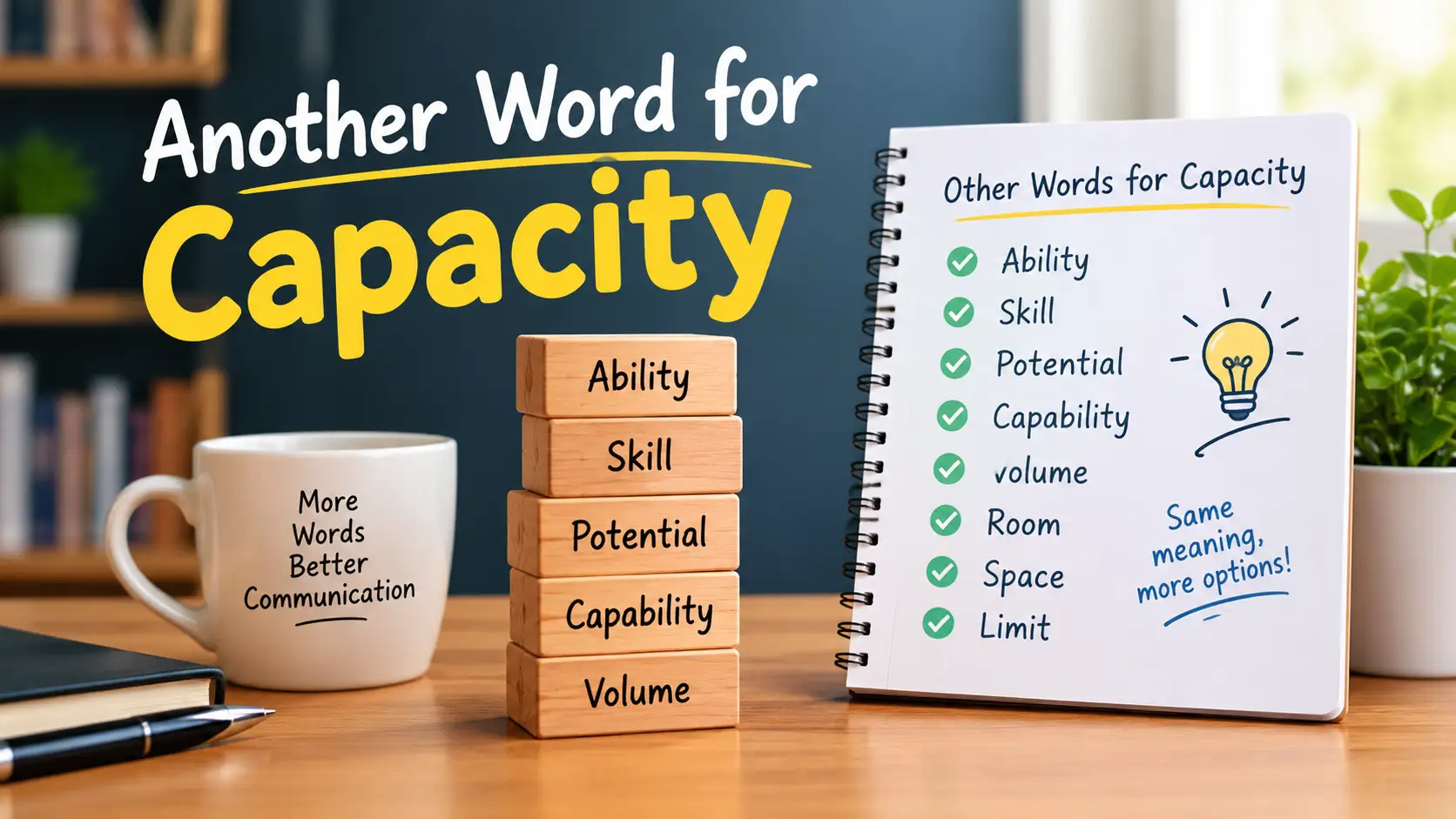
Quick list: ability, capability, volume, room, space, maximum, limit, output, potential, role
This article looks at 30 alternatives with meanings, IPA, usage notes, examples, and context. Some are direct synonyms. Others are related words that fit only one sense of capacity, and the Usage notes say which is which.
At a Glance: Capacity Synonyms and Related Alternatives
| Alternative | Part of Speech | Meaning | Register / Tone | Ideal Context |
| Ability | noun | power or skill to do something | neutral | people, general use |
| Capability | noun | power to do a particular thing | neutral to formal | systems, machines, teams |
| Volume | noun | amount of space something fills or holds | neutral, technical | containers, liquids, measurements |
| Room | noun | available space | informal to neutral | everyday spaces, storage |
| Maximum | noun | greatest amount allowed or possible | neutral | rules, limits, signs |
| Output | noun | amount produced | neutral, business | factories, farms, workers |
| Potential | noun | possible future ability | neutral | people, ideas, growth |
| Competence | noun | ability to do something well; legal fitness | formal | work, law |
| Role | noun | part someone plays | neutral | jobs, teams, groups |
| Bandwidth | noun | time and energy to handle tasks | informal, business | workload, schedules |
Which Word Should You Use?
| If you want to… | Use | Why |
| Say how much a bottle or tank holds | volume | It names the amount of space inside. |
| Say there is space for more things | room | It is simple and natural in everyday talk. |
| Give the highest number allowed in a place | maximum occupancy | It is the usual wording on safety signs. |
| Describe a natural skill for learning | aptitude | It points to natural talent. |
| Describe how much a factory can produce | output | It focuses on the amount made. |
| Explain the job someone is acting in | role | It replaces “in the capacity of” simply. |
| Say you have no time or energy for more work | bandwidth | It is a common informal workplace term. |
| Describe the power to keep going for a long time | stamina | It stresses lasting strength. |
Exploring the Multiple Meanings of “Capacity”
1. Ability to Hold or Contain
- Meaning: The ability to receive or hold something.
- Explanation: This is the oldest physical sense. It is about how much a container or space can take in, and it is usually given as a number with a unit.
- Example: The jug has a capacity of four liters.
2. Maximum Amount or Limit
- Meaning: The greatest amount or number that is possible or allowed.
- Explanation: Here capacity means the upper limit. It appears in phrases such as “filled to capacity” and “a capacity crowd,” which means a crowd that fills a place.
- Example: The hall was filled to capacity.
3. Mental or Physical Ability
- Meaning: The power to do, learn, or feel something.
- Explanation: This sense is about people, and it is often followed by to or for. It can mean a skill or a deeper quality, such as a capacity for kindness.
- Example: She has the capacity to learn quickly.
4. Productive Output
- Meaning: The amount a factory, farm, or system can produce.
- Explanation: This business sense is about how much can be made or handled. It is common in phrases such as “operating at full capacity.”
- Example: The company plans to double its factory capacity.
5. Role or Position
- Meaning: The job or position a person holds when they act.
- Explanation: This sense appears in set phrases such as “in his capacity as judge.” It says which hat the person is wearing at that moment.
- Example: He spoke in his capacity as team manager.
6. Legal Fitness
- Meaning: The legal power or qualification to do something.
- Explanation: In law, capacity means a person is legally able to act, such as making a will or standing trial.
- Example: The judge asked If he had the capacity to stand trial.
Sources: Merriam Webster (merriam webster.com/dictionary/capacity); Dictionary.com (dictionary.com/browse/capacity)
Analyzing 30 Capacity Alternatives in Detail
Some of these words are close synonyms for one sense of capacity, while others are related words that work only in certain contexts.
Size and Holding Space
1. Volume
IPA: US /ˈvɑːl.juːm/ · UK /ˈvɒl.juːm/
Definition: The amount of space that something fills or contains.
- Usage: A close match for the “holding” sense, especially in measurement. It is more technical than capacity. Volume describes the space itself, while capacity stresses what a container can take in.
- Example: The tank has a volume of 200 liters.
2. Room
IPA: /ruːm/ (US and UK)
Definition: Space that is available to be filled or used.
- Usage: A relaxed, everyday alternative. It works for “how much more can fit” but is not used for exact measurements.
- Example: The car has plenty of room for luggage.
3. Space
IPA: /speɪs/ (US and UK)
Definition: An area or amount that is empty or free to use.
- Usage: A neutral alternative for the holding sense. It is slightly broader than room and works in both casual and formal writing.
- Example: The shelf has space for twenty books.
4. Size
IPA: /saɪz/ (US and UK)
Definition: How big something is.
- Usage: A related word, not an exact synonym. Size tells you how big something is, not how much it can hold, so use it only when the two ideas are close.
- Example: Choose a bag size that fits your laptop.
5. Tonnage
IPA: US /ˈtʌn.ɪdʒ/ · UK /ˈtʌn.ɪdʒ/ (US and UK)
Definition: The carrying capacity of a ship, measured in tons; also the total weight of goods carried.
- Usage: A specialized related word for ships and shipping. It is not a general synonym for capacity.
- Example: The port can handle ships of very large tonnage.
Maximums and Limits
6. Maximum
IPA: US /ˈmæk.sə.məm/ · UK /ˈmæk.sɪ.məm/
Definition: The greatest amount or number that is allowed or possible.
- Usage: A direct match for the “upper limit” sense. It is neutral and common on signs, forms, and rules.
- Example: The maximum for this lift is eight people.
7. Limit
IPA: /ˈlɪm.ɪt/ (US and UK)
Definition: A point or amount beyond which something cannot or may not go.
- Usage: A close match for the “maximum” sense. It can describe both physical and set limits, but it does not carry the “ability to hold” idea.
- Example: The weight limit for the bridge is ten tons.
8. Ceiling
IPA: /ˈsiː.lɪŋ/ (US and UK)
Definition: An upper limit set on something, such as prices, spending, or numbers.
- Usage: A related word for limits that people or rules set. It is not used for a container’s physical volume.
- Example: The city set a ceiling on the number of tickets sold.
9. Occupancy
IPA: US /ˈɑː.kjə.pən.si/ · UK /ˈɒk.jə.pən.si/
Definition: The number of people using a space, or the act of living in or using a place.
- Usage: A related word, mainly in the phrase maximum occupancy, which is the posted limit for people in a room or building. On its own it does not mean “capacity.”
- Example: The sign says maximum occupancy is 120 people.
Everyday Ability
Everyday alternatives to “capacity” describe a person’s skill, power, or potential to perform a task. The best choice depends on whether you mean general ability, practical skills, or natural talent.
10. Ability
IPA: US /əˈbɪl.ə.t̬i/ · UK /əˈbɪl.ə.ti/
Definition: The power or skill to do something.
Usage: This is the closest everyday synonym for the “power to do” sense. It is simple, neutral, and suitable for people, animals, and things.
Example: She has the ability to explain difficult ideas simply.
11. Capability
IPA: US /ˌkeɪ.pəˈbɪl.ə.t̬i/ · UK /ˌkeɪ.pəˈbɪl.ə.ti/
Definition: The ability to perform a particular task or function.
Usage: This word often describes machines, software, teams, and organizations. It emphasizes what someone or something can do.
Example: The new phone has impressive camera capabilities.
12. Power
IPA: US /ˈpaʊ.ɚ/ · UK /ˈpaʊ.ə/
Definition: The ability to act or produce an effect.
Usage: “Power” is broader than “capacity” and may also refer to strength, authority, or control.
Example: The medicine has the power to reduce pain.
13. Potential
IPA: /pəˈten.ʃəl/
Definition: The possibility of developing or achieving something in the future.
Usage: Unlike capacity, potential emphasizes what someone or something might achieve later.
Example: The young player has great potential.
14. Competence
IPA: US /ˈkɑːm.pə.t̬əns/ · UK /ˈkɒm.pɪ.təns/
Definition: The ability to perform a task adequately or effectively.
Usage: This formal word suits professional skills, required standards, and legal contexts.
Example: The test measures basic competence in mathematics.
15. Aptitude
IPA: US /ˈæp.tə.tuːd/ · UK /ˈæp.tɪ.tjuːd/
Definition: A natural ability to learn or do something well.
Usage: “Aptitude” emphasizes natural talent or ease in learning a particular skill.
Example: He shows a strong aptitude for languages.
Mind and Natural Gifts
16. Faculty
IPA: US /ˈfæk.əl.t̬i/ · UK /ˈfæk.əl.ti/
Definition: A natural power of the body or mind, such as sight, hearing, or reason.
- Usage: A related word, mostly plural (faculties) for mental abilities. It does not mean “amount a container holds.” It also has a separate meaning, a university’s teaching staff.
- Example: She kept all her faculties well into old age.
17. Talent
IPA: /ˈtæl.ənt/ (US and UK)
Definition: A natural skill or gift.
- Usage: A related word for a special ability. It suggests something unusual, while capacity can be ordinary.
- Example: She has a talent for drawing.
18. Intellect
IPA: US /ˈɪn.t̬əl.ekt/ · UK /ˈɪn.təl.ekt/
Definition: The power of the mind to think, reason, and understand.
- Usage: A formal alternative for mental capacity. It is not used for physical ability or for containers.
- Example: He had the intellect to solve the puzzle.
19. Brainpower
IPA: US /ˈbreɪnˌpaʊ.ɚ/ · UK /ˈbreɪnˌpaʊ.ə/
Definition: Mental ability or intelligence.
- Usage: An informal alternative for mental capacity. It is a related word, not a full synonym.
- Example: The project will need a lot of brainpower.
Strength and Endurance
20. Stamina
IPA: US /ˈstæm.ə.nə/ · UK /ˈstæm.ɪ.nə/
Definition: The physical or mental strength to keep doing something for a long time.
- Usage: A related word for the capacity to keep going. It fits sports, long work days, and hard tasks.
- Example: Marathon runners need great stamina.
21. Endurance
IPA: US /ɪnˈdʊr.əns/ · UK /ɪnˈdjʊə.rəns/
Definition: The ability to keep going through pain, hardship, or long effort.
- Usage: A related word that stresses lasting through difficulty. It is more serious in tone than stamina.
- Example: The long climb tested her endurance.
22. Tolerance
IPA: US /ˈtɑː.lɚ.əns/ · UK /ˈtɒl.ər.əns/
Definition: The ability to bear or put up with something; also the amount of something a body or material can withstand.
- Usage: A related word for the capacity to accept or bear something. It is not a general synonym.
- Example: Some people have a high tolerance for spicy food.
23. Strength
IPA: /streŋθ/ (US and UK)
Definition: The power to resist force, pressure, or strain.
- Usage: A related word, and only for the “withstand” idea. It does not mean the amount something holds.
- Example: The bridge’s strength lets it carry heavy trucks.
Output and Workload
24. Output
IPA: /ˈaʊt.pʊt/ (US and UK)
Definition: The amount of something that is produced.
- Usage: A good match for production capacity. Note that output is what is actually made, while capacity can mean the most that could be made.
- Example: The plant doubled its output last year.
25. Throughput
IPA: /ˈθruː.pʊt/ (US and UK)
Definition: The amount of material or data that is processed in a set time.
- Usage: A technical alternative for the rate at which a system handles work. It is used in industry and computing.
- Example: The new server improved network throughput.
26. Productivity
IPA: US /ˌproʊ.dʌkˈtɪv.ə.t̬i/ · UK /ˌprɒd.ʌkˈtɪv.ə.ti/
Definition: The rate at which goods are produced, or how efficiently work is done.
- Usage: A related word, not an exact synonym. Productivity measures how well resources are used, not the most that could be produced.
- Example: Farm productivity rose after the new tools arrived.
27. Bandwidth
IPA: /ˈbænd.wɪdθ/ (US and UK)
Definition: In everyday talk, the time and energy a person has to deal with tasks; technically, the amount of data a connection can carry.
- Usage: An informal, workplace use that is close to capacity for workload. Avoid it in formal writing.
- Example: I don’t have the bandwidth for another project this month.
Role and Position
28. Role
IPA: US /roʊl/ · UK /rəʊl/
Definition: The part someone plays in a situation or organization.
- Usage: The simplest replacement for capacity in “in his capacity as…” It is natural in both speech and writing.
- Example: In her role as coach, she plans every practice.
29. Position
IPA: /pəˈzɪʃ.ən/ (US and UK)
Definition: A job or rank within an organization.
- Usage: A close match for the “role” sense, especially in phrases like “in a supervisory position.”
- Example: He spoke in his position as union leader.
30. Function
IPA: /ˈfʌŋk.ʃən/ (US and UK)
Definition: The purpose or job that a person or thing has.
- Usage: A formal, less common alternative for the “role” sense. It sounds official and is rarer than role in everyday speech.
- Example: In her function as security officer, she checks every entrance.
Sources: Merriam Webster (merriam webster.com/dictionary/capacity); Dictionary.com (dictionary.com/browse/capacity)
Capacity vs. Capability vs. Ability
These three words overlap, and dictionaries often define them in terms of each other. The differences below are common tendencies in usage, not strict rules.
| Word | Usually Focuses On | Typical Use | Example |
| Capacity | how much can be held, produced, or learned | containers, venues, factories, people | The stadium has a capacity of 50,000. |
| Capability | what can be done | machines, systems, teams | The software has new search capabilities. |
| Ability | the power or skill to do something | people, general use | She has the ability to lead. |
In short, use capacity for amounts and limits, capability for what a system can do, and ability for a person’s skill.
Sources: Merriam Webster (merriam webster.com/dictionary/capacity); Dictionary.com (dictionary.com/browse/capacity)
Capacity and Opposite/Paired Word Pairs
| Word | Paired Word | Note |
| capacity (ability, legal) | incapacity | The true opposite: lack of ability or legal power. |
| ability | inability | The natural opposite of the “power to do” sense. |
| capacity | demand | A common business pair: how much can be supplied versus how much is wanted. |
| capacity | load | Load is the amount actually carried; capacity is the most that can be carried. |
| capacity | utilization | Utilization is how much of the available capacity is in use. |
Not every sense of capacity has a clean opposite. The “ability” and “legal” senses have true opposites (incapacity, inability). The “holding” and “output” senses are better understood through paired terms such as demand, load, and utilization.
Sources: Merriam Webster (merriam webster.com/dictionary/capacity); Dictionary.com (dictionary.com/browse/capacity)
Common Word Partners of “Capacity”
| Pattern | Common Partners | Example |
| adjective + capacity | seating, storage, carrying, maximum, full, spare, production, vital | The hall has a seating capacity of 500. |
| verb + capacity | reach, exceed, increase, expand, have | The factory plans to expand its capacity. |
| capacity + noun | capacity crowd, capacity audience | A capacity crowd filled the stadium. |
| capacity + to / for | capacity to learn, capacity for love | He has a great capacity for hard work. |
| in + (possessive) + capacity | in his capacity as, in any capacity | She spoke in her capacity as mayor. |
| to / at + capacity | filled to capacity, at capacity | The restaurant was at capacity. |
Sources: Merriam Webster (merriam webster.com/dictionary/capacity); Dictionary.com (dictionary.com/browse/capacity)
Idiomatic Phrases Featuring “Capacity”
Capacity has few true idioms. The phrases below are established expressions that dictionaries list.
1. Filled to Capacity
- Meaning: Completely full, with no more room.
- Example: The auditorium was filled to capacity.
2. At Capacity
- Meaning: Using all available space or resources, so nothing more can be taken on.
- Example: The hospital is at capacity this week.
3. In One’s Capacity as…
- Meaning: In the role or position someone holds at that time.
- Example: In his capacity as judge, he made the final ruling.
4. In Any Capacity
- Meaning: In any role or job.
- Example: She is happy to help in any capacity.
Sources: Merriam Webster (merriam webster.com/dictionary/capacity); Dictionary.com (dictionary.com/browse/capacity)
Word Formation of “Capacity”
Etymology & Structure
Capacity came into English from Old French capacité, which came from Latin capacitas, meaning “breadth” or “ability to hold much.” The Latin word comes from capax (“able to hold much”), which comes from capere (“to take”). The ending ity makes a noun that names a state or quality.
Date and History
Merriam Webster gives the 15th century as the first known use in English, and Etymonline dates it to the early 15th century. The original senses were “ability to contain” and “ability” in a legal, moral, or mental sense. Etymonline dates the electrical sense to 1777, the “amount a container holds” sense to 1885, “largest audience a place can hold” to 1908, and the industrial sense of “ability to produce” to 1931.
Word Class Variations
- Noun: capacity (plural: capacities)
- Adjective (used before a noun): capacity, as in “a capacity crowd”
- Related adjectives: capacious (able to hold a lot), capacitive (relating to capacitance)
- Related verbs: capacitate (to make capable), incapacitate (to make unable to act)
- Related nouns: incapacity, capacitance, capacitor
Sources: Etymonline (etymonline.com/word/capacity); Merriam Webster (merriam webster.com/dictionary/capacity)
Common Word Choice Mistakes
- “The room has a capacity of 100 people”: use “100 people.”
- “She has the capacity of learning”: use “capacity to learn” or “capacity for learning.”
- “He works in the capacity of manager”: use “in the capacity of manager” or “in his capacity as manager.”
- “The auditorium has a capacity of 500 seats”: use “capacity.” Capability describes what something can do, not how many it holds.
- “Her mental faculty is excellent”: use the plural, “faculties,” for mental powers.
- “The electrical capacity of the capacitor”: in science, use “capacitance.”
- “The report shows our team bandwidth”: in formal writing, use “capacity” or “workload.”
Frequently Asked Questions
What is the closest synonym for capacity?
It depends on the sense. Ability or capability fits the “power to do” meaning, and volume or room fits the “amount held” meaning.
What is a formal alternative to capacity?
Competence, capability, and intellect are formal choices for the ability sense. Maximum occupancy is a formal choice for room limits.
What is the difference between capacity and capability?
Capacity usually points to how much can be held or done, while capability usually points to what can be done. The words overlap, so context decides.
Can capacity be used for people?
Yes. People can have a capacity for work, love, or learning. A crowd can also be described as a “capacity crowd.”
Can capacity mean a job or role?
Yes. In phrases such as “in his capacity as manager,” it means the role someone holds at that time.
What is the opposite of capacity?
For ability or legal power, the opposite is incapacity, and inability fits the ability sense. For amounts held or produced, there is no single opposite.
Is capacity the same as volume?
Not exactly. Volume is the amount of space something takes up or holds, while capacity is the most a container or space can hold.
What is an informal alternative to capacity?
Room works for space, brainpower for mental ability, and bandwidth for time and energy at work.
What does “filled to capacity” mean?
It means completely full, with no more room for people or things.
Is capacity a countable noun?
Usually it is used in the singular. The plural, capacities, appears when talking about several abilities or roles, such as “in various capacities.”
Conclusion
The closest alternatives to capacity are ability and capability for power to do something, and volume and room for the amount something holds. Maximum and limit fit upper limits, output fits production, and role fits “in the capacity of.”
Context matters because capacity has several senses. A word that fits a tank, such as volume, will not fit a person’s skill, where aptitude or ability is better. A word for a job, such as role, will not fit a factory.
To choose the right word, first ask what you mean: space, a limit, a skill, output, or a role. Then pick the word that fits that sense, and check If the tone should be formal or relaxed.

Noman is the founder and author of Factwy.com, where he shares informative, useful, and easy-to-understand content. With a passion for research and writing, he creates articles that simplify complex topics and provide valuable insights. His goal is to deliver clear, accurate, and reader-friendly information that helps visitors learn something new every day.