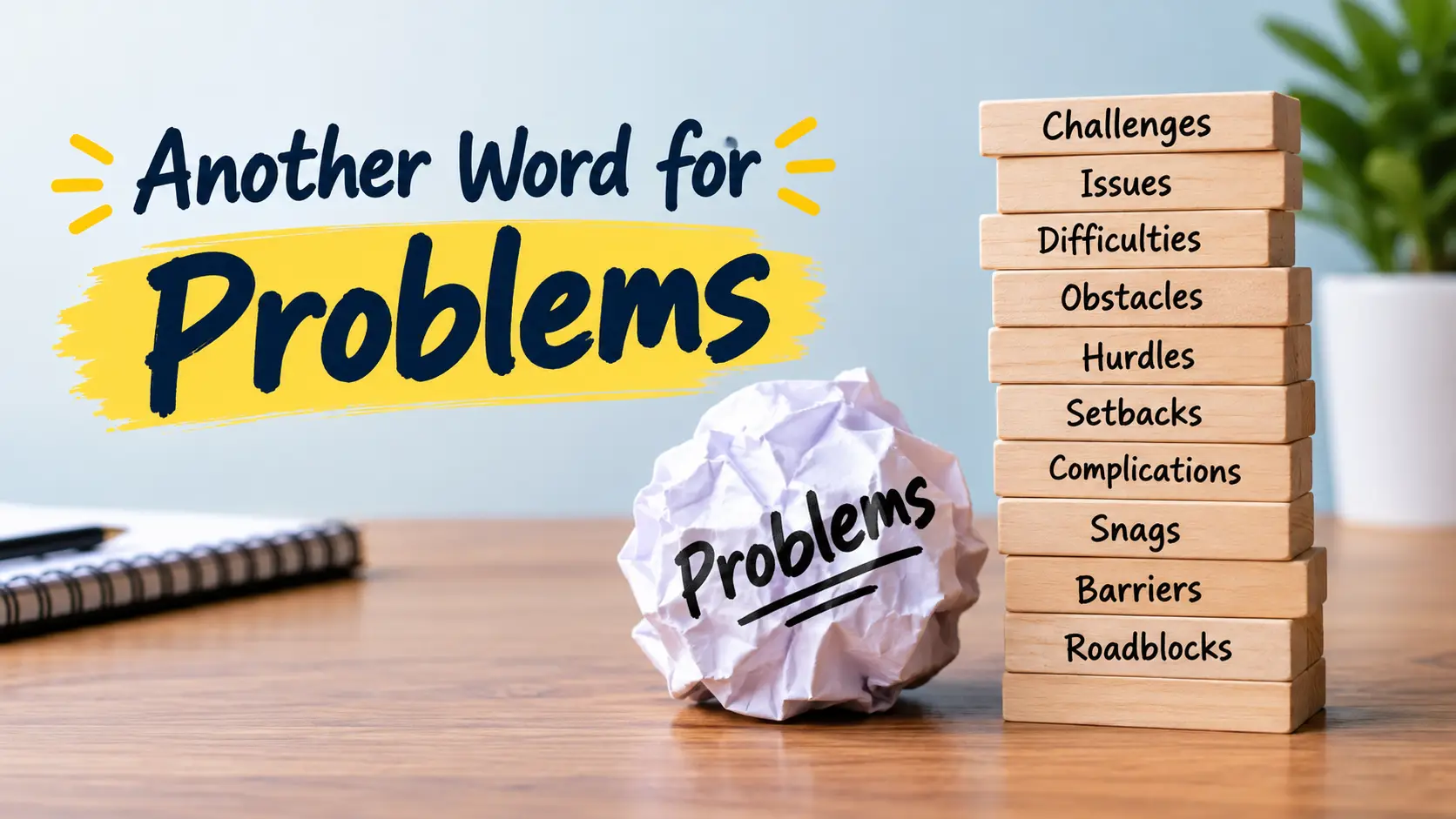
Another Word for Problems: 30 Synonyms With Examples
The closest everyday alternatives to “problems” are troubles, difficulties, and issues. “Issues” sounds calmer and more professional, “troubles” sounds more personal, and “difficulties” sounds more formal. “Problems” can also mean faults in a machine, questions to solve, or things that worry someone. Each meaning calls for a different word.
If a plan is blocked, use obstacles or hurdles.When describing a minor technical fault, use glitches or bugs. For a difficult life situation, use hardships. When facing a choice between two bad options, use a dilemma. The right word depends on how serious the problem is, who is speaking, and what kind of problem it is.
Quick list: trouble, difficulty, issue, obstacle, challenge, setback, hurdle, glitch, complication, hardship
Below you will find 30 alternatives with meanings, IPA, usage notes, and examples. The article also covers word pairs, collocations, idioms, word history, and common mistakes.
At a Glance: Problems Synonyms and Related Alternatives
| Alternative | Part of Speech | Meaning | Register / Tone | Ideal Context |
| Trouble | Noun | Difficulty, worry, or something going wrong | Neutral, personal | Everyday speech, health, money, family |
| Difficulty | Noun | Something that makes a task hard | Neutral to formal | Reports, school, work |
| Issue | Noun | A matter that needs attention or a decision | Neutral, professional | Business, customer service, meetings |
| Challenge | Noun | A hard task that tests ability | Positive, polite | Workplace, goals, sports |
| Obstacle | Noun | Something that blocks progress | Neutral | Plans, careers, travel |
| Setback | Noun | A delay or step backward | Neutral | Projects, recovery, business |
| Glitch | Noun | A small, often temporary fault | Informal to neutral | Technology, machines |
| Hardship | Noun | A condition of suffering or lack | Serious, formal | Poverty, war, life struggles |
| Dilemma | Noun | A hard choice between options | Neutral to formal | Decisions, ethics |
| Complication | Noun | A new factor that makes things harder | Neutral to formal | Plans, medicine, law |
Which Word Should You Use?
| If you want to… | Use | Why |
| Speak in a general, friendly way | trouble | It is short, natural, and fits many situations. |
| Sound professional without sounding negative | issue | It names a matter to deal with and avoids strong feelings. |
| Describe a fault in software or a device | glitch or bug | Both are standard in technology talk. |
| Describe something that blocks a goal | obstacle or hurdle | Both suggest something to get past. |
| Describe a small delay or minor fault | hitch or snag | Both suggest something small and often temporary. |
| Describe serious suffering or lack | hardship | It points to real struggle, not just inconvenience. |
| Describe a choice between two bad options | dilemma | It means a hard choice, not just any problem. |
| Make a problem sound more manageable | challenge | It suggests something that can be met and overcome. |
Exploring the Multiple Meanings of “Problems”
1. A Difficulty or Trouble
- Meaning: Something that is hard to deal with or causes worry.
- Explanation: This is the most common sense. It covers money, health, school, work, and relationships. Words like trouble, difficulty, and hardship fit here.
- Example: She has been having money problems since she lost her job.
2. A Fault or Something That Is Not Working
- Meaning: A condition in which a machine, system, or process does not work properly.
- Explanation: This sense is common in technology and repairs. Glitch, bug, defect, and malfunction fit here, each at a different level of seriousness.
- Example: The engineer found a problem with the engine.
3. A Question to Be Solved
- Meaning: A question, often in maths or logic, that needs a solution.
- Explanation: Here “problem” is neutral and has nothing to do with trouble. Puzzle and conundrum are related, but only partly the same.
- Example: The class solved ten math problems before lunch.
4. An Objection or Dislike
- Meaning: A reason for disagreeing with or disliking something.
- Explanation: This sense appears in phrases like “have a problem with.” Concern or objection fits better than trouble here.
- Example: I have no problem with working late on Friday.
5. A Long Term Condition or Difficulty in a Person’s Life
- Meaning: A continuing health, behavior, or personal difficulty.
- Explanation: This sense is common in phrases like “health problems” or “a drinking problem.” Words like trouble or issue can fit, but they may sound weaker or too general.
- Example: He has had back problems for years.
Sources: Merriam Webster; Collins English Dictionary; Dictionary.com
Analyzing 30 Problems Alternatives in Detail
Some alternatives below are close synonyms of “problems,” while others fit only certain situations and are marked as related alternatives. Words are shown in their singular dictionary form, and most also work in the plural.
Common Synonyms for Problems
Looking for another word for problems? Several synonyms can help you describe everyday troubles, serious hardships, unexpected setbacks, and obstacles. The best choice depends on the situation and the type of difficulty you want to express.
1. Trouble
IPA: /ˈtrʌbəl/ (US and UK)
Definition: Difficulty, worry, or a situation in which something goes wrong.
Usage: Trouble is a common, everyday synonym for problems. It often describes personal concerns, unexpected difficulties, or situations that cause worry. The phrase “in trouble” can also refer to danger or punishment.
Example: We had trouble finding a parking space.
2. Difficulty
IPA: US /ˈdɪfɪˌkʌlti/ · UK /ˈdɪfɪkəlti/
Definition: A challenge that makes something hard to do or understand.
Usage: Difficulty is a slightly more formal alternative to problem. It works well when discussing challenging tasks, learning experiences, or situations that require extra effort. You can use it in phrases such as “difficulty understanding” or “difficulty completing.”
Example: Many students have difficulty understanding long words.
3. Issue
IPA: /ˈɪʃuː/ (US and UK)
Definition: A matter that needs attention or a problem that requires a solution.
Usage: Issue is a useful synonym for problem in business, customer service, and professional communication. It often sounds more neutral and less negative. However, it can also refer to a topic under discussion rather than a problem.
Example: The customer reported an issue with her order.
4. Hardship
IPA: US /ˈhɑːrdʃɪp/ · UK /ˈhɑːdʃɪp/
Definition: A serious difficulty that causes suffering or makes life challenging.
Usage: Hardship describes more serious problems, particularly those involving poverty, loss, difficult living conditions, or prolonged struggles. It is stronger than the general word problem.
Example: The family faced great hardship after the flood.
5. Setback
IPA: /ˈsɛtbæk/ (US and UK)
Definition: An event that delays progress or makes a situation more difficult.
Usage: Setback is a suitable alternative when a problem interrupts progress toward a goal. It frequently appears in discussions about work, education, business, and personal achievements.
Example: The storm caused a major setback for the construction team.
6. Complication
IPA: US /ˌkɑːmplɪˈkeɪʃən/ · UK /ˌkɒmplɪˈkeɪʃən/
Definition: An additional factor that makes an already difficult situation more complex.
Usage: Complication works well when an unexpected development creates further problems. People commonly use it when discussing plans, legal matters, medical situations, and projects.
Example: A last-minute change created a complication for the schedule.
Synonyms for Problems That Block Progress
Some problems prevent people from reaching their goals or moving forward. Words such as obstacle, hurdle, barrier, and roadblock describe these situations more precisely.
7. Obstacle
IPA: US /ˈɑːbstəkəl/ · UK /ˈɒbstəkəl/
Definition: Something that blocks progress or makes it harder to achieve a goal.
Usage: Obstacle is a close synonym for problem when a person faces something that stands in the way of success. It can describe physical barriers as well as challenges involving money, work, or personal goals.
Example: Lack of money was the biggest obstacle to her plans.
8. Hurdle
IPA: US /ˈhɜːrdəl/ · UK /ˈhɜːdəl/
Definition: A difficulty that someone must overcome to make progress.
Usage: Hurdle comes from the sport of hurdling and often describes a challenge that people can overcome. It is common in discussions about careers, education, business, and personal development.
Example: Finding the first customer was the biggest hurdle for the new business.
9. Barrier
IPA: US /ˈbæriər/ · UK /ˈbæriə/
Definition: Something that prevents access, movement, communication, or progress.
Usage: Barrier is a useful alternative to problem when something creates a strong or lasting obstacle. Common expressions include “language barrier,” “financial barrier,” and “barrier to success.”
Example: The language barrier made communication difficult during the trip.
10. Roadblock
IPA: US /ˈroʊdblɑːk/ · UK /ˈrəʊdblɒk/
Definition: Something that prevents progress or brings an activity to a halt.
Usage: Roadblock is often used figuratively to describe a problem that stops a project, plan, or process from moving forward. It suggests a more immediate interruption than a general difficulty.
Example: A missing document became a roadblock for the project.
11. Snag
IPA: /snæɡ/ (US and UK)
Definition: A small, unexpected problem that causes difficulty or delay.
Usage: Snag is an informal synonym for problem. It usually describes a minor, unexpected issue that appears while someone is completing a task or making arrangements.
Example: We hit a snag when the printer ran out of ink.
12. Hitch
IPA: /hɪtʃ/ (US and UK)
Definition: A minor problem or delay that interrupts progress.
Usage: Hitch is a neutral, informal word for a small difficulty. It commonly appears in the expression “without a hitch,” which means that something happens smoothly, without problems or delays.
Example: The event went ahead without a hitch.
Faults and Technical Problems
13. Glitch
IPA: /ɡlɪtʃ/ (US and UK)
Definition: A small, often temporary fault in a machine or system.
- Usage: Informal to neutral. It fits technology and suggests a minor fault, not a serious failure.
- Example: A software glitch stopped the website for an hour.
14. Bug
IPA: /bʌɡ/ (US and UK)
Definition: An error or fault in a computer program or system.
- Usage: Specific to software and computing. Do not use it for general life problems.
- Example: The developer fixed the bug before the app was released.
15. Defect
IPA: /ˈdiːfɛkt/ (US and UK)
Definition: A fault or flaw that stops something from being perfect or working well.
- Usage: Formal and technical. It fits products, manufacturing, and quality checks.
- Example: The company recalled the car because of a safety defect.
16. Fault
IPA: US /fɔːlt/ · UK /fɒlt/
Definition: A weakness or something that is not working properly.
- Usage: Close to the “something not working” sense. It can also mean blame, as in “It’s my fault,” which has a different meaning.
- Example: The electrician found a fault in the wiring.
17. Malfunction
IPA: /mælˈfʌŋkʃən/ (US and UK)
Definition: A failure to work in the normal or expected way.
- Usage: Formal and technical. It is stronger than “glitch” and fits machines, equipment, and systems.
- Example: A malfunction in the system stopped the lift.
18. Flaw
IPA: /flɔː/ (US and UK)
Definition: A mistake or weakness in a plan, object, or argument.
- Usage: A related alternative. It points to a weakness inside something, not a problem outside it.
- Example: The test showed a flaw in the design.
Formal Alternatives and Concerns
19. Challenge
IPA: /ˈtʃælɪndʒ/ (US and UK)
Definition: A difficult task or situation that tests a person’s ability.
- Usage: A positive, polite replacement for “problem.” It suggests something that can be met and overcome, so it may sound mild when the problem is serious.
- Example: Learning a new language is a big challenge.
20. Predicament
IPA: /prɪˈdɪkəmənt/ (US and UK)
Definition: A difficult or unpleasant situation that is hard to escape.
- Usage: A related alternative. It describes a person’s bad situation, not a technical fault.
- Example: He was in a predicament after losing his keys and phone.
21. Dilemma
IPA: /dɪˈlɛmə/ (US and UK)
Definition: A situation in which a person must choose between two or more options that are all unpleasant or difficult.
- Usage: A related alternative. It means a hard choice, not just any problem.
- Example: She faced a dilemma: stay with her family or take the new job.
22. Quandary
IPA: US /ˈkwɑːndri/ · UK /ˈkwɒndri/
Definition: A state of uncertainty about what to do in a difficult situation.
- Usage: A related alternative that is formal or literary. It stresses confusion about what to do.
- Example: The manager was in a quandary over which team to cut.
23. Concern
IPA: US /kənˈsɜːrn/ · UK /kənˈsɜːn/
Definition: A matter that causes worry or interest.
- Usage: A related alternative. It is gentle and polite, and fits meetings and customer messages. It fits the “objection or worry” sense better than the “fault” sense.
- Example: The parents raised a concern about school safety.
Worry and Burden Words
24. Woe
IPA: US /woʊ/ · UK /wəʊ/
Definition: Great sadness or trouble.
- Usage: Literary or humorous. It is often used in the plural, as in “financial woes.” It usually appears in news writing.
- Example: The team’s financial woes got worse this year.
25. Burden
IPA: US /ˈbɜːrdn/ · UK /ˈbɜːdn/
Definition: A heavy load, duty, or difficulty that is hard to bear.
- Usage: A related alternative. It stresses weight and long term pressure, not the problem itself.
- Example: The debt became a heavy burden on the family.
26. Headache
IPA: /ˈhɛdeɪk/ (US and UK)
Definition: A pain in the head; figuratively, a source of annoyance or trouble.
- Usage: An informal, figurative word. It suggests a problem that is annoying and long lasting, not necessarily serious.
- Example: Parking in the city center is a real headache.
27. Worry
IPA: US /ˈwɜːri/ · UK /ˈwʌri/
Definition: A state of anxiety, or something that causes anxiety.
- Usage: A related alternative. It names the feeling caused by a problem, or the problem as a source of worry.
- Example: Her biggest worry is paying the rent.
28. Ordeal
IPA: US /ɔːrˈdiːl/ · UK /ɔːˈdiːl/
Definition: A very difficult or painful experience.
- Usage: A related alternative. It is much stronger than “problem” and describes a hard experience that someone lives through.
- Example: The long wait at the hospital was an ordeal for the family.
Puzzles and Questions to Solve
29. Puzzle
IPA: /ˈpʌzəl/ (US and UK)
Definition: Something that is hard to understand or explain.
- Usage: A related alternative that fits the “question to solve” sense. It is not a word for trouble or hardship.
- Example: The missing money remained a puzzle for the police.
30. Conundrum
IPA: /kəˈnʌndrəm/ (US and UK)
Definition: A confusing or difficult problem with no easy answer.
- Usage: A related alternative. It is slightly formal or playful and fits puzzling situations, not ordinary repairs or tasks.
- Example: How to save money and still enjoy life is a common conundrum.
Sources: Merriam Webster; Collins English Dictionary and Collins Thesaurus; Dictionary.com
Problem vs. Issue vs. Challenge vs. Difficulty
These four words are often used for one another, but they feel different.
| Word | Main Feeling | Best Used When | Example |
| Problem | Direct, negative | Something is wrong and needs fixing | The car has a problem with its brakes. |
| Issue | Neutral, careful | You want to sound professional or avoid blame | We are looking into the billing issue. |
| Challenge | Positive, active | The situation is hard but can be overcome | The steep road is a challenge for new drivers. |
| Difficulty | Calm, a bit formal | Something makes a task hard to do | She had difficulty reading the small print. |
“Issue” can also mean a topic, as in “the issue of climate change,” so it is not always about something going wrong. “Challenge” can make a serious problem sound too small, so use it carefully when real harm is involved.
Sources: Merriam Webster; Collins English Dictionary
Problems and Opposite/Paired Word Pairs
| Word | Paired Word | Note |
| Problem | Solution | The most natural pairing. |
| Problem | Answer | Common for questions and puzzles. |
| Difficulty | Ease | A true contrast: hard versus easy. |
| Trouble | Peace | A looser contrast, used in everyday speech. |
| Setback | Breakthrough | A contrast between a step back and a step forward. |
| Obstacle | Opportunity | A figurative contrast, not a dictionary opposite. |
| Glitch | Fix | A pairing of problem and repair, not a true opposite. |
“Problem” has no single perfect opposite. The most natural partner is “solution,” which names the answer to a problem. Other pairs are looser: some are real opposites, such as difficulty and ease, while others are common contrasts or problem and repair pairings. Use them as natural word partners, not as exact opposites.
Sources: Merriam Webster; Collins Thesaurus
Common Word Partners of “Problems”
| Pattern | Common Partners | Example |
| Verb + problem | solve, fix, tackle, address, face, cause, create, run into | The team worked quickly to solve the problem. |
| Adjective + problem | serious, major, minor, big, common, technical, health | Technical problems delayed the meeting. |
| Problem + noun | problem solving, problem area | Problem solving is an important school skill. |
| Problem + preposition | problem with, problem of | I have a problem with my phone. |
| Noun + problems | money, health, sleep, relationship, back | She has had back problems for years. |
Sources: Collins English Dictionary; Oxford Collocations Dictionary
Idiomatic Phrases Featuring “Problems”
1. No problem
- Meaning: A casual reply meaning “that is fine” or “you’re welcome,” used when someone thanks you or asks for a favor.
- Example: “Thanks for your help.” “No problem.”
2. A problem shared is a problem halved
- Meaning: A proverb saying that talking about a problem with someone makes it easier to bear.
- Example: I told my sister what was wrong, and I felt better. A problem shared is a problem halved.
3. Teething problems
- Meaning: Small difficulties that appear at the start of a new project, system, or product. The phrase is most common in British English.
- Example: The new payment system had a few teething problems in its first week.
4. Problem child
- Meaning: An established expression for a child, or sometimes a thing, that causes repeated trouble. It is a fixed compound, not a strong idiom, and can sound unkind when used about a person.
- Example: The old server is the problem child of our computer system.
Sources: Merriam Webster; Collins English Dictionary; Cambridge Dictionary
Word Formation of “Problems”
Etymology & Structure
“Problems” is the plural of the noun problem. The word came into English through Old French problema, from Latin problema, from Greek problēma. The Greek word meant something put forward, such as a question or task, and comes from proballein, “to throw or lay before.” This is built from pro (forward) and ballein (to throw).
Date and History
Etymonline dates the English word to the late 14th century, when it meant a difficult question put forward to be solved.
Word Class Variations
- Noun: problem, problems
- Adjective: problematic, problematical
- Adverb: problematically
- Verb: problematize (used mainly in academic writing)
Sources: Etymonline; Merriam Webster; Collins English Dictionary
Common Word Choice Mistakes
- He has many troubles with the engine: use “trouble with the engine” or “problems with the engine.”
- I had difficulty opening the file: use “difficulty opening the file.”
- The printer has a dilemma: use “problem.” A dilemma is a choice between options.
- She made a problem at work: use “caused a problem” or “created a problem.”
- We solved the hurdle: use “overcame” or “cleared the hurdle.”
- I have an issue about my order: use “an issue with my order.”
- Fixing a leaking tap is a conundrum: use “problem” or “task.” A conundrum is a puzzling matter with no easy answer.
Frequently Asked Questions
What is the closest synonym for “problems”?
“Troubles” and “difficulties” are the closest everyday synonyms. “Issues” is the most common replacement in professional writing.
What is a formal word for problems?
“Difficulties,” “complications,” and “predicaments” are formal choices, depending on the situation.
What is a polite or softer word for problems?
“Issues,” “concerns,” and “challenges” sound softer and less negative.
What is another word for technical problems?
“Glitches,” “bugs,” “faults,” and “malfunctions” all fit, with “glitch” being the mildest.
What is the difference between a problem and an issue?
A problem is something wrong that needs to be fixed. An issue is a matter to deal with, and it can also simply be a topic.
What is the opposite of problems?
“Solutions” is the most natural pair. “Ease” is a better opposite for “difficulties.”
Can “problem” mean a question?
Yes. In maths and logic, a problem is a question that needs a solution, as in “math problems.”
Is “challenge” the same as “problem”?
Not exactly. A challenge is a difficulty that tests someone’s ability and is often seen as positive. A problem is something that is simply wrong.
What is a figurative word for problems?
“Headache,” “hurdle,” and “roadblock” are common figurative choices.
Can “problem” be used for people?
Yes, in phrases like “problem child,” but it can sound unkind. Use it carefully.
Conclusion
The closest everyday alternatives to “problems” are troubles, difficulties, and issues. For blocked plans, obstacles and hurdles fit well. For technical faults, glitches and bugs are standard choices.
Context decides the best word. A glitch is small and often temporary, a hardship is serious, a dilemma is a hard choice, and a conundrum is a puzzle without an easy answer. Using the wrong one can make a small problem sound huge or a serious one sound small.
To choose well, first ask what kind of problem you mean: a fault, a block, a choice, a worry, or a hard life situation. Then match the word to that meaning and to your audience.

Noman is the founder and author of Factwy.com, where he shares informative, useful, and easy-to-understand content. With a passion for research and writing, he creates articles that simplify complex topics and provide valuable insights. His goal is to deliver clear, accurate, and reader-friendly information that helps visitors learn something new every day.