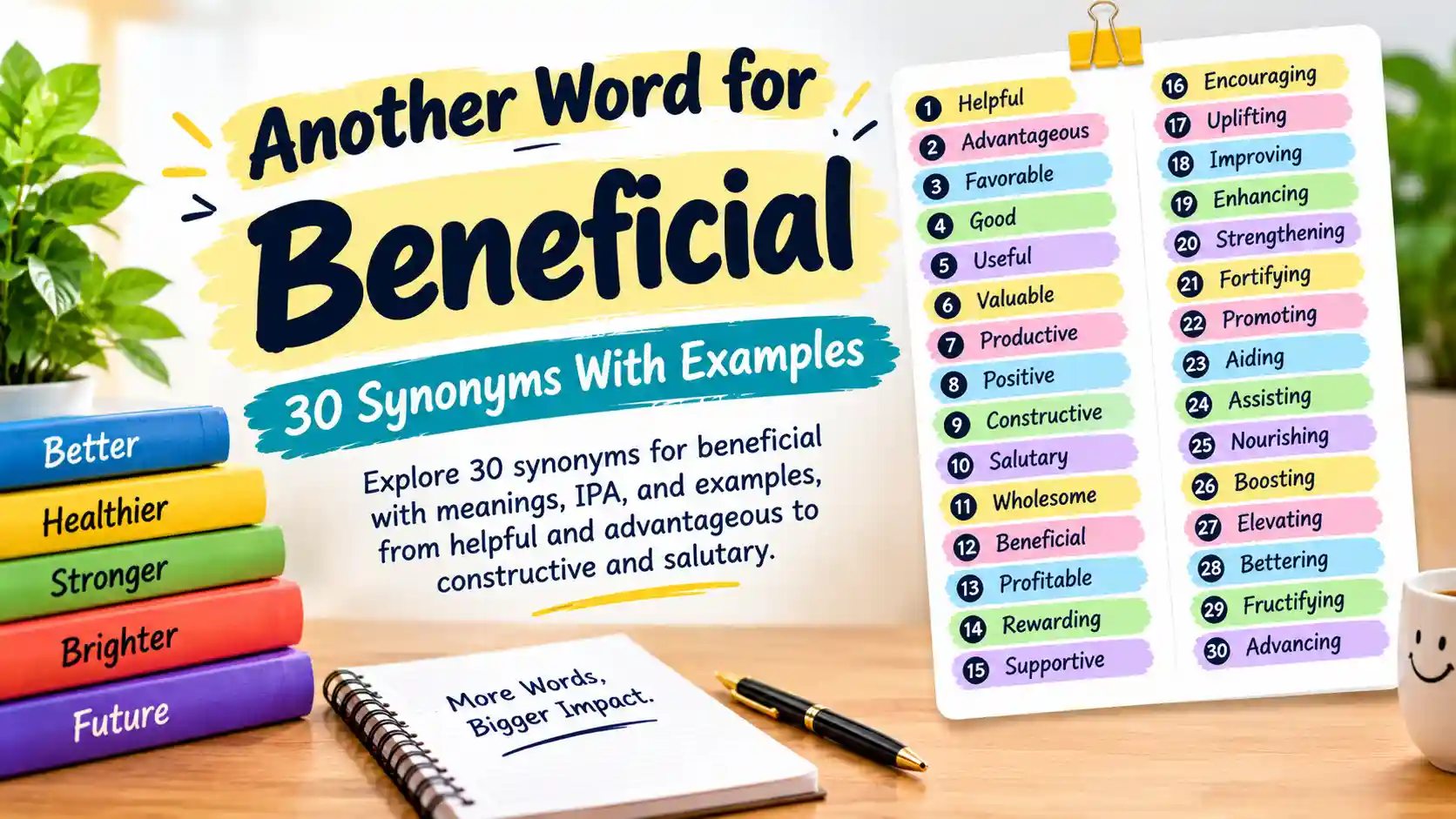
Another Word for Beneficial: 30 Synonyms With Examples
Another word for beneficial is most often helpful, advantageous, useful, or favorable. For something that improves health, you can say healthy, wholesome, or salutary. The best choice depends on whether you mean helping a person, giving an advantage, improving health, producing a good result, or being worth the effort.
“Beneficial” is an adjective that describes something that produces a good effect or an advantage. It can describe health (“beneficial bacteria”), results (“a beneficial change”), or fairness between parties (“a mutually beneficial deal”). Each area has its own more precise alternatives.
Quick list: helpful, advantageous, useful, favorable, valuable, constructive, productive, healthy, rewarding, profitable
This article looks at 30 alternatives, with meanings, IPA, usage notes, examples, and context, so you can choose the word that fits.
At a Glance: Beneficial Synonyms and Related Alternatives
| Alternative | Part of Speech | Meaning | Register / Tone | Ideal Context |
| Helpful | adjective | Giving help or being of use | Neutral, common | Everyday advice, tools, and people |
| Advantageous | adjective | Giving a favorable position or benefit | Formal | Business, strategy, and contracts |
| Useful | adjective | Able to be used for a purpose | Neutral | Tools, skills, and information |
| Favorable | adjective | Helping or likely to help | Neutral to formal | Conditions, outcomes, and terms |
| Valuable | adjective | Of great use or worth | Neutral | Advice, skills, and resources |
| Constructive | adjective | Helping to improve or build | Neutral to formal | Feedback, talks, and criticism |
| Healthy | adjective | Good for health or wellbeing | Neutral | Food, habits, and lifestyle |
| Productive | adjective | Producing good results | Neutral | Work, meetings, and effort |
| Rewarding | adjective | Giving satisfaction or a good return | Neutral | Work, experiences, and effort |
| Profitable | adjective | Producing a financial gain or other gain | Neutral | Business and investments |
Which Word Should You Use?
| If you want to… | Use | Why |
| Say something helps in daily life | helpful, useful | They are simple and natural in everyday speech. |
| Say something gives an edge | advantageous | It stresses a favorable position over others. |
| Describe good feedback | constructive | It means feedback meant to improve something. |
| Describe good effects on health | healthy, wholesome, salutary | They fit food, habits, and health advice. |
| Describe a deal that helps both sides | mutually beneficial, win win | These are fixed phrases for shared benefit. |
| Sound formal or academic | advantageous, conducive, salutary | They suit reports, essays, and official writing. |
| Say something is worth the effort | rewarding, worthwhile | They focus on satisfaction or a good return. |
| Say something earns money | profitable, lucrative | They link the benefit to financial gain. |
Exploring the Multiple Meanings of “Beneficial”
1. Producing a Good Effect
- Meaning: Resulting in good; promoting wellbeing or a positive outcome.
- Explanation: This is the main sense. It describes something whose effect is good, whether or not anyone planned it.
- Example: Regular sleep is beneficial for learning.
2. Giving an Advantage
- Meaning: Helpful in a way that gives a benefit or favorable position.
- Explanation: Here the focus is on gain, such as a better position, saving, or opportunity. It is common in business and law.
- Example: A lower interest rate would be beneficial to buyers.
3. Good for Health
- Meaning: Having a positive effect on the body or mind.
- Explanation: This is a common use in science and everyday talk. It often appears with words such as “effects,” “bacteria,” and “nutrients.”
- Example: Walking after meals can have beneficial effects on blood sugar.
4. Shared Gain Between Parties
- Meaning: Helping all the people or groups involved.
- Explanation: This sense usually appears in the fixed phrase “mutually beneficial.” It stresses that no side loses.
- Example: The two schools signed a mutually beneficial agreement.
5. Relating to a Benefit in Law and Finance
- Meaning: Describing a person who receives a benefit from property or a trust, as in “beneficial owner.”
- Explanation: This is a specialist legal sense. A beneficial owner enjoys the benefits of property that may be legally held by someone else.
- Example: The bank must identify the beneficial owner of the account.
Sources: Merriam Webster; Collins English Dictionary; Dictionary.com; Cambridge Dictionary
Analyzing 30 Beneficial Alternatives in Detail
Some of these words are close synonyms of “beneficial,” while others fit only one sense or context, and the Usage notes say which is which.
Group 1: Core Everyday Alternatives
1. Helpful
IPA: (US and UK) /ˈhɛlpfəl/
Definition: Giving or ready to give help; useful.
- Usage: A close, everyday synonym. It is simpler and warmer than “beneficial” and works for people, advice, and tools.
- Example: The guide was helpful for first time visitors.
2. Useful
IPA: (US and UK) /ˈjuːsfəl/
Definition: Able to be used for a practical purpose; serving a need.
- Usage: A close synonym for practical benefit. It is less about outcomes and more about being usable.
- Example: A map is useful on a long hike.
3. Good
IPA: (US and UK) /ɡʊd/
Definition: Having a positive effect; suitable or beneficial.
- Usage: A simple related alternative, as in “good for you.” It is plain and flexible but less specific than “beneficial.”
- Example: Fresh air is good for children.
4. Valuable
IPA: (US and UK) /ˈvæljuəbəl/
Definition: Of great use, importance, or worth.
- Usage: A related alternative. It stresses worth and importance more than a specific effect. It is common with advice, skills, and time.
- Example: She gave me valuable advice before the interview.
5. Positive
IPA: US /ˈpɑːzətɪv/ · UK /ˈpɒzətɪv/
Definition: Good, helpful, or encouraging in effect.
- Usage: A related alternative for good results or influence. It often describes changes, effects, and attitudes, not physical benefit.
- Example: The new rules had a positive effect on safety.
Group 2: Advantage and Gain Alternatives
6. Advantageous
IPA: (US and UK) /ˌædvənˈteɪdʒəs/
Definition: Giving a favorable position or an advantage.
- Usage: A close, formal synonym for the “gives an advantage” sense. It is common in business and strategy.
- Example: Moving closer to the port was advantageous for the company.
7. Favorable
IPA: (US and UK) /ˈfeɪvərəbəl/
Definition: Helping or likely to help; showing approval.
- Usage: A close synonym when describing conditions or outcomes. The British spelling is “favourable.” It can also mean “showing approval.”
- Example: The loan has favorable terms for small businesses.
8. Profitable
IPA: (US and UK) /ˈprɑːfɪtəbəl/ US · /ˈprɒfɪtəbəl/ UK
Definition: Producing a financial gain or other advantage.
- Usage: A related alternative. It fits money, but it can also mean “bringing a gain” in general. It is not a good choice for health.
- Example: The shop had its most profitable year yet.
9. Lucrative
IPA: (US and UK) /ˈluːkrətɪv/
Definition: Producing a great deal of money.
- Usage: A related alternative limited to money. It is stronger than “profitable” and sounds a little formal.
- Example: She left teaching for a more lucrative career.
10. Worthwhile
IPA: US /ˌwɜːrθˈwaɪl/ · UK /ˌwɜːθˈwaɪl/
Definition: Worth the time, money, or effort spent.
- Usage: A related alternative. It judges whether something is worth the cost, not just whether it helps.
- Example: The long trip was worthwhile for the view alone.
Group 3: Health and Wellbeing Alternatives
11. Healthy
IPA: (US and UK) /ˈhɛlθi/
Definition: Good for health or promoting good health.
- Usage: A close synonym for the health sense. It is common in talk about food, habits, and lifestyle.
- Example: Swimming is a healthy way to stay fit.
12. Wholesome
IPA: US /ˈhoʊlsəm/ · UK /ˈhəʊlsəm/
Definition: Good for health; also morally or socially positive.
- Usage: A close synonym for food and healthy living. It can also describe clean, positive entertainment, which “beneficial” does not usually do.
- Example: The school serves simple, wholesome meals.
13. Salutary
IPA: US /ˈsæljəˌtɛri/ · UK /ˈsæljʊtri/
Definition: Producing a good effect, especially when unpleasant.
- Usage: A formal, related alternative. It often describes a hard experience that leads to improvement.
- Example: The failure was a salutary lesson for the team.
14. Nourishing
IPA: US /ˈnɜːrɪʃɪŋ/ · UK /ˈnʌrɪʃɪŋ/
Definition: Providing the food or substances needed for health and growth.
- Usage: A related alternative for food and nutrition only. It can be used figuratively but is usually about nutrients.
- Example: Soup is a nourishing meal on a cold day.
15. Therapeutic
IPA: (US and UK) /ˌθɛrəˈpjuːtɪk/
Definition: Helping to heal or relax the body or mind.
- Usage: A related alternative for healing or calming effects. It is narrower than “beneficial” and fits treatments, activities, and settings.
- Example: Gardening can be therapeutic after a stressful week.
Group 4: Improvement and Positive Influence Alternatives
16. Constructive
IPA: (US and UK) /kənˈstrʌktɪv/
Definition: Helping to develop or improve something.
- Usage: A related alternative. It is most natural with feedback, criticism, discussion, and suggestions.
- Example: The teacher gave constructive comments on my essay.
17. Productive
IPA: US /prəˈdʌktɪv/ · UK /prəˈdʌktɪv/
Definition: Achieving or producing a good amount or good results.
- Usage: A related alternative focused on results. It suits work, meetings, and time, not general benefit.
- Example: We had a productive meeting this morning.
18. Conducive
IPA: US /kənˈduːsɪv/ · UK /kənˈdjuːsɪv/
Definition: Making a certain result likely or possible.
- Usage: A related formal alternative. It is almost always followed by “to” and describes conditions that help something happen.
- Example: A quiet room is conducive to study.
19. Improving
IPA: (US and UK) /ɪmˈpruːvɪŋ/
Definition: Making something better.
- Usage: A related alternative that describes the direction of an effect. It is less common as a standalone adjective.
- Example: The improving weather lifted everyone’s mood.
20. Supportive
IPA: (US and UK) /səˈpɔːrtɪv/ US · /səˈpɔːtɪv/ UK
Definition: Giving help or encouragement.
- Usage: A related alternative for people, places, and environments that give encouragement. It does not mean “advantageous.”
- Example: A supportive team helped her through the first year.
Group 5: Satisfying and Worth It Alternatives
21. Rewarding
IPA: US /rɪˈwɔːrdɪŋ/ · UK /rɪˈwɔːdɪŋ/
Definition: Giving satisfaction, or a feeling that something is worth doing.
- Usage: A related alternative focused on personal satisfaction, often with work or experience.
- Example: Teaching can be a rewarding career.
22. Fruitful
IPA: (US and UK) /ˈfruːtfəl/
Definition: Producing good or useful results.
- Usage: A related alternative, mostly figurative, for talks, work, and effort that lead to results. It sounds warm and slightly formal.
- Example: The two groups had a fruitful discussion.
23. Enriching
IPA: (US and UK) /ɪnˈrɪtʃɪŋ/
Definition: Improving the quality or value of something, especially a person’s life or understanding.
- Usage: A related alternative for experiences that add depth or knowledge. It is more personal and less practical than “beneficial.”
- Example: Travel can be an enriching experience for young people.
24. Instructive
IPA: (US and UK) /ɪnˈstrʌktɪv/
Definition: Providing useful knowledge or information.
- Usage: A related alternative for experiences or examples that teach something. It is narrower than “beneficial.”
- Example: The visit to the factory was instructive for the students.
25. Edifying
IPA: (US and UK) /ˈɛdɪfaɪɪŋ/
Definition: Providing moral or intellectual improvement.
- Usage: A related formal alternative, sometimes slightly old fashioned. It fits books, talks, and experiences that improve the mind or character.
- Example: The lecture was an edifying experience.
Group 6: Formal and Sector Specific Alternatives
26. Advantage giving
IPA: Not applicable (phrase).
Definition: Providing a favorable position over others.
- Usage: A plain descriptive phrase for the advantage sense. It is clear but less natural than “advantageous,” so use it sparingly.
- Example: The new tool is advantage giving for small teams.
27. Remunerative
IPA: (US and UK) /rɪˈmjuːnərətɪv/
Definition: Providing a good income; profitable.
- Usage: A formal related alternative limited to payment and earnings. It is rare in everyday speech.
- Example: The contract proved a remunerative one for the firm.
28. Expedient
IPA: (US and UK) /ɪkˈspiːdiənt/
Definition: Helpful or suitable for a purpose, sometimes without regard to ethics.
- Usage: A related alternative with a possible negative tone. It means practical or convenient, which can imply the easy choice is not the right one.
- Example: It was expedient to leave early and avoid the traffic.
29. Salubrious
IPA: (US and UK) /səˈluːbriəs/
Definition: Healthy; favorable to health or wellbeing.
- Usage: A formal, literary alternative for healthy air, climate, or surroundings. It is rare, so use it only when the tone fits.
- Example: The doctor recommended a more salubrious climate.
30. Of benefit
IPA: Not applicable (phrase).
Definition: Useful or helpful; giving an advantage.
- Usage: A plain, neutral alternative in the phrase “of benefit to.” It is useful when you want to avoid repeating “beneficial.”
- Example: The new library will be of benefit to local students.
Sources: Merriam Webster; Collins English Dictionary and Collins Thesaurus; Dictionary.com; Cambridge Dictionary
Beneficial vs. Advantageous vs. Helpful vs. Useful
These four words overlap but have different emphases.
| Word | Focus | Typical Pattern | Example |
| Beneficial | A good effect or result | “beneficial to/for” | Exercise is beneficial to the heart. |
| Advantageous | A favorable position or edge | “advantageous to/for” | The location is advantageous for trade. |
| Helpful | Giving help or support | “helpful to/with” | She was helpful during the move. |
| Useful | Serving a practical purpose | “useful for” | This app is useful for planning trips. |
A simple rule: use beneficial for good effects, advantageous for an edge, helpful for support, and useful for practical use. “Beneficial” is also more formal than “helpful” or “useful.”
Sources: Merriam Webster; Collins English Dictionary; Cambridge Dictionary
Beneficial and Opposite/Paired Word Pairs
| Word | Paired Word | Note |
| beneficial | harmful | The most common opposite; means causing damage. |
| beneficial | detrimental | A formal opposite meaning causing harm or loss. |
| beneficial | disadvantageous | The opposite of “advantageous”; puts someone in a worse position. |
| beneficial | adverse | Used for harmful effects, as in “adverse effects.” |
| beneficial effects | side effects | A common pairing in health and science writing. |
| beneficial | neutral | Describes something with no good or bad effect. |
“Harmful” is the standard opposite of “beneficial,” and “detrimental” is its more formal counterpart. Some pairs show contrast in a given context, such as health and science, but they are not strict opposites.
Sources: Merriam Webster; Collins English Dictionary; Cambridge Dictionary
Common Word Partners of “Beneficial”
| Pattern | Common Partners | Example |
| beneficial + noun | effect, impact, change, outcome, bacteria, relationship | The program had a beneficial effect on students. |
| mutually beneficial | mutually beneficial | They reached a mutually beneficial agreement. |
| beneficial + to / for | beneficial to health, beneficial for children | Sleep is beneficial for memory. |
| highly / extremely + beneficial | highly beneficial, extremely beneficial | Early reading is highly beneficial. |
| prove / be / seem + beneficial | prove beneficial, seem beneficial | The change proved beneficial. |
| beneficial + owner | beneficial owner | The company listed its beneficial owners. |
Sources: Collins English Dictionary; Cambridge Dictionary; Merriam Webster
Idiomatic Phrases Featuring “Beneficial”
“Beneficial” appears in few true idioms. The items below are established fixed expressions, not classic idioms.
1. Mutually beneficial
- Meaning: Good for all the people or groups involved.
- Example: The partnership is mutually beneficial for both companies.
2. Beneficial owner
- Meaning: A person who enjoys the benefits of property or an account even though someone else may hold the legal title. This is a legal and financial term.
- Example: Banks must record the beneficial owner of each large account.
3. Beneficial effect
- Meaning: A good result produced by something, often in health, science, or policy writing.
- Example: The new rule had a beneficial effect on traffic.
Sources: Merriam Webster; Collins English Dictionary; Cambridge Dictionary
Word Formation of “Beneficial”
Etymology & Structure
“Beneficial” comes from the noun “benefit” with the suffix ial, which forms adjectives meaning “relating to.” “Benefit” comes through Old French bienfait and Latin benefactum, from bene (“well”) and facere (“to do”). The word therefore carries the idea of “doing well” for someone.
Date and History
“Benefit” entered English in the Middle English period. “Beneficial” appeared in English by the late 1400s, according to etymology sources. Treat exact dates as approximate, since dictionaries differ slightly.
Word Class Variations
- Adjective: beneficial
- Adverb: beneficially (“to act beneficially”)
- Noun: benefit, beneficiary (a person who receives a benefit)
- Verb: benefit, benefits, benefited (also benefitted), benefiting
- Related forms: benefactor, benevolent, nonbeneficial
Sources: Etymonline; Merriam Webster; Collins English Dictionary
Common Word Choice Mistakes
- Beneficial in health: beneficial for health.
- A benefit of the plan: a benefit of the plan. (Beneficial is an adjective, not a noun.)
- Beneficial to be healthy: It is beneficial to be healthy. (The subject “it” is needed.)
- He benefited by the rule: He benefited from the rule.
- Mutual beneficial: mutually beneficial. (An adverb is needed.)
- More beneficial than the best: the most beneficial. (Do not mix a comparative with a superlative.)
- The benefits of exercise: the benefits of exercise.
Frequently Asked Questions
What is the closest synonym for beneficial?
“Helpful” is the closest everyday synonym. “Advantageous” is closer when you mean giving an edge.
What is a formal alternative to beneficial?
“Advantageous,” “salutary,” and “conducive” are formal. Choose by meaning: “salutary” for good effects from a hard experience.
What is a casual alternative to beneficial?
“Helpful,” “useful,” and “good for you” are simple and natural in speech.
What is the difference between beneficial and advantageous?
“Beneficial” stresses a good effect or result. “Advantageous” stresses a favorable position or edge.
What is the opposite of beneficial?
“Harmful” is the most common opposite. “Detrimental” is more formal.
Does beneficial mean good for health?
It can, as in “beneficial bacteria,” but it is broader. It can describe any good effect, not just health.
Is beneficial the same as useful?
Not exactly. “Useful” means serving a purpose, while “beneficial” means producing a good result or advantage.
What does mutually beneficial mean?
It means helpful to both or all sides. It is common in deals, partnerships, and agreements.
Can beneficial be used for people?
Rarely. It usually describes things such as effects, changes, or actions. For people, “helpful” or “supportive” is more natural.
Which word means helpful in a hard or unpleasant way?
“Salutary” fits, as in “a salutary lesson.” It suggests a bad experience that leads to improvement.
Conclusion
The closest everyday alternatives to “beneficial” are “helpful,” “useful,” and “advantageous.” For health, “healthy” and “wholesome” are common, while “constructive” and “productive” suit feedback and work.
Context decides which word works. Some words stress advantage, some stress health, and some stress results or satisfaction. Formal choices such as “salutary” and “conducive” fit careful writing, while “helpful” fits everyday talk.
To choose the right alternative, first decide what you mean: a good effect, an edge, a health gain, or a result worth the effort. Then match your word to that meaning and check its tone for your reader.

Noman is the founder and author of Factwy.com, where he shares informative, useful, and easy-to-understand content. With a passion for research and writing, he creates articles that simplify complex topics and provide valuable insights. His goal is to deliver clear, accurate, and reader-friendly information that helps visitors learn something new every day.