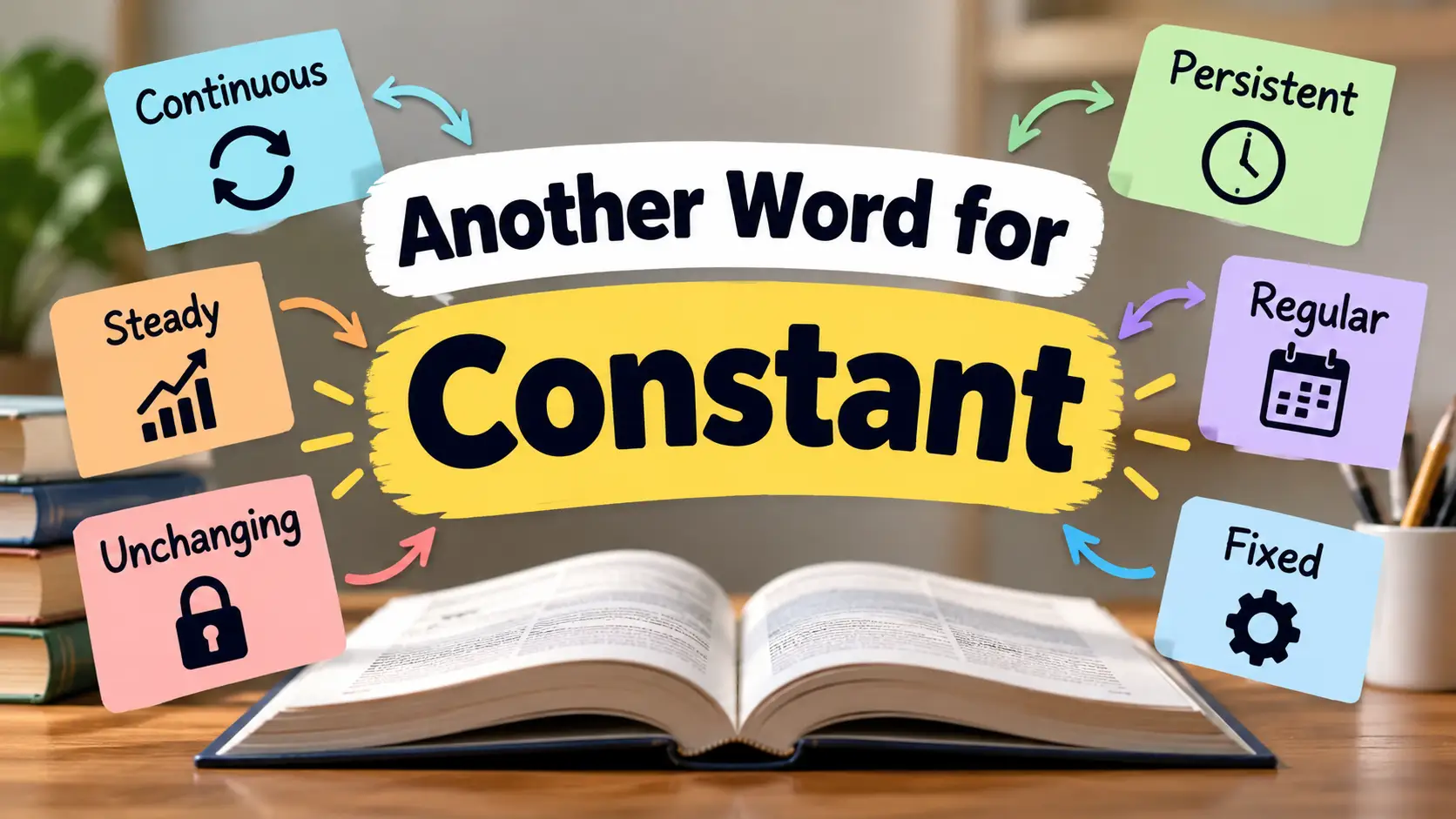
Another Word for Constant: 30 Synonyms With Examples
Another word for constant is continuous, steady, or continual, depending on what you mean.When something never stops, use nonstop or incessant. If something does not change, use stable, fixed, or steady. If a person is loyal, use faithful or steadfast.As a noun, a constant is something that stays the same, and invariant is a close technical match.
“Constant” has several senses, so no single synonym works everywhere. A “constant noise” is not the same as a “constant friend.” The best choice depends on whether you mean never stopping, happening often, staying the same, or staying loyal.
Quick list: continuous, continual, incessant, steady, stable, consistent, fixed, loyal, faithful, steadfast
This article looks at 30 alternatives, with meanings, IPA, usage notes, examples, and context.
At a Glance: Constant Synonyms and Related Alternatives
| Alternative | Part of Speech | Meaning | Register / Tone | Ideal Context |
| Continuous | Adjective | Without a break or gap | Neutral | Flow, sound, lines, processes |
| Continual | Adjective | Repeated again and again, often with pauses | Neutral | Interruptions, complaints, problems |
| Incessant | Adjective | Never stopping, usually in an annoying way | Formal, negative | Noise, talking, questions |
| Steady | Adjective | Even and not changing much | Neutral, positive | Speed, pace, income, temperature |
| Stable | Adjective | Not likely to change suddenly or fall | Neutral, formal | Prices, health, relationships |
| Consistent | Adjective | Behaving or happening in the same way over time | Neutral, positive | Performance, quality, results |
| Fixed | Adjective | Set in place and not changing | Neutral | Rates, dates, rules |
| Loyal | Adjective | Faithful to a person, group, or cause | Warm, positive | Friends, fans, customers |
| Faithful | Adjective | True to a person, promise, or duty | Warm, slightly formal | Partners, friends, service |
| Steadfast | Adjective | Firm and not giving up | Formal, literary | Support, belief, courage |
Which Word Should You Use?
| If you want to… | Use | Why |
| Say something has no breaks at all | continuous | It stresses an unbroken flow. |
| Say something keeps happening again and again | continual | It allows short pauses between events. |
| Complain about noise or talking that will not stop | incessant | It carries a clear note of annoyance. |
| Describe a speed, rate, or income that does not jump around | steady | It suggests calm, even movement. |
| Describe something that is not likely to change suddenly | stable | It suggests safety and balance. |
| Praise a person for reliable results | consistent | It focuses on quality over time. |
| Describe a loyal friend or partner | faithful | It stresses trust and commitment. |
| Name a value that never changes in science or math | invariant | It is the precise technical term. |
Exploring the Multiple Meanings of “Constant”
1. Never Stopping
- Meaning: Happening all the time or without a break.
- Explanation: This sense often describes things that are tiring or annoying, such as pain or noise. It can also describe something that is only very frequent, not truly nonstop.
- Example: The constant noise from the road made it hard to sleep.
2. Frequently Repeated
- Meaning: Occurring again and again over time.
- Explanation: Here the thing may stop and start, but it comes back so often that it feels endless. Continual and recurrent fit this sense better than continuous.
- Example: She was tired of the constant interruptions during meetings.
3. Not Changing
- Meaning: Staying the same in amount, level, or rate.
- Explanation: This sense is common in science, weather, and everyday measurement. It describes something that stays at one level.
- Example: The room stayed at a constant temperature all day.
4. Loyal and Faithful
- Meaning: Firm in loyalty or devotion to a person or cause.
- Explanation: This is an older sense and is common with people and relationships. It is positive and a little formal.
- Example: He was a constant friend through many hard years.
5. A Thing That Does Not Change (Noun)
- Meaning: A value, fact, or condition that stays the same.
- Explanation: In math and science, a constant is a fixed number or quantity. In everyday speech, it is a steady part of a situation that does not change while other things do.
- Example: Her morning walk was the one constant in a busy year.
Sources: Merriam Webster; Collins English Dictionary; Dictionary.com.
Analyzing 30 Constant Alternatives in Detail
Some of these words are direct synonyms for one sense of “constant,” while others are related alternatives that fit only certain contexts. The groups below follow the main senses.
Group 1: Continuous and Nonstop
1. Continuous
IPA: /kənˈtɪnjuəs/ (US and UK)
Definition: Going on without a break or gap.
- Usage: A close synonym for “constant” in the sense of never stopping. It stresses that nothing interrupts the flow, so it is a better match than continual for truly unbroken things.
- Example: The machine makes a continuous hum all day.
2. Continual
IPA: /kənˈtɪnjuəl/ (US and UK)
Definition: Happening again and again, often with short pauses between.
- Usage: A close synonym for “constant” in the “frequently repeated” sense. Many writers prefer it when something stops and starts.
- Example: The continual phone calls kept her from finishing her work.
3. Nonstop
IPA: US /ˌnɑːnˈstɑːp/ · UK /ˌnɒnˈstɒp/
Definition: Continuing without stopping.
- Usage: An informal, everyday alternative. It works well for activity, travel, or talking, but it is less formal than continuous.
- Example: They talked nonstop for the whole trip.
4. Incessant
IPA: /ɪnˈsesənt/ (US and UK)
Definition: Continuing without pause, often in an unpleasant way.
- Usage: A formal synonym for “constant” with a strong negative tone. It suggests annoyance, so it is rarely used for good things.
- Example: The incessant barking kept the whole street awake.
5. Ceaseless
IPA: /ˈsiːsləs/ (US and UK)
Definition: Never coming to an end.
- Usage: A formal or literary synonym for “constant.” It can be neutral or poetic and is common in writing about nature or effort.
- Example: The ceaseless waves wore down the rock over many years.
Group 2: Never Ending and Persistent
6. Perpetual
IPA: US /pərˈpetʃuəl/ · UK /pəˈpetʃuəl/
Definition: Lasting forever or for a very long time without change.
- Usage: A formal near synonym that suggests something never ends. It is stronger than “constant” and is often used for states, not short events.
- Example: The town seemed to live in perpetual summer.
7. Relentless
IPA: /rɪˈlentləs/ (US and UK)
Definition: Continuing in a harsh or severe way without easing.
- Usage: A related alternative, not an exact synonym. It adds a sense of pressure or harshness, so it fits heat, pressure, or pursuit better than calm things.
- Example: The relentless rain flooded the fields.
8. Endless
IPA: /ˈendləs/ (US and UK)
Definition: Having or seeming to have no end.
- Usage: A common, everyday alternative. It is often exaggerated, as in “endless meetings,” and works well when something feels too long.
- Example: She had an endless list of chores.
9. Persistent
IPA: US /pərˈsɪstənt/ · UK /pəˈsɪstənt/
Definition: Continuing firmly or for a long time, especially despite difficulty.
- Usage: A related alternative. It is close to “constant” for things like pain or coughs that will not go away, and it can also describe people who do not give up.
- Example: A persistent cough kept him awake at night.
10. Unremitting
IPA: /ˌʌnrɪˈmɪtɪŋ/ (US and UK)
Definition: Never stopping or becoming weaker.
- Usage: A formal, rarer synonym. It is mostly used for effort, pressure, or pain that continues without relief.
- Example: Years of unremitting work finally paid off.
Group 3: Steady and Even
11. Steady
IPA: /ˈstedi/ (US and UK)
Definition: Regular and even, without sudden change.
- Usage: A close synonym for “constant” in the “not changing” sense. It has a calm, positive tone.
- Example: The car kept a steady speed on the highway.
12. Stable
IPA: /ˈsteɪbl/ (US and UK)
Definition: Not likely to change or fail suddenly.
- Usage: A near synonym for “constant” when you mean safe and balanced, not just unchanged. It is common for health, prices, and relationships.
- Example: The patient’s condition has remained stable.
13. Uniform
IPA: US /ˈjuːnɪfɔːrm/ · UK /ˈjuːnɪfɔːm/
Definition: The same in all parts or at all times.
- Usage: A close synonym in technical or formal writing. It stresses sameness across a whole thing, such as heat or thickness.
- Example: The paint should be a uniform thickness.
14. Consistent
IPA: /kənˈsɪstənt/ (US and UK)
Definition: Acting or happening in the same way over time.
- Usage: A related alternative. It is close to “constant” when talking about quality or behavior, but it means “reliably the same,” not “nonstop.”
- Example: She is a consistent player who rarely has a bad game.
15. Even
IPA: /ˈiːvn/ (US and UK)
Definition: Smooth, regular, and not changing much.
- Usage: A simple, informal alternative. It fits temperature, pace, and tone, and is less common than steady.
- Example: He spoke in a calm, even voice.
Group 4: Fixed and Unchanging
16. Fixed
IPA: /fɪkst/ (US and UK)
Definition: Set in place and not likely to change.
- Usage: A near synonym for “constant” in the “not changing” sense. It suggests something was set on purpose, such as a price or a time.
- Example: The bank offers a fixed rate for five years.
17. Invariable
IPA: US /ɪnˈveriəbl/ · UK /ɪnˈveəriəbl/
Definition: Never changing.
- Usage: A formal synonym. It is stronger than “constant” and is often used for rules, patterns, or habits.
- Example: Her invariable habit was to arrive early.
18. Invariant
IPA: US /ɪnˈveriənt/ · UK /ɪnˈveəriənt/
Definition: Not changing, or a quantity that does not change.
- Usage: The best technical match for “constant” as a noun in math and science. It is not used much in everyday speech.
- Example: The total energy of the system is an invariant.
19. Permanent
IPA: US /ˈpɜːrmənənt/ · UK /ˈpɜːmənənt/
Definition: Lasting or meant to last for a very long time or forever.
- Usage: A related alternative. It focuses on how long something lasts, not on whether it stays at the same level.
- Example: She took a permanent job at the school.
20. Immutable
IPA: /ɪˈmjuːtəbl/ (US and UK)
Definition: Not able to be changed.
- Usage: A formal, strong alternative. It describes things that cannot change at all, such as laws or truths, so it is too strong for ordinary uses of “constant.”
- Example: Some people believe the laws of nature are immutable.
Group 5: Loyal and Faithful
21. Loyal
IPA: /ˈlɔɪəl/ (US and UK)
Definition: Faithful to a person, group, or cause.
- Usage: A close synonym for the “faithful” sense of “constant.” It is warm and common in everyday English.
- Example: He stayed loyal to his team through every losing season.
22. Faithful
IPA: /ˈfeɪθfl/ (US and UK)
Definition: Staying true to a person, promise, or duty.
- Usage: A close synonym in this sense. It is slightly more formal than loyal and often appears in writing about love or duty.
- Example: She was a faithful friend for forty years.
23. Steadfast
IPA: US /ˈstedfæst/ · UK /ˈstedfɑːst/
Definition: Firm and not changing in loyalty, belief, or purpose.
- Usage: A formal, slightly literary synonym. It stresses strength and refusing to give up.
- Example: The nurses were steadfast in their care for patients.
24. Devoted
IPA: US /dɪˈvoʊtɪd/ · UK /dɪˈvəʊtɪd/
Definition: Very loving or loyal toward someone or something.
- Usage: A related alternative. It adds strong love or deep commitment, which “constant” does not always imply.
- Example: He was a devoted fan of the band.
25. Staunch
IPA: /stɔːntʃ/ (US and UK)
Definition: Strong and loyal in support or belief.
- Usage: A related alternative. It often describes supporters, allies, or defenders, and it has a firm, serious tone.
- Example: She was a staunch supporter of local schools.
26. Dependable
IPA: /dɪˈpendəbl/ (US and UK)
Definition: Able to be trusted to do what is needed.
- Usage: A related alternative, not an exact synonym. It describes reliability more than loyalty, so it fits workers and tools as well as friends.
- Example: He is a dependable neighbor who always helps.
Group 6: Frequent and Recurring
27. Frequent
IPA: /ˈfriːkwənt/ (US and UK)
Definition: Happening often.
- Usage: A related alternative. It is weaker than “constant” because it says only that something happens often, not that it never stops.
- Example: The area has frequent storms in spring.
28. Regular
IPA: US /ˈreɡjələr/ · UK /ˈreɡjələ/
Definition: Happening at the same time or in the same way again and again.
- Usage: A related alternative. It stresses a pattern or schedule, not nonstop action.
- Example: She makes regular visits to her grandmother.
29. Recurrent
IPA: US /rɪˈkɜːrənt/ · UK /rɪˈkʌrənt/
Definition: Happening again or repeatedly.
- Usage: A related alternative, often used in medical and formal writing. It means something keeps coming back, not that it never stops.
- Example: He suffers from recurrent headaches.
30. Habitual
IPA: /həˈbɪtʃuəl/ (US and UK)
Definition: Done as a regular habit or practice.
- Usage: A related alternative. It fits behaviors or ways of acting that have become automatic, like complaining or arriving late.
- Example: His habitual silence made him hard to know.
Sources: Merriam Webster; Collins English Dictionary and Thesaurus; Dictionary.com; Cambridge Dictionary.
Constant vs. Continuous vs. Continual
These three words are often mixed up. Many style guides separate them, though in everyday speech people use them loosely.
| Word | Core Idea | Pauses Allowed? | Example |
| Constant | Nonstop, or very frequent, or unchanging | Sometimes | Constant worry kept him awake. |
| Continuous | Unbroken flow | No | A continuous line of cars crossed the bridge. |
| Continual | Repeated over and over | Yes | Continual delays frustrated the team. |
“Constant” is the widest of the three, since it can also mean “unchanging” or “loyal.” If you want to be exact about pauses, choose continuous for no breaks and continual for repeated ones.
Sources: Merriam Webster; Collins English Dictionary.
Constant and Opposite/Paired Word Pairs
| Word | Paired Word | Note |
| constant | changing | The most direct opposite of the “not changing” sense. |
| constant | variable | Used as nouns in math, science, and programming. |
| constant | occasional | Contrasts “all the time” with “now and then.” |
| constant | intermittent | Contrasts nonstop with starting and stopping. |
| constant | sporadic | Describes rare, scattered events. |
| constant | fickle | Describes people whose feelings change quickly. |
| constant | inconstant | A formal opposite for loyalty, meaning changeable or unfaithful. |
The best opposite depends on the sense. For frequency, use occasional, intermittent, or sporadic. For loyalty, use fickle or inconstant. In science, the usual pair is constant and variable.
Sources: Merriam Webster; Collins English Thesaurus.
Common Word Partners of “Constant”
| Pattern | Common Partners | Example |
| constant + noun | noise, pain, pressure, worry, reminder, companion | The pain was a constant reminder of the accident. |
| in constant + noun | motion, use, contact, demand | The kitchen is in constant use. |
| remain/stay constant | temperature, level, rate, speed | The price has stayed constant for years. |
| keep/hold something constant | temperature, speed, other factors | Scientists hold other factors constant in an experiment. |
| a constant state of | flux, alert, change | The city is in a constant state of change. |
| constantly + verb | change, ask, check, worry, complain | He constantly checks his phone. |
| a constant in | life, a situation, an experiment | Music was a constant in her life. |
Sources: Collins English Dictionary; Cambridge Dictionary; Merriam Webster.
Idiomatic Phrases Featuring “Constant”
“Constant” is not common in true idioms. These are well known established expressions and sayings that contain it.
1. The only constant is change
- Meaning: Change is the one thing that always happens. It is often linked to the Greek thinker Heraclitus, though the modern wording is a paraphrase, not an exact quote.
- Example: Our industry keeps shifting, because the only constant is change.
2. Constant dripping wears away the stone
- Meaning: A proverb meaning that steady, repeated effort can overcome even strong obstacles.
- Example: She kept asking politely until the rule changed, since constant dripping wears away the stone.
3. Constant as the northern star
- Meaning: A literary expression for a person who is completely steady and never changes, taken from Shakespeare’s Julius Caesar.
- Example: In the poem, the speaker promises to be as constant as the northern star.
4. A constant companion
- Meaning: Something or someone that is always with a person. It is a fixed expression, often used for feelings, pets, or objects.
- Example: Worry became his constant companion.
Sources: Merriam Webster; Collins English Dictionary; Oxford Reference (proverbs); Shakespeare, Julius Caesar.
Word Formation of “Constant”
Etymology & Structure
“Constant” comes into English from Old French constant, which came from the Latin constans (stem constant ). The Latin word is the present participle of constare, meaning “to stand firm” or “to stand together.” That verb is built from com (“together”) and stare (“to stand”). The core idea is standing firm, which explains the senses of steadiness and loyalty.
Date and History
The adjective appears in English in the late 14th century, first with the sense of being firm and steadfast. The senses of “continual” and “unchanging” developed later. The noun, meaning a quantity that does not change, came into use in science and mathematics after that.
Word Class Variations
- Adjective: constant
- Noun: constant (a fixed value or thing); constancy (the quality of being constant)
- Adverb: constantly
- Opposite forms: inconstant (adjective), inconstancy (noun)
There is no common verb form of “constant.”
Sources: Etymonline; Merriam Webster; Collins English Dictionary.
Common Word Choice Mistakes
- “The phone rings constantly”: say “constantly,” because it is an adverb.
- “A continuous friend”: say “a constant friend” or “a loyal friend,” because continuous does not describe loyalty.
- “Continuous interruptions”: say “continual interruptions,” because interruptions stop and start.
- “Incessant praise” meant as a compliment: use “constant praise” or “steady praise,” because incessant sounds annoying.
- “An immutable schedule” for a normal timetable: say “a fixed schedule,” because immutable is too strong for everyday plans.
- “A constant in the experiment” is confused with “a variable”: a constant stays the same, and a variable changes.
- “Inconsistent friend” when you mean unfaithful: say “inconstant friend” or “fickle friend,” because inconsistent usually describes uneven behavior or results.
Frequently Asked Questions
What is the closest synonym for constant?
It depends on the sense. Continuous is closest for “never stopping,” steady for “not changing,” and faithful for “loyal.”
What is a formal alternative to constant?
Invariable, perpetual, and unremitting are formal. Steadfast is a formal choice for loyalty.
What is the difference between constant and continuous?
Continuous means with no break at all. Constant can also mean very frequent, unchanging, or loyal.
What is the difference between constant and continual?
Continual means repeated again and again, with pauses. Constant is wider and can mean nonstop or unchanging.
Can constant describe a person?
Yes. It can mean loyal and faithful, as in “a constant friend.” This use is a little formal or literary.
What is a literary alternative to constant?
Ceaseless and steadfast are common literary choices.
What is the opposite of constant?
When describing frequency, use occasional or intermittent. For change, use changing or variable. For loyalty, use fickle or inconstant.
What does constant mean in math and science?
A constant is a value that does not change, such as the speed of light in a vacuum. Invariant is a close technical word.
Is constant the same as consistent?
No. Consistent means reliably the same over time, while constant often means nonstop or unchanging.
Is constant always negative?
No. “Constant noise” sounds negative, but “constant support” and “a constant friend” are positive.
Conclusion
The closest alternatives to “constant” are continuous, continual, steady, and faithful. Each one matches a different sense, so none of them replace “constant” everywhere. When describing events that never stop, use incessant or ceaseless. For things that remain unchanged, choose fixed, stable, or invariant. For loyal people, use faithful or steadfast.
Context matters most. A word that fits “constant noise” will not fit “constant friend.” Small differences also matter. Continuous means no pause, continual allows pauses, and consistent means reliably the same.
To choose the right word, first ask which sense you mean: nonstop, repeated, unchanging, or loyal. Then check the tone, since incessant is negative, steadfast is formal, and steady is calm. If you are unsure, constant itself is often the clearest choice.

Noman is the founder and author of Factwy.com, where he shares informative, useful, and easy-to-understand content. With a passion for research and writing, he creates articles that simplify complex topics and provide valuable insights. His goal is to deliver clear, accurate, and reader-friendly information that helps visitors learn something new every day.