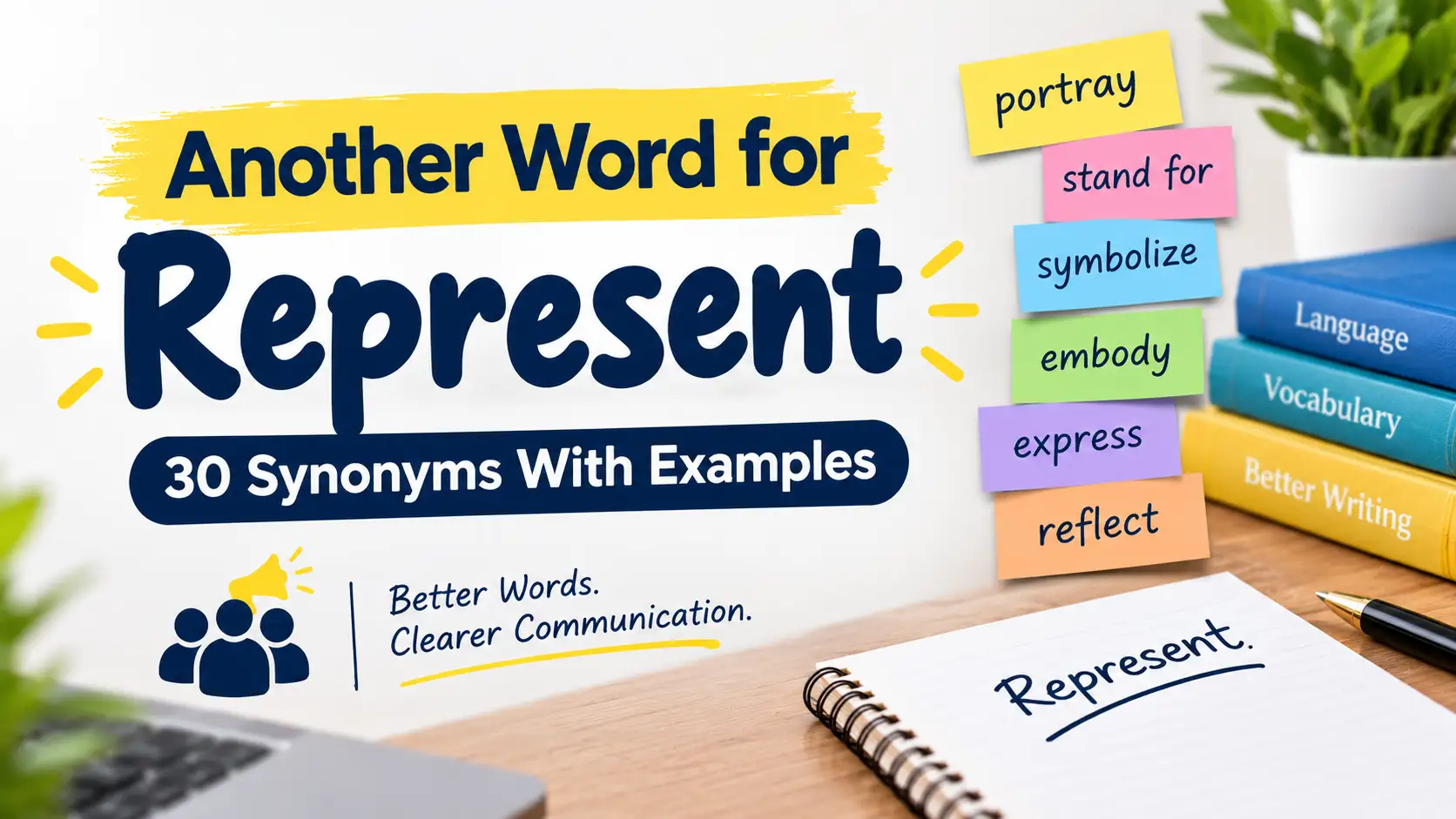
Another Word for Represent: 30 Synonyms With Examples
The closest everyday alternatives to represent depend on the meaning. For a symbol, use stand for or symbolize. For acting on someone’s behalf, use speak for or act for. In art, writing, and film, depict or portray fit best, and for proof of a typical example, typify or exemplify work well.
Represent has many senses, including standing for something, acting for someone, showing something, being an example, making up part of a whole, and describing something as a certain way. Each sense has different best alternatives, and they are not always interchangeable.
Quick list: symbolize, stand for, signify, speak for, act for, depict, portray, embody, constitute, pose as
This article looks at 30 alternatives to represent. Each has a meaning, IPA, a usage note, an example, and context, so you can tell which words are close synonyms and which fit only one sense.
At a Glance: Represent Synonyms and Related Alternatives
| Alternative | Part of Speech | Meaning | Register / Tone | Ideal Context |
| symbolize | verb | Be a symbol of something | Neutral | Colors, objects, images |
| stand for | phrasal verb | Be a sign or short form of something | Neutral | Letters, colors, abbreviations |
| signify | verb | Be a sign of something | Formal | Meaning of events, signs, gestures |
| speak for | phrasal verb | Express the views of others | Neutral | Groups, teams, clients |
| act for | phrasal verb | Do things on someone’s behalf | Neutral to formal | Business, legal matters |
| depict | verb | Show in a picture or in words | Neutral to formal | Art, books, film |
| portray | verb | Show or describe in a certain way | Neutral | Characters, people, events |
| embody | verb | Be a perfect example of a quality | Formal | Values, ideas, qualities |
| constitute | verb | Make up a part of something | Formal | Percentages, parts, legal use |
| pose as | phrasal verb | Pretend to be someone or something | Neutral | Fraud, undercover work |
Which Word Should You Use?
| If you want to… | Use | Why |
| Say a symbol has a meaning | symbolize | It stresses a symbolic link. |
| Explain an abbreviation or a color | stand for | It is the plainest choice. |
| Speak for a group or a client | speak for | It is natural and clear. |
| Take someone’s place for a while | stand in for | It suggests a temporary replacement. |
| Show something in art, books, or film | depict, portray | Depict is neutral. Portray often adds a view or interpretation. |
| Say someone is a perfect example | epitomize, embody | They stress that the person shows a quality completely. |
| Say something forms part of a total | make up, account for | They suit percentages and amounts. |
| Say someone pretends to be something | pose as | It suggests pretending, often to trick others. |
Exploring the Multiple Meanings of “Represent”
1. Standing for or Symbolizing
- Meaning: To be a sign or symbol of something else.
- Explanation: The thing stands in for an idea, a quantity, or another object. This is common with colors, letters, numbers, and charts.
- Example: The red line on the chart represents total sales.
2. Acting or Speaking for Others
- Meaning: To speak or act on behalf of a person or group.
- Explanation: This sense appears in law, politics, business, and sport. The person usually has permission or an official role. Etymonline traces the legal sense to around 1500 and the legislative sense to the 1650s.
- Example: A lawyer will represent you in court.
3. Depicting or Showing
- Meaning: To show something in a picture, in words, or in a performance.
- Explanation: Here represent means to portray. It is common in art and writing.
- Example: The painting represents a quiet village at dawn.
4. Being an Example or Type
- Meaning: To be a typical example of something.
- Explanation: The thing is not a symbol. It is an example of a larger group or idea. Etymonline dates the sense “serve as a specimen or example of” to 1858.
- Example: The team represents the best of local talent.
5. Making Up or Amounting To
- Meaning: To be equal to something, or to form part of a total.
- Explanation: This sense is common in business, news, and data. It usually appears with numbers or amounts.
- Example: Young workers represent 30 percent of the staff.
6. Describing as Being a Certain Way
- Meaning: To describe or claim that someone or something has a certain character or quality.
- Explanation: This sense is formal and often appears in the phrase represent oneself as. It can suggest the description may not be true.
- Example: He represented himself as an expert in finance.
Sources: Merriam Webster, Collins Dictionary, and Dictionary.com entries for represent; Etymonline, “represent.”
Analyzing 30 Represent Alternatives in Detail
Some of these words are direct synonyms for one sense of representation, while others are related alternatives that fit only a certain context.
Symbolizing and Standing For
1. Symbolize
IPA: /ˈsɪmbəlaɪz/ (US and UK)
Definition: To be a symbol of something, or to use a symbol to show it.
- Usage: It is a direct synonym for sense 1. It stresses that the thing carries a symbolic meaning, so it is narrower than it represents.
- Example: The dove symbolizes peace.
2. Stand for
IPA: US /ˈstænd fɔːr/ · UK /ˈstænd fɔː/
Definition: To be a sign or short form of something.
- Usage: It is the plainest everyday synonym for sense 1. It is common with letters, colors, abbreviations, and values.
- Example: NASA stands for National Aeronautics and Space Administration.
3. Signify
IPA: /ˈsɪɡnɪfaɪ/ (US and UK)
Definition: To be a sign of something, or to have a certain meaning.
- Usage: It is a formal related alternative. It is close to represent when the thing points to a meaning, but it is less about acting or showing.
- Example: A white flag signifies surrender.
4. Denote
IPA: US /dɪˈnoʊt/ · UK /dɪˈnəʊt/
Definition: To be a sign of something, or to name it exactly.
- Usage: It is a formal related alternative. It is common in technical writing, where it points to the exact meaning of a term or symbol.
- Example: In this table, an asterisk denotes an estimate.
5. Mean
IPA: /miːn/ (US and UK)
Definition: To have a certain meaning or to be a sign of something.
- Usage: It is a related alternative for sense 1. It is the simplest word for explaining what a sign stands for, but it cannot replace represent in the sense of acting for someone.
- Example: A green light means you can go.
Acting and Speaking on Someone’s Behalf
If you’re looking for another word for represent when someone acts, speaks, or appears on behalf of another person or group, these alternatives can help. Each synonym has a slightly different meaning and level of formality.
6. Speak for
IPA: US /ˈspiːk fɔːr/ · UK /ˈspiːk fɔː/
Definition: To express the views, opinions, or wishes of another person or group.
- Usage: A direct synonym for represent in the sense of giving someone a voice. It suggests speaking on another person’s behalf but does not always imply official authority.
- Example: The captain spoke for the whole team.
7. Act for
IPA: US /ˈækt fɔːr/ · UK /ˈækt fɔː/
Definition: To take action or perform duties on behalf of another person.
- Usage: A direct alternative to represent, especially in business, professional, and legal contexts. It often suggests that someone has authority to act for another person.
- Example: She acts for several clients in property cases.
8. Stand in for
IPA: US /ˈstænd ɪn fɔːr/ · UK /ˈstænd ɪn fɔː/
Definition: To temporarily take another person’s place.
- Usage: A related synonym for represent that emphasizes temporary replacement rather than an ongoing or official role.
- Example: He stood in for the manager during the meeting.
9. Deputize
IPA: US /ˈdɛpjətaɪz/ · UK /ˈdɛpjʊtaɪz/
Definition: To appoint or act as a deputy for another person.
- Usage: A formal alternative to represent. It describes taking an official role or performing duties on someone else’s behalf. In British English, the spelling deputise is also common.
- Example: The vice chair deputized for the chair at the event.
10. Advocate for
IPA: US /ˈædvəkeɪt fɔːr/ · UK /ˈædvəkeɪt fɔː/
Definition: To publicly support, defend, or argue for a person, group, or cause.
- Usage: A related alternative to represent. It emphasizes support and public advocacy rather than an official representative role.
- Example: The charity advocates for people who have no housing.
11. Appear for
IPA: US /əˈpɪr fɔːr/ · UK /əˈpɪə fɔː/
Definition: To appear in court on behalf of another person.
- Usage: A narrow legal alternative to represent, particularly common in British English. Use it specifically when discussing court or legal proceedings.
- Example: A senior lawyer will appear for the defendant.
Depicting and Showing
12. Depict
IPA: /dɪˈpɪkt/ (US and UK)
Definition: To show something in a picture or describe it in words.
- Usage: It is a direct synonym for sense 3. It is neutral and common in writing about art, books, and film.
- Example: The mural depicts the town’s history.
13. Portray
IPA: US /pɔːrˈtreɪ/ · UK /pɔːˈtreɪ/
Definition: To show or describe someone or something in a certain way.
- Usage: It is a direct synonym for sense 3. It often adds an interpretation, so it can also mean an actor playing a role.
- Example: The film portrays him as a hero.
14. Show
IPA: US /ʃoʊ/ · UK /ʃəʊ/
Definition: To make something clear or visible.
- Usage: It is the plainest everyday alternative for sense 3. It is less formal and less specific than depicted.
- Example: The photo shows two children on a beach.
15. Illustrate
IPA: /ˈɪləstreɪt/ (US and UK)
Definition: To explain or show something with examples, pictures, or diagrams.
- Usage: It is a related alternative. It focuses on making a point clearer, not simply showing something.
- Example: This chart illustrates the rise in prices.
16. Picture
IPA: US /ˈpɪktʃɚ/ · UK /ˈpɪktʃə/
Definition: To show something in a picture, or to imagine it clearly.
- Usage: It is a related alternative. As a verb it is less common than depict, and it often suggests imagination.
- Example: The artist pictured the city in warm colors.
17. Render
IPA: US /ˈrɛndɚ/ · UK /ˈrɛndə/
Definition: To show or represent something in art, writing, or design.
- Usage: It is a formal related alternative. It is used mainly in art, design, and computer graphics.
- Example: The architect rendered the building in fine detail.
Embodying and Exemplifying
18. Embody
IPA: US /ɪmˈbɑːdi/ · UK /ɪmˈbɒdi/
Definition: To be a perfect or clear example of a quality or idea.
- Usage: It is a formal related alternative for sense 4. It suggests someone or something shows a quality fully.
- Example: The coach embodies the spirit of the club.
19. Typify
IPA: /ˈtɪpɪfaɪ/ (US and UK)
Definition: To be a typical example of something.
- Usage: It is a direct synonym for sense 4. It stresses typical qualities, not perfect ones.
- Example: The small stone houses typify the region.
20. Epitomize
IPA: /ɪˈpɪtəmaɪz/ (US and UK)
Definition: To be a perfect example of something.
- Usage: It is a related alternative. It is stronger than typify because it suggests the best or clearest example.
- Example: The song epitomizes the sound of the 1980s.
21. Exemplify
IPA: /ɪɡˈzɛmplɪfaɪ/ (US and UK)
Definition: To be or give an example of something.
- Usage: It is a direct synonym for sense 4. It is formal and common in essays, where an example helps explain a point.
- Example: Her work exemplifies good teaching.
22. Personify
IPA: US /pərˈsɑːnɪfaɪ/ · UK /pəˈsɒnɪfaɪ/
Definition: To be a perfect example of a quality, or to show an idea as a person.
- Usage: It is a related alternative. It often suggests that a person is the living form of a quality.
- Example: He personifies kindness.
Making Up and Amounting To
23. Constitute
IPA: US /ˈkɑːnstətuːt/ · UK /ˈkɒnstɪtjuːt/
Definition: To be or form part of something, or to be equal to it.
- Usage: It is a formal direct synonym for sense 5. It also means to form legally, so check the context.
- Example: Women constitute half of the workforce.
24. Make up
IPA: /ˌmeɪk ˈʌp/ (US and UK)
Definition: To form a part of a whole.
- Usage: It is the plain everyday synonym for sense 5. It works well with numbers and parts.
- Example: Students make up most of the audience.
25. Account for
IPA: US /əˈkaʊnt fɔːr/ · UK /əˈkaʊnt fɔː/
Definition: To make up a certain part or amount of a total.
- Usage: It is a related alternative for sense 5. It is common in news and business when stating shares of a total, but it also means “explain” in other contexts.
- Example: Rent accounts for half of our monthly costs.
26. Amount to
IPA: /əˈmaʊnt tuː/ (US and UK)
Definition: To be equal to a total or add up to it.
- Usage: It is a related alternative for sense 5. It suggests a total or result, not a part of a whole.
- Example: The repairs amounted to nearly two thousand dollars.
Describing as or Pretending to Be
27. Present as
IPA: /prɪˈzɛnt æz/ (US and UK)
Definition: To show or describe someone or something as being a certain way.
- Usage: It is a direct synonym for sense 6. It suggests the image may differ from reality.
- Example: The ad presents the product as a simple solution.
28. Claim to be
IPA: /ˈkleɪm tə ˈbiː/ (US and UK)
Definition: To say you are something, often without proof.
- Usage: It is the plain everyday synonym for the represent oneself as sense. It suggests the claim may not be true.
- Example: The caller claimed to be from the bank.
29. Pose as
IPA: US /ˈpoʊz æz/ · UK /ˈpəʊz əz/
Definition: To pretend to be someone or something, usually to trick others.
- Usage: It is a related alternative, stronger than claimed to be. It suggests a planned pretence, often in fraud or undercover work.
- Example: The thief posed as a delivery driver.
30. Characterize
IPA: US /ˈkɛrəktəraɪz/ · UK /ˈkærəktəraɪz/
Definition: To describe the nature or quality of someone or something.
- Usage: It is a related alternative for sense 6. It fits when you describe someone or something in a particular way, and it can be neutral or critical.
- Example: The report characterizes the plan as risky.
Sources: Merriam Webster, Collins Dictionary, and Dictionary.com entries for the words listed.
Represent in Different Contexts
Represent changes meaning with context. This table shows the sense and the best alternatives.
| Context | What Represent Means | Better Alternatives | Example |
| Charts and maps | Stands for | stand for, show | Each dot represents ten people. |
| Law and politics | Acts for others | act for, speak for | She represents the northern district. |
| Art and film | Shows | depict, portray | The film represents life in the 1920s. |
| Business and data | Makes up | account for, make up | Exports represent 20 percent of sales. |
| Description | Presents as | present as, claim to be | He represents himself as an expert. |
Etymonline also records a separate word, re present, spelled with a hyphen. It means “offer again” or “bring before again” and dates from the 1560s. The hyphen and the full pronunciation of re separate it from represent.
Sources: Etymonline, “represent” and “re present”; Merriam Webster and Collins Dictionary entries for represent.
Represent and Opposite/Paired Word Pairs
| Word | Paired Word | Note |
| represent | misrepresent | To give a false or wrong picture or account. |
| represent | distort | To change something so it no longer shows the truth. |
| represented | underrepresented | A group with fewer people than its share. |
| represented | overrepresented | A group with more than its share. |
| represent | present | Present shows something directly. Represent stands for it or acts for it. |
| be represented | represent yourself | A person can have a lawyer or act alone in court. |
Represent has no single opposite. The best contrast depends on the sense, and misrepresentation is the closest for giving a wrong picture.
Sources: Etymonline, “misrepresent”; Merriam Webster and Collins Dictionary entries for represent.
Common Word Partners of “Represent”
| Pattern | Common Partners | Example |
| represent people or groups | clients, constituents, a country, a company, a district | He represents a rural district in parliament. |
| represent a change or risk | a change, a challenge, a threat, an opportunity, a step forward | The new law represents a major change. |
| represent + data or symbols | a number, a sound, an idea, a value | The letters represent sounds. |
| adverb + represent | accurately, fairly, truly, poorly | The report fairly represents the facts. |
| be + adverb + represented | well, poorly, fully | Many age groups were well represented. |
| represent oneself | yourself, himself, herself | He chose to represent himself in court. |
Sources: Collins Dictionary and Merriam Webster entries for represent.
Idiomatic Phrases Featuring “Represent”
Represent has few true idioms. These are established expressions that include the word.
1. Represent oneself
- Meaning: To act as your own lawyer, or to speak for yourself without a representative.
- Example: He couldn’t afford a lawyer, so he represented himself.
2. Be well represented
- Meaning: To have many members or examples present in a group or place.
- Example: All age groups were well represented at the meeting.
3. Represent (informal)
- Meaning: To proudly show where you are from or which group you belong to. Dictionary.com lists this as an informal use.
- Example: He wore his hometown jersey to represent.
4. A representative sample
- Meaning: A small group that accurately shows the features of a larger group. It features the related adjective representative.
- Example: The survey used a representative sample of adults.
Sources: Merriam Webster, Collins Dictionary, and Dictionary.com entries for represent and representative.
Word Formation of “Represent”
Etymology & Structure
According to Etymonline, represent comes from Old French represent (“present, show, portray”) and directly from Latin repraesentare (“make present, set in view, show”). Latin repraesentare is made of re , possibly an intensive prefix, and praesentare, “to present,” which literally means “to place before.” Praesentare comes from praesens, “present, at hand.”
Date and History
Etymonline reports that representen appeared in the late 14th century with the meanings “show, display, express” and “bring to mind by description.” The same period also had the senses “symbolize” and “be a representative of another’s authority.” The legal sense of speaking and acting for another dates by 1500, and the legislative sense of being a deputy for a group of people dates from the 1650s. The meaning “serve as a specimen or example of” is recorded by 1858.
Word Class Variations
- Verb: represent, represents, represented, representing
- Noun: representation, representative, representative (a person)
- Adjective: representative, representational, unrepresentative
- Related terms: misrepresent (1640s), underrepresent, overrepresent, re present
Sources: Etymonline, “represent,” “representation,” “representative,” “misrepresent,” and “re present.”
Common Word Choice Mistakes
- The flag represents the country: use represents the country, with no preposition.
- The lawyer will represent me: use will represent me.
- He represented as a doctor: used to represent himself as a doctor or posed as a doctor.
- The group consists of five people: use consists of or is made up of.
- That song epitomizes pop music in general: use typifies. Epitomize means a perfect example.
- She is the personification of kindness: use personifies kindness or is the personification of kindness.
- This symbol presents peace: use represents or symbolizes. Present shows something directly and does not stand for it.
Frequently Asked Questions
1. What is the closest synonym for represent?
It depends on the meaning. Stand for and symbolize fit symbols, speak for and act for fit people, and depict and portray fit art.
2. What is a formal alternative to represent?
Signify, denote, constitute, and deputize are formal. Each fits only one sense.
3. What is the difference between represent and symbolize?
Symbolize stresses a symbolic meaning, such as a dove for peace. Representation is broader and also covers acting for others.
4. What is the difference between represent and depict?
Depict means to show something in a picture or words. Represent can also mean to stand for something or to act for a person.
5. What is the difference between represent and present?
Present means to show or give something directly. Represent means to stand for it, show it, or act for it.
6. What can I say instead of representing a lawyer or politician?
Act for and speak for are the closest. Appear is used for lawyers in court, especially in British English.
7. Can represent mean make up?
Yes. Young workers represent 30 percent of the staff means they make up 30 percent. Make up, account for, and constitute are the closest alternatives.
8. Does it represent a slang word?
Sometimes. In informal use, represent can mean to proudly show where you come from or which group you belong to.
9. Can represent be used for people and things?
Yes. A person can represent a country, and a symbol or chart can represent an idea or number.
10. What is the opposite of represent?
Misrepresentation is the closest to giving a wrong picture. For acting for others, there is no single opposite.
Conclusion
The closest alternatives to represent are stand for and symbolize for symbols, speak for and act for people, and depict and portray for art. For parts of a whole, make up and account for work best, and typify and exemplify fit examples.
Context matters because represent can mean standing for, acting for, showing, being an example, making up, or describing as. A word that fits one sense may be wrong in another. Epitomize is stronger than typify, and pose as suggests pretending.
To choose the right word, first decide which sense you mean. Then match the tone, whether plain, formal, legal, or artistic. If you are unsure, represent itself is usually clear

Noman is the founder and author of Factwy.com, where he shares informative, useful, and easy-to-understand content. With a passion for research and writing, he creates articles that simplify complex topics and provide valuable insights. His goal is to deliver clear, accurate, and reader-friendly information that helps visitors learn something new every day.