
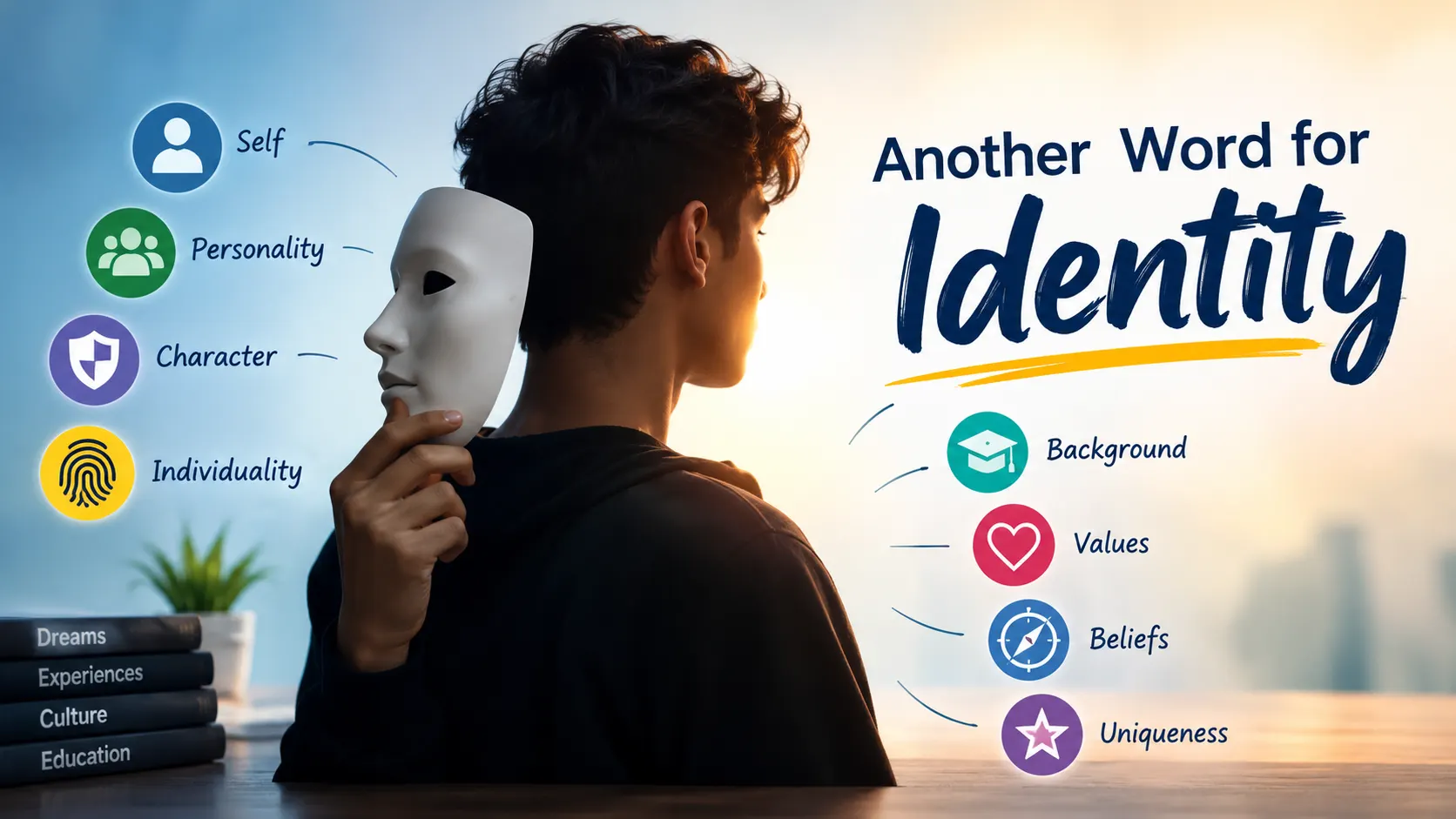
Another Word for Identity: 30 Synonyms With Examples
Another word for identity is selfhood, individuality, or personality when you mean who a person is. When cultural or group meanings, heritage, background, and roots often work better. For proof of who someone is, you can say identification, ID, or credentials. For the idea of being the same, use sameness or oneness.
The best alternative depends on which meaning of “identity” you have in mind. The word can describe a person’s sense of self, a group’s shared traits, a document that proves who you are, a brand’s public image, or the state of being exactly alike. A word that fits one of these often fails in another.
Quick list: selfhood, individuality, personality, self image, identification, heritage, background, sameness, uniqueness, persona
This article looks at 30 alternatives to “identity.” Each one has a meaning, IPA pronunciation, usage note, and example sentence, so you can see which context it fits.
At a Glance: Identity Synonyms and Related Alternatives
| Alternative | Part of Speech | Meaning | Register / Tone | Ideal Context |
| Selfhood | noun | the state of being a distinct person | Formal, thoughtful | Psychology, philosophy, personal growth |
| Individuality | noun | the qualities that make one person different from others | Neutral | Describing what makes someone stand out |
| Personality | noun | the set of traits that shape how a person behaves | Neutral, everyday | Describing someone’s manner and temperament |
| Identification | noun | proof of who someone is, or the act of recognizing someone | Formal, practical | Documents, security, police and legal contexts |
| Persona | noun | the image a person shows to the public | Neutral to literary | Public, online, or professional image |
| Heritage | noun | traditions and history passed down in a family or group | Neutral to formal | Culture, ancestry, national history |
| Background | noun | a person’s family, education, and past experience | Neutral, everyday | Describing where someone comes from |
| Sameness | noun | the state of being exactly alike | Neutral | The “being identical” sense of identity |
| Uniqueness | noun | the quality of being the only one of its kind | Neutral | Stressing what cannot be copied |
| Image | noun | the way a person or group is seen by others | Neutral, everyday | Public perception, branding |
Which Word Should You Use?
| If you want to… | Use | Why |
| Talk about a person’s sense of who they are | selfhood or self image | Both focus on the inner view of the self. |
| Describe what makes someone different from others | individuality or uniqueness | Both stress differences, not belonging. |
| Describe someone’s manner and temperament | personality | It covers habits, mood, and behavior. |
| Refer to a card, passport, or proof of who someone is | identification or ID | These are the normal words for documents and checks. |
| Talk about a culture or family history | heritage, roots, or background | They point to the past and to groups. |
| Say that two things are the same | sameness or equivalence | Identity can mean this, but these words are clearer. |
| Describe the public face someone shows | persona or image | They focus on how a person appears, not who they are. |
| Describe a company’s look and public message | brand or image | These fit business writing better than “identity.” |
Exploring the Multiple Meanings of “Identity”
1. Who a Person Is
- Meaning: The traits, beliefs, and qualities that make a person who they are.
- Explanation: This is the most common sense today. It covers both how people see themselves and how they are recognized by others. It is often used to talk about personal growth.
- Example: Moving to a new country made her think hard about her identity.
2. Group or Shared Identity
- Meaning: The traits, culture, or history that a group shares and that set it apart.
- Explanation: This sense applies to nations, communities, religions, and other groups. It is used in phrases like “national identity” and “cultural identity.” Here the word describes belonging, not individual difference.
- Example: The festival helps keep the town’s cultural identity alive.
3. Proof of Who Someone Is
- Meaning: The fact of being a particular person, especially as shown by documents or details.
- Explanation: In this sense, identity is something that can be checked, hidden, stolen, or proven. It is common in law, security, and banking.
- Example: The bank asked for proof of her identity before opening the account.
4. Sameness
- Meaning: The state of being exactly the same as something else.
- Explanation: This is an older, more technical sense. It is less common in everyday speech, but it explains why “identical” is related to “identity.”
- Example: The test showed the identity of the two samples.
5. Public or Brand Identity
- Meaning: The image and look an organization or public figure presents to others.
- Explanation: Businesses often talk about “brand identity,” meaning their name, logo, colors, and message. The sense is about planned public image, not inner character.
- Example: The new logo gave the company a stronger identity.
6. Identity in Mathematics
- Meaning: An equation that is true for all values of its variables, or a value that leaves other numbers unchanged in an operation.
- Explanation: This is a technical sense. For example, 0 is the additive identity because adding it changes nothing.
- Example: Zero is the identity element for addition.
Sources: Merriam Webster; Collins English Dictionary; Dictionary.com.
Analyzing 30 Identity Alternatives in Detail
Some of the words below are close synonyms, while others are related alternatives that fit only one sense of “identity.” Each Usage note says which is which.
Group 1: Selfhood and Individuality
1. Selfhood
IPA: /ˈsɛlfhʊd/ (US and UK)
Definition: The quality of being a distinct, separate person with a sense of self.
- Usage: A close synonym for the personal sense of identity. It is more formal and abstract, and it often appears in psychology, philosophy, and literature.
- Example: Writing in her diary helped her feel a stronger sense of selfhood.
2. Individuality
IPA: US /ˌɪndəˌvɪdʒuˈælədi/ · UK /ˌɪndɪˌvɪdʒuˈælɪti/
Definition: The qualities that make a person different from all others.
- Usage: A close synonym when identity means what sets someone apart. It stresses difference, so it does not fit group identity.
- Example: The school encourages students to show their individuality.
3. Self
IPA: /sɛlf/ (US and UK)
Definition: A person’s own nature, character, or being, seen as separate from others.
- Usage: A short, common word that overlaps with identity in the sense of inner nature. It is less precise, and it does not cover documents or groups.
- Example: After the long illness, he felt like his old self again.
4. Personality
IPA: US /ˌpɜːrsəˈnælədi/ · UK /ˌpɜːsəˈnælɪti/
Definition: The combined traits that shape how a person thinks, feels, and behaves.
- Usage: A related alternative, not an exact synonym. Personality describes behavior and temperament, while identity also includes background, beliefs, and how a person sees themselves.
- Example: His warm personality made him easy to like.
5. Self image
IPA: /ˈsɛlf ˌɪmɪdʒ/ (US and UK)
Definition: The way a person sees or thinks about themselves.
- Usage: A related alternative that covers only the inner view. It does not include how others see the person, which identity often does.
- Example: Her self image improved after she started a new job.
Group 2: Recognition and Documents
6. Identification
IPA: US /aɪˌdɛntəfəˈkeɪʃən/ · UK /aɪˌdɛntɪfɪˈkeɪʃən/
Definition: Something that proves who a person is, or the act of recognizing who someone is.
- Usage: The usual formal choice for the proof of identity sense. It does not work for the inner sense of self.
- Example: Please bring identification to the exam.
7. ID
IPA: /ˌaɪ ˈdiː/ (US and UK)
Definition: A short form of “identification,” usually meaning a card or document that shows who you are.
- Usage: A casual, everyday alternative for documents only. It cannot replace identity in the sense of selfhood or culture.
- Example: The guard asked to see my ID at the gate.
8. Name
IPA: /neɪm/ (US and UK)
Definition: The word or words by which a person is known.
- Usage: A related alternative. A name labels a person, but it is only one part of identity. It fits when identity means who someone is called.
- Example: The witness refused to give her name to the press.
9. Credentials
IPA: /krɪˈdɛnʃəlz/ (US and UK)
Definition: Documents or details that prove a person’s identity, qualifications, or authority.
- Usage: A related alternative used in formal and technical settings, including login systems. It focuses on proof, not on the person.
- Example: The officer checked her credentials at the door.
10. Persona
IPA: US /pərˈsoʊnə/ · UK /pəˈsəʊnə/
Definition: The role or image a person shows to the public, which may differ from their true self.
- Usage: A related alternative, not an exact synonym. A persona can be chosen or even invented, so it may not match a person’s real identity.
- Example: The singer has a bold stage persona that is very different from her private self.
Group 3: Heritage and Belonging
11. Heritage
IPA: US /ˈhɛrətɪdʒ/ · UK /ˈhɛrɪtɪdʒ/
Definition: Traditions, beliefs, and history passed down from earlier generations.
- Usage: A related alternative for the group or cultural sense of identity. It looks to the past and does not describe a person’s character.
- Example: She is proud of her Pakistani heritage.
12. Background
IPA: /ˈbækɡraʊnd/ (US and UK)
Definition: A person’s family, education, and past experience.
- Usage: A related alternative that describes where someone comes from. It is neutral and common in everyday speech, but it explains less than identity does.
- Example: People from different backgrounds joined the project.
13. Roots
IPA: /ruːts/ (US and UK)
Definition: A person’s family origins or the place where their family comes from.
- Usage: A warm, informal alternative for cultural identity. It almost always appears in the plural for this meaning.
- Example: He traveled to the village to learn about his roots.
14. Origin
IPA: US /ˈɔːrədʒɪn/ · UK /ˈɒrɪdʒɪn/
Definition: The place, family, or situation from which a person or thing comes.
- Usage: A related alternative. It points to where something started, not to the whole of who someone is.
- Example: The form asks about your country of origin.
15. Nationality
IPA: US /ˌnæʃəˈnælədi/ · UK /ˌnæʃəˈnælɪti/
Definition: The legal status of belonging to a particular nation.
- Usage: A narrow related alternative. Nationality is only one part of identity, and it can be shown on documents.
- Example: Please write your name and nationality on the form.
Group 4: Sameness
16. Sameness
IPA: /ˈseɪmnəs/ (US and UK)
Definition: The quality of being exactly alike.
- Usage: A direct synonym for the older “being the same” sense of identity. It does not fit the personal or group senses.
- Example: The sameness of the two reports surprised the editor.
17. Oneness
IPA: /ˈwʌnnəs/ (US and UK)
Definition: The state of being a single unit or being in complete agreement.
- Usage: A related alternative. It stresses unity, not exact likeness, and it sometimes carries a spiritual tone.
- Example: The team felt a oneness of purpose.
18. Equivalence
IPA: /ɪˈkwɪvələns/ (US and UK)
Definition: The state of being equal in value, meaning, or effect.
- Usage: A related alternative. Things that are equivalent are equal in some way, but they are not necessarily exactly the same. It is formal and often technical.
- Example: The test shows the equivalence of the two methods.
19. Likeness
IPA: /ˈlaɪknəs/ (US and UK)
Definition: The quality of being similar or a picture that looks like someone.
- Usage: A weaker related alternative. Likeness means similar, not identical, so it is not a true synonym for the sameness sense.
- Example: There was a strong likeness between the two brothers.
20. Unity
IPA: US /ˈjunədi/ · UK /ˈjuːnɪti/
Definition: The state of being joined as one or in agreement.
- Usage: A related alternative. It fits group identity when the focus is on togetherness, not on traits.
- Example: The song brought a sense of unity to the crowd.
Group 5: Distinctive Qualities
21. Uniqueness
IPA: US /juˈniknəs/ · UK /juːˈniːknəs/
Definition: The quality of being the only one of its kind.
- Usage: A related alternative that stresses what cannot be copied. It is close to individuality but can describe things as well as people.
- Example: The uniqueness of each fingerprint helps police solve crimes.
22. Distinctiveness
IPA: /dɪˈstɪŋktɪvnəs/ (US and UK)
Definition: The quality of being clearly different and easy to recognize.
- Usage: A related alternative often used for brands, styles, and cultures. It stresses what stands out.
- Example: The distinctiveness of the region’s food draws visitors every year.
23. Essence
IPA: /ˈɛsəns/ (US and UK)
Definition: The basic quality that makes something what it is.
- Usage: A related alternative for the deepest, core sense of identity. It is formal and a little abstract.
- Example: Kindness is the essence of who she is.
24. Nature
IPA: US /ˈneɪtʃər/ · UK /ˈneɪtʃə/
Definition: The basic qualities or character of a person or thing.
- Usage: A related alternative. It describes inborn qualities, so it fits only part of what identity means.
- Example: It is not in his nature to give up.
25. Character
IPA: US /ˈkɛrɪktər/ · UK /ˈkærəktə/
Definition: The mental and moral qualities that make a person who they are.
- Usage: A related alternative that stresses moral qualities, such as honesty. Identity is wider and also covers background and group membership.
- Example: Her character showed when she admitted the mistake.
Group 6: Public Image and Branding
26. Reputation
IPA: /ˌrɛpjuˈteɪʃən/ (US and UK)
Definition: The general opinion people have about someone or something.
- Usage: A related alternative. Reputation is how others judge you, which is not the same as who you are.
- Example: The restaurant has a good reputation in the city.
27. Image
IPA: /ˈɪmɪdʒ/ (US and UK)
Definition: The impression a person, group, or company gives to the public.
- Usage: A related alternative for the public or brand sense. An image can be planned and may differ from the truth.
- Example: The company changed its logo to improve its image.
28. Brand
IPA: /brænd/ (US and UK)
Definition: A name, design, or reputation that makes a product or company recognizable.
- Usage: A context specific alternative for business. When people say “personal brand,” they mean a planned public identity.
- Example: The brand is known for its simple, clean design.
29. Label
IPA: US /ˈleɪbəl/ · UK /ˈleɪbəl/
Definition: A word or phrase used to describe or group a person.
- Usage: A limited related alternative. A label is often put on a person by others, and it covers only part of identity.
- Example: He did not like the label of “shy kid.”
30. Profile
IPA: US /ˈproʊfaɪl/ · UK /ˈprəʊfaɪl/
Definition: A short description of a person’s main details, or a page showing those details online.
- Usage: A context specific alternative, mainly for online accounts and short biographies. It shows facts about a person and not their inner sense of self.
- Example: She updated her profile with a new photo and job title.
Sources: Merriam Webster; Collins English Dictionary and Collins Thesaurus; Dictionary.com; Cambridge Dictionary (for pronunciation checks).
Identity vs. Personality vs. Character vs. Individuality
These four words are often mixed up. They overlap, but each has a different focus.
| Word | Main Focus | Quick Example |
| Identity | Who you are, including background, beliefs, and group ties | “Language is part of their cultural identity.” |
| Personality | How you behave and come across | “She has a cheerful personality.” |
| Character | Your moral qualities, such as honesty | “He showed strong character.” |
| Individuality | What makes you different from others | “The artist’s individuality shows in every painting.” |
A simple way to remember: personality is what people notice, character is what you do when it is hard, individuality is how you differ, and identity is the bigger picture that includes all of these.
Sources: Merriam Webster; Collins English Dictionary; Cambridge Dictionary.
Identity and Opposite/Paired Word Pairs
| Word | Paired Word | Note |
| Identity | Anonymity | Anonymity means being unnamed or unknown. It is the closest opposite when identity means who someone is. |
| Identity | Difference | Fits the same sense. Identity means being the same, while difference means being unlike. |
| Individual identity | Conformity | Conformity means following the group, so it contrasts with standing out. It is a contrast, not a strict opposite. |
| Identity | Role | A role is what someone does, while identity is who they are. They are often paired in discussions of work and life. |
| Public identity | Private self | Often paired to show the gap between what people see and what is real. |
“Identity” has no single perfect opposite because it has several meanings. The best contrast depends on the sense: anonymity for who someone is, and difference for sameness. Other pairs are contrasts, so use them with care.
Sources: Merriam Webster; Collins Thesaurus.
Common Word Partners of “Identity”
| Pattern | Common Partners | Example |
| adjective + identity | national, cultural, personal, gender, corporate, true, secret | She kept her true identity hidden. |
| sense of identity | a strong sense of identity, a sense of identity | The club gave him a sense of identity. |
| verb + identity | establish, confirm, reveal, protect, hide, steal | The police tried to confirm his identity. |
| identity + noun | identity card, identity theft, identity crisis, identity politics, identity verification | He reported the identity theft to the bank. |
| mistaken identity | a case of mistaken identity | The arrest was a case of mistaken identity. |
| identity of + noun | the identity of the winner, the identity of the writer | The identity of the donor is not known. |
Sources: Collins English Dictionary; Oxford Collocations Dictionary; Cambridge Dictionary.
Idiomatic Phrases Featuring “Identity”
“Identity” appears in few true idioms. The phrases below are established expressions with fixed or widely used meanings.
1. Identity crisis
- Meaning: A period of confusion in which a person is unsure who they are or what they want. The term is widely linked to the psychologist Erik Erikson.
- Example: After he left the army, he went through an identity crisis.
2. Mistaken identity
- Meaning: A situation in which one person is wrongly thought to be someone else.
- Example: The man was freed after police admitted it was mistaken identity.
3. Identity theft
- Meaning: The crime of using another person’s personal details, such as their name or bank information, to commit fraud.
- Example: She checks her bank account often to protect against identity theft.
4. Secret identity
- Meaning: A hidden identity, especially one used by a character in stories who lives a double life.
- Example: In the story, the teacher’s secret identity is a masked hero.
Sources: Merriam Webster; Collins English Dictionary; Cambridge Dictionary.
Word Formation of “Identity”
Etymology & Structure
“Identity” came into English from Middle French identité. That word comes from Late Latin identitas, which is probably built from Latin idem, meaning “the same.” The ending ity forms nouns that name a state or quality. So the word’s older meaning is “the state of being the same.”
Date and History
Etymonline and Merriam Webster both placed the word in English by the 1500s with the meaning of sameness. The sense of a person’s individual character, used in everyday speech today, developed later. Exact dates differ slightly between dictionaries, so check the entry for the sense you need.
Word Class Variations
- Noun: identity (plural: identities)
- Verb: identify (related but formed from a separate Medieval Latin root combining identitas and facere, “to make”)
- Related nouns: identification, identifier
- Adjective: identical, identifiable
- Adverb: identically, identifiably
- Rare related form: identitarian (an adjective used in political discussion)
“Identity” is a noun only. It has no verb form of its own.
Sources: Etymonline; Merriam Webster; Collins English Dictionary.
Common Word Choice Mistakes
- “Please show your identity at the gate”: say “Please show your ID” or “identification.”
- “He has a strong identity” meaning he is friendly: say “personality.”
- “Her heritage is shy and quiet”: say “personality” or “character.” Heritage means traditions from the past.
- “The identity of him is secret”: say “his identity is secret.”
- “The two coats are in identity”: say “the two coats are identical.”
- “Reputation” for “who someone really is”: say “identity” or “character.” Reputation is only what others think.
- “Equivalence” for a person’s sense of self: say “selfhood” or “identity.”
Frequently Asked Questions
What is the closest synonym for identity?
For the personal sense, the closest synonyms are selfhood and individuality. Which word works best depends on whether you mean a person, a group, or proof of who someone is.
What is a formal alternative to identity?
Selfhood, identification, and credentials are formal options. Which one fits depends on whether you mean the self or proof of who someone is.
What is a casual alternative to identity?
“ID” works for documents, and “roots” or “background” work for family and culture. For personal traits, “personality” is the everyday word.
What is the opposite of identity?
Anonymity is the closest opposite when identity means who someone is. When identity means sameness, the opposite is difference.
What is the difference between identity and personality?
Personality is about how you behave and come across. Identity is wider and also includes your background, beliefs, and how you see yourself.
Can identity be used for groups?
Yes. People speak of national identity, cultural identity, and group identity to mean the shared traits that set a group apart.
Is identity the same as identification?
Not quite. Identity is who you are, while identification is proof of it, such as a passport or ID card.
What is a good word for brand identity?
Image, brand, and distinctiveness work well. “Image” stresses how the public sees a company.
Can identity mean “sameness”?
Yes, though this is an older and more technical sense. Today people usually say “sameness” or “identical” instead.
Is “identity” a countable noun?
Yes. You can say “one identity” or “many identities,” for example, “She has several online identities.”
Conclusion
The closest alternatives to “identity” are selfhood, individuality, and personality when you mean who a person is. Heritage, background, and roots fit group and cultural meanings, while identification and ID cover proof. Sameness is the best choice for the older “being exactly alike” meaning.
Context matters because “identity” has many senses and few words cover all of them. Personality describes behavior, character describes moral qualities, and persona describes a public face. Reputation shows what others think, and a brand describes a planned image.
To choose the right word, first decide which sense of “identity” you mean: the self, a group, a document, a brand, or sameness. Then pick the alternative that matches that sense. If two

Noman is the founder and author of Factwy.com, where he shares informative, useful, and easy-to-understand content. With a passion for research and writing, he creates articles that simplify complex topics and provide valuable insights. His goal is to deliver clear, accurate, and reader-friendly information that helps visitors learn something new every day.