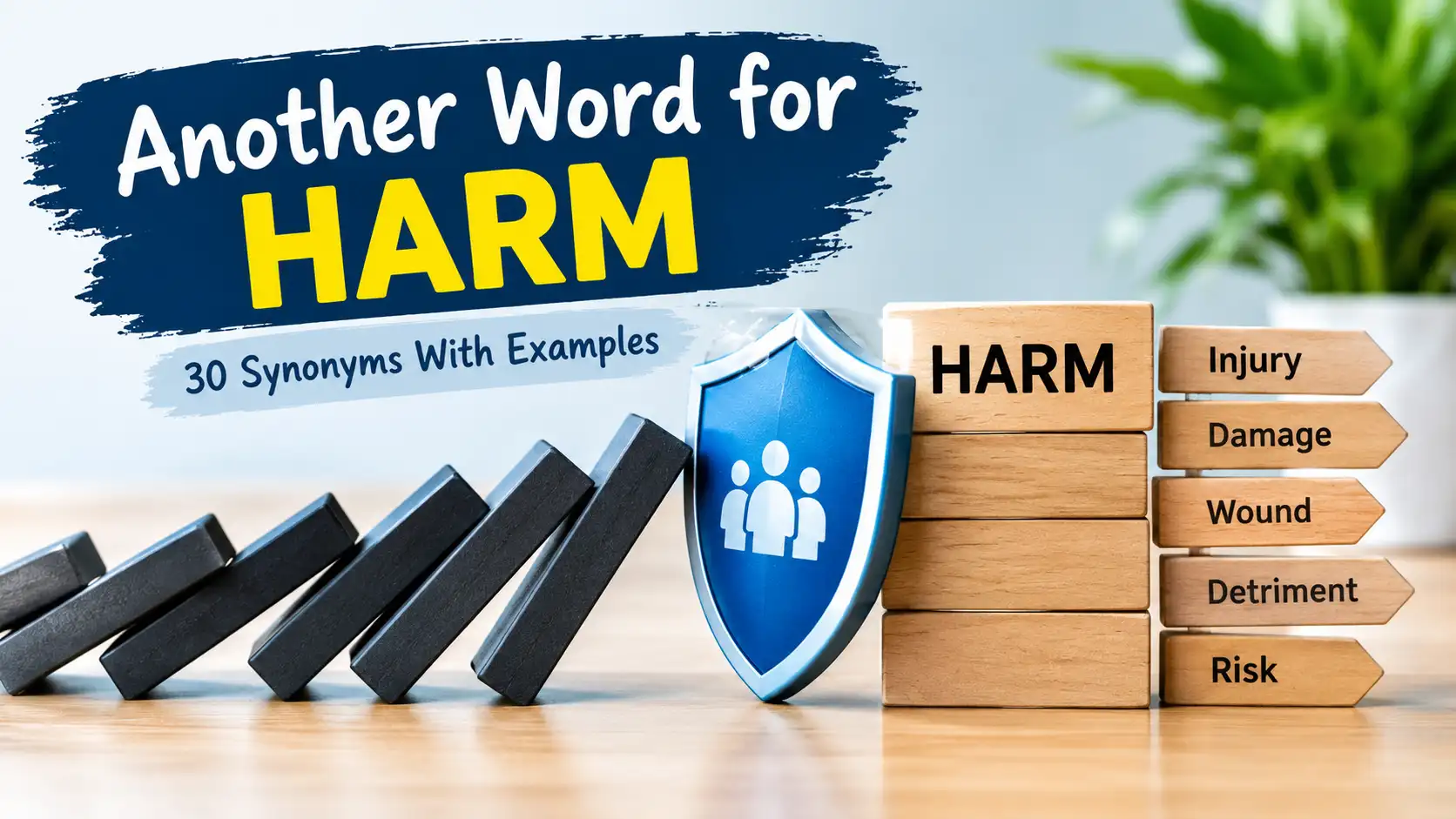
Another Word for Harm: 30 Synonyms With Examples
Another word for harm is damage, hurt, or injury. The best choice depends on what is affected: a person’s body, someone’s feelings, an object, a reputation, or the environment. Harm works as both a noun (“the harm caused by the storm”) and a verb (“smoking can harm your lungs”), so synonyms must also match the part of speech.
Alternatives fall into several areas: physical hurt (injure, wound, maim), damage to things (damage, spoil, mar), mistreatment of people (abuse, mistreat, wrong), formal wording (detriment, prejudice), severe harm (ruin, cripple, devastate), and figurative or literary harm (tarnish, scathe, mischief).
Quick list: hurt, damage, injure, injury, wound, impair, ruin, abuse, detriment, undermine
This article explains 30 alternatives to harm, with meanings, IPA, usage notes, examples, and context, so you can pick the word that fits.
At a Glance: Harm Synonyms and Related Alternatives
| Alternative | Part of Speech | Meaning | Register / Tone | Ideal Context |
| Hurt | verb, noun | to cause pain or injury; pain or injury | Neutral, everyday | Body or feelings |
| Damage | noun, verb | harm that reduces value or function | Neutral | Objects, property, environment |
| Injure | verb | to cause physical harm to a living being | Neutral to formal | Accidents, sports, news |
| Injury | noun | physical harm to the body | Neutral | Medical and everyday use |
| Impair | verb | to weaken or make worse | Formal | Health, ability, judgment |
| Detriment | noun | harm or disadvantage | Formal | Law, business, academic writing |
| Abuse | verb, noun | to treat badly or cruelly | Neutral to serious | People, animals, power |
| Ruin | verb, noun | to destroy or spoil completely | Neutral, strong | Plans, finances, property |
| Undermine | verb | to weaken gradually | Neutral to formal | Confidence, authority, health |
| Tarnish | verb | to damage the good quality of something | Neutral to literary | Reputation, image |
Which Word Should You Use?
| If you want to… | Use | Why |
| Describe pain to the body or feelings in plain English | hurt | It is the most common everyday word. |
| Describe harm to objects or property | damage | It focuses on loss of value or function. |
| Describe physical harm to a person in news or reports | injure / injury | These words are clear and specific to the body. |
| Write in a formal, legal, or business style | detriment, prejudice | They suit documents and official language. |
| Describe cruel or improper treatment | abuse, mistreat, maltreat | They stress how someone is treated. |
| Describe harm that cannot be repaired | ruin, cripple, devastate | They show severe or lasting harm. |
| Describe slow, hidden harm | undermine, impair | They suggest gradual weakening. |
| Protect or hurt someone’s image | tarnish | It is used mainly for reputation. |
Exploring the Multiple Meanings of “Harm”
1. Physical Hurt (Noun)
- Meaning: Physical injury or hurt.
- Explanation: This sense is about bodily damage to people or animals. It is often used in warnings, safety rules, and law, as in “bodily harm.”
- Example: The driver escaped without any serious harm.
2. Damage or Loss (Noun)
- Meaning: Damage, loss, or a negative effect on something that is not a body.
- Explanation: Here harm covers things like reputation, the economy, or the environment. It is broader and less physical than the first sense.
- Example: The scandal did lasting harm to the company’s reputation.
3. Wrong or Evil (Noun)
- Meaning: Something morally wrong or evil.
- Explanation: This older sense appears in phrases like “meaning no harm.” It points to bad intent or bad results rather than physical damage.
- Example: She meant no harm by the joke.
4. To Injure (Verb)
- Meaning: To cause physical injury or hurt to a person or animal.
- Explanation: As a verb, harm often appears in negative or conditional sentences, such as rules and warnings.
- Example: The fall did not harm the child.
5. To Damage or Impair (Verb)
- Meaning: To damage something, or to make it less effective or valuable.
- Explanation: This sense extends harm to health, relationships, plans, and the environment.
- Example: Too much sugar can harm your teeth.
Sources: Merriam Webster, Collins English Dictionary, Dictionary.com (entries for harm).
Analyzing 30 Harm Alternatives in Detail
Some of the words below are direct synonyms of harm, while others are related alternatives that fit only certain contexts.
Everyday Core Alternatives
1. Hurt
IPA: US /hɜːrt/ · UK /hɜːt/
Definition: To cause physical pain or injury, or to cause emotional pain; also, pain or injury.
- Usage: Direct synonym for harm in plain, everyday English. It covers both body and feelings, which makes it more flexible than injury.
- Example: I never wanted to hurt your feelings.
2. Damage
IPA: /ˈdæmɪdʒ/ (US and UK)
Definition: Harm that reduces the value, usefulness, or normal function of something.
- Usage: Direct synonym for harm in the sense of loss or injury to things. It is less common for people’s bodies, where injury is more natural.
- Example: The flood caused serious damage to the road.
3. Injure
IPA: US /ˈɪndʒər/ · UK /ˈɪndʒə/
Definition: To cause physical harm to a person or animal.
- Usage: Direct synonym for the verb harm when the body is involved. It sounds more factual than hurt and is common in reports.
- Example: Two players were injured during the match.
4. Injury
IPA: /ˈɪndʒəri/ (US and UK)
Definition: Harm or damage done to a person’s body, or to a person’s rights or reputation.
- Usage: Noun counterpart to the physical sense of harm. It is more specific than harm, which can also refer to non physical loss.
- Example: He missed the season because of a knee injury.
5. Wound
IPA: /wuːnd/ (US and UK)
Definition: To injure the body by cutting or breaking the skin, or to hurt someone’s feelings deeply; also, such an injury.
- Usage: Related alternative that is stronger and more specific than harm. It suggests a visible injury or a deep emotional hurt.
- Example: His unkind words wounded her more than she showed.
Alternatives for Spoiling and Weakening
6. Impair
IPA: US /ɪmˈper/ · UK /ɪmˈpeə/
Definition: To make something weaker, worse, or less able to work properly.
- Usage: Formal verb that fits health, judgment, and ability. It is a close synonym for harm when the damage is a loss of function rather than visible damage.
- Example: Lack of sleep can impair your memory.
7. Mar
IPA: US /mɑːr/ · UK /mɑː/
Definition: To damage something, especially by spoiling its appearance or quality.
- Usage: Related alternative for harm to something’s beauty or enjoyment, not for injury to a person. It is somewhat formal or literary.
- Example: A few mistakes marred an otherwise perfect performance.
8. Spoil
IPA: /spɔɪl/ (US and UK)
Definition: To damage or lessen the value, quality, or enjoyment of something.
- Usage: Related alternative that is informal and common. It does not mean physical injury to people.
- Example: The rain spoiled our picnic.
9. Undermine
IPA: US /ˌʌndərˈmaɪn/ · UK /ˌʌndəˈmaɪn/
Definition: To weaken something gradually or secretly.
- Usage: Related alternative that stresses slow, hidden harm. It is used for trust, confidence, authority, or health, not sudden injury.
- Example: Constant criticism can undermine a child’s confidence.
10. Compromise
IPA: US /ˈkɑːmprəmaɪz/ · UK /ˈkɒmprəmaɪz/
Definition: To weaken or put something at risk, such as safety, quality, or a reputation.
- Usage: Related alternative, not an exact synonym. It is common in technical, security, and medical contexts.
- Example: The leak compromised the safety of the whole system.
Alternatives for Mistreatment
11. Abuse
IPA: Verb /əˈbjuːz/ · noun /əˈbjuːs/ (US and UK)
Definition: To treat a person or animal cruelly or wrongly, or to use something in a harmful way.
- Usage: Related alternative that focuses on how someone is treated, often repeatedly. It is stronger and more serious than harm and should be used carefully.
- Example: The charity rescues animals that have been abused.
12. Mistreat
IPA: /ˌmɪsˈtriːt/ (US and UK)
Definition: To treat a person or animal badly or unfairly.
- Usage: Related alternative that is milder than abuse. It describes poor treatment, not necessarily physical injury.
- Example: The workers said they were mistreated by their manager.
13. Maltreat
IPA: /ˌmælˈtriːt/ (US and UK)
Definition: To treat someone or something cruelly or roughly.
- Usage: Related alternative that is more formal than mistreatment. It appears in reports and official writing.
- Example: The report found that prisoners had been maltreated.
14. Wrong
IPA: US /rɔːŋ/ · UK /rɒŋ/
Definition: To treat someone unfairly or unjustly; also, an unfair or unjust act.
- Usage: Related alternative for moral harm or injustice. As a verb it is somewhat formal and often passive (“to be wronged”).
- Example: He felt that the company had wronged him.
15. Victimize
IPA: /ˈvɪktɪmaɪz/ (US and UK)
Definition: To single out a person for cruel or unfair treatment.
- Usage: Related alternative that implies targeting a specific person. It does not fit accidental harm.
- Example: She was victimized by bullies for years.
Nouns for Harm and Its Effects
16. Detriment
IPA: /ˈdetrɪmənt/ (US and UK)
Definition: Harm, damage, or disadvantage.
- Usage: Direct, formal noun synonym for harm. It is common in law, business, and academic writing, usually in the phrase “to the detriment of.”
- Example: Working late every night was to the detriment of his health.
17. Prejudice
IPA: US /ˈpredʒədɪs/ · UK /ˈpredʒudɪs/
Definition: In law, harm or loss to a person’s rights or interests; more generally, an unfair opinion formed without enough knowledge.
- Usage: Related alternative that fits only the legal sense of harm. In everyday English, prejudice usually means unfair bias, so avoid it as a general synonym.
- Example: The delay caused no prejudice to either party.
18. Blight
IPA: /blaɪt/ (US and UK)
Definition: Something that spoils or damages, or to damage or ruin something.
- Usage: Related alternative for widespread, lasting harm, such as to a community or a plan. It is often used figuratively.
- Example: Empty buildings became a blight on the neighborhood.
19. Ill
IPA: /ɪl/ (US and UK)
Definition: Harm or evil, used as a noun.
- Usage: Older, formal noun, mostly in fixed phrases such as “wish someone ill.” It is not common as a stand alone synonym today.
- Example: He wished no ill on anyone.
20. Disservice
IPA: US /dɪsˈsɜːrvɪs/ · UK /dɪsˈsɜːvɪs/
Definition: A harmful or unfair action.
- Usage: Related alternative for harm caused by unhelpful or unfair actions, often done with good intentions. It is used mostly in the phrase “do someone a disservice.”
- Example: Ignoring the problem does your team a disservice.
Alternatives for Severe Harm
21. Ruin
IPA: /ˈruːɪn/ (US and UK)
Definition: To destroy or badly damage something; also, complete loss or destruction.
- Usage: Related alternative that is much stronger than harm. It means the damage is severe, often permanent.
- Example: One bad decision ruined his career.
22. Destroy
IPA: /dɪˈstrɔɪ/ (US and UK)
Definition: To damage something so badly that it no longer exists or works.
- Usage: Related alternative at the extreme end. It means total harm, so it should not replace harm in ordinary cases.
- Example: The fire destroyed the old library.
23. Cripple
IPA: /ˈkrɪpl/ (US and UK)
Definition: To severely damage or weaken something, or to cause someone permanent physical disability.
- Usage: Related alternative that is used figuratively for systems, economies, and organizations. Be careful with the literal use for people, because the word can be offensive.
24. Devastate
IPA: /ˈdevəsteɪt/ (US and UK)
Definition: To destroy or cause great damage to a place, or to shock and upset someone deeply.
- Usage: Related alternative for large scale or very emotional harm, such as disasters or grief.
- Example: The storm devastated several coastal towns.
25. Maim
IPA: /meɪm/ (US and UK)
Definition: To injure someone so seriously that part of the body is permanently damaged.
- Usage: Related alternative that means severe, lasting physical harm. It is much stronger than injury.
- Example: The accident maimed him for life.
Figurative and Literary Alternatives
26. Tarnish
IPA: US /ˈtɑːrnɪʃ/ · UK /ˈtɑːnɪʃ/
Definition: To damage or spoil the good quality of something, especially a reputation; also, to lose shine, as metal does.
- Usage: Related alternative used almost only for reputation or image, not for bodies or objects in general.
- Example: The scandal tarnished the senator’s good name.
27. Sabotage
IPA: /ˈsæbətɑːʒ/ (US and UK)
Definition: To deliberately damage or ruin something, such as a plan or a machine.
- Usage: Related alternative that requires intent. It does not fit accidental harm.
- Example: Someone sabotaged the project by deleting key files.
28. Endanger
IPA: US /ɪnˈdeɪndʒər/ · UK /ɪnˈdeɪndʒə/
Definition: To put someone or something at risk of harm.
- Usage: Related alternative, not an exact synonym. It describes the risk of harm rather than the harm itself.
- Example: Pollution endangers many species of fish.
29. Mischief
IPA: /ˈmɪstʃɪf/ (US and UK)
Definition: Harm or damage caused by a person or thing; also, playful misbehavior.
- Usage: The harm sense is older and formal, mostly in legal or literary writing. Today the playful sense is far more common, so use this word carefully.
- Example: The storm did great mischief to the crops.
30. Scathe
IPA: /skeɪð/ (US and UK)
Definition: Harm or injury; also, to harm or injure.
- Usage: Direct but rare and literary. Today it appears mainly in the word unscathed and the phrase “scathing criticism.”
- Example: The old tale tells of a knight who feared no scathe.
Sources: Merriam Webster, Collins English Dictionary and Collins Thesaurus, Dictionary.com (entries for the words above).
Harm vs. Damage vs. Injury vs. Hurt
These four words overlap, but each has a typical use.
| Word | Mainly Used For | Typical Example |
| Harm | People, animals, things, and abstract ideas | “The chemical can cause harm to fish.” |
| Damage | Objects, property, systems, the environment | “The storm caused damage to the roof.” |
| Injury | The physical body | “She suffered a shoulder injury.” |
| Hurt | Pain, physical or emotional | “His words hurt her deeply.” |
Harm is the broadest of the four. Damage sounds natural with things, injury with bodies, and hurt with pain. When in doubt, ask what has been affected.
Sources: Merriam Webster, Collins English Dictionary, Dictionary.com.
Harm and Opposite/Paired Word Pairs
| Word | Paired Word | Note |
| harm | benefit | The most common noun is the opposite. |
| harm | good | Used in “do more harm than good.” |
| harm | help | Common verb opposite. |
| harm | protect | Contrasts causing harm with preventing it. |
| hurt | heal | Often used for body and feelings. |
| harmful | harmless | The standard adjective pair. |
| damage | repair | Natural contrast for objects. |
| injury | recovery | Natural pair for health contexts. |
Harm has several opposites because it covers several senses. For the noun, benefit and good work best. For the verb, help, protect, and heal are the usual choices, depending on what is affected.
Sources: Merriam Webster, Collins Thesaurus, Dictionary.com.
Common Word Partners of “Harm”
| Pattern | Common Partners | Example |
| verb + harm | do, cause, risk, prevent, avoid | Seatbelts help prevent harm in crashes. |
| adjective + harm | serious, physical, emotional, irreparable, lasting | The treatment caused no lasting harm. |
| harm + preposition | harm to, harm from | The report looks at the harm to wildlife. |
| noun + harm | bodily harm, self harm, environmental harm | He was charged with causing bodily harm. |
| harm + noun | harm reduction | The clinic offers a harm reduction program. |
| harm (verb) + object | harm the environment, harm your health, harm someone’s reputation | Loud noise can harm your hearing. |
Sources: Collins English Dictionary, Merriam Webster, Oxford Learner’s Dictionaries (collocation notes for harm).
Idiomatic Phrases Featuring “Harm”
1. Do more harm than good
- Meaning: To make a situation worse even though the aim was to help.
- Example: Giving him advice now might do more harm than good.
2. No harm done
- Meaning: Nothing bad happened, so there is nothing to worry about.
- Example: “Sorry I’m late.” “No problem, no harm done.”
3. In harm’s way
- Meaning: In a place or situation where someone could be hurt or killed.
- Example: Firefighters often put themselves in harm’s way.
4. There’s no harm in (doing something)
- Meaning: It is a safe or reasonable thing to try. This is a common set expression rather than a true idiom.
- Example: There’s no harm in asking for a discount.
Sources: Merriam Webster, Cambridge Dictionary, Collins English Dictionary (idiom entries for harm).
Word Formation of “Harm”
Etymology & Structure
Harm comes from Old English hearm, meaning hurt, pain, or evil. It is a short, native English word with Germanic roots. Related forms exist in other Germanic languages, such as German Harm (grief, sorrow). Etymonline traces it to a Proto Germanic root.
Date and History
The word is found in Old English, so it has been part of the language for over a thousand years. It was used as both a noun and a verb early on.
Word Class Variations
- Noun: harm
- Verb: harm, harms, harmed, harming
- Adjective: harmful, harmless
- Adverb: harmfully, harmlessly
- Related nouns: harmfulness, harmlessness
Sources: Etymonline (entry for harm), Merriam Webster, Collins English Dictionary.
Common Word Choice Mistakes
- “She made harm to the project”: she did harm to the project (or caused harm).
- “The glass was harmed”: the glass was damaged (or broken). Harm is rare for everyday objects.
- “He injured my feelings”: he hurt my feelings. Injury is mainly physical.
- “Do not put yourself in the harm’s way”: do not put yourself in harm’s way.
- “No harm done”: no harm done. In this phrase harm does not take a plural.
- “The medicine is harmful”: the medicine is harmful. Use the adjective after “is.”
- “The pesticide is harmless to bees, so it is dangerous”: use harmless only for something that does not cause harm; the opposite is harmful.
Frequently Asked Questions
What is the closest synonym for harm?
Damage and hurt are the closest everyday synonyms. Damage fits things best, and hurt fits people.
What is a formal alternative to harm?
Detriment (noun) and impair (verb) are good formal choices. Detriment is common in legal and business writing.
What is the difference between harm and damage?
Harm can refer to people, animals, things, and ideas. Damage is most natural for objects, property, and the environment.
What is the difference between harm and injury?
Injury is physical harm to a body. Harm is broader and can include emotional or financial loss.
Can harm be used for feelings?
Yes, but hurt is more natural. You can say “emotional harm,” but “hurt feelings” is more common in everyday speech.
What is a stronger word than harm?
Ruin, destroy, and devastate are stronger. They suggest severe or complete damage.
What is a literary alternative to harm?
Scathe is a rare, literary word for harm. Today you will mostly see it unscathed.
What is the opposite of harm?
For the noun, the opposite is benefit or good. For the verb, it is to help or protect.
Is harm a noun or a verb?
Both. “The harm was serious” uses a noun, and “It can harm your health” uses a verb.
Does “harm” mean the same as “abuse”?
No. Abuse is about cruel or improper treatment, often repeated. Harm is a general word for any damage or injury, accidental or intentional.
Conclusion
The closest everyday alternatives to harm are hurt, damage, and injury. Detriment and impair suit formal writing, while ruin, cripple, and devastate describe severe harm.
Context matters because these words are not interchangeable. Injury fits bodies, damage fits things, abuse fits mistreatment, and tarnish fits reputation. Some words, such as prejudice and mischief, only match certain senses of harm.
To choose the right alternative, ask what is affected, how serious the harm is, and how formal your writing needs to be. If you need one safe, general word, harm itself is usually the right choice.

Noman is the founder and author of Factwy.com, where he shares informative, useful, and easy-to-understand content. With a passion for research and writing, he creates articles that simplify complex topics and provide valuable insights. His goal is to deliver clear, accurate, and reader-friendly information that helps visitors learn something new every day.