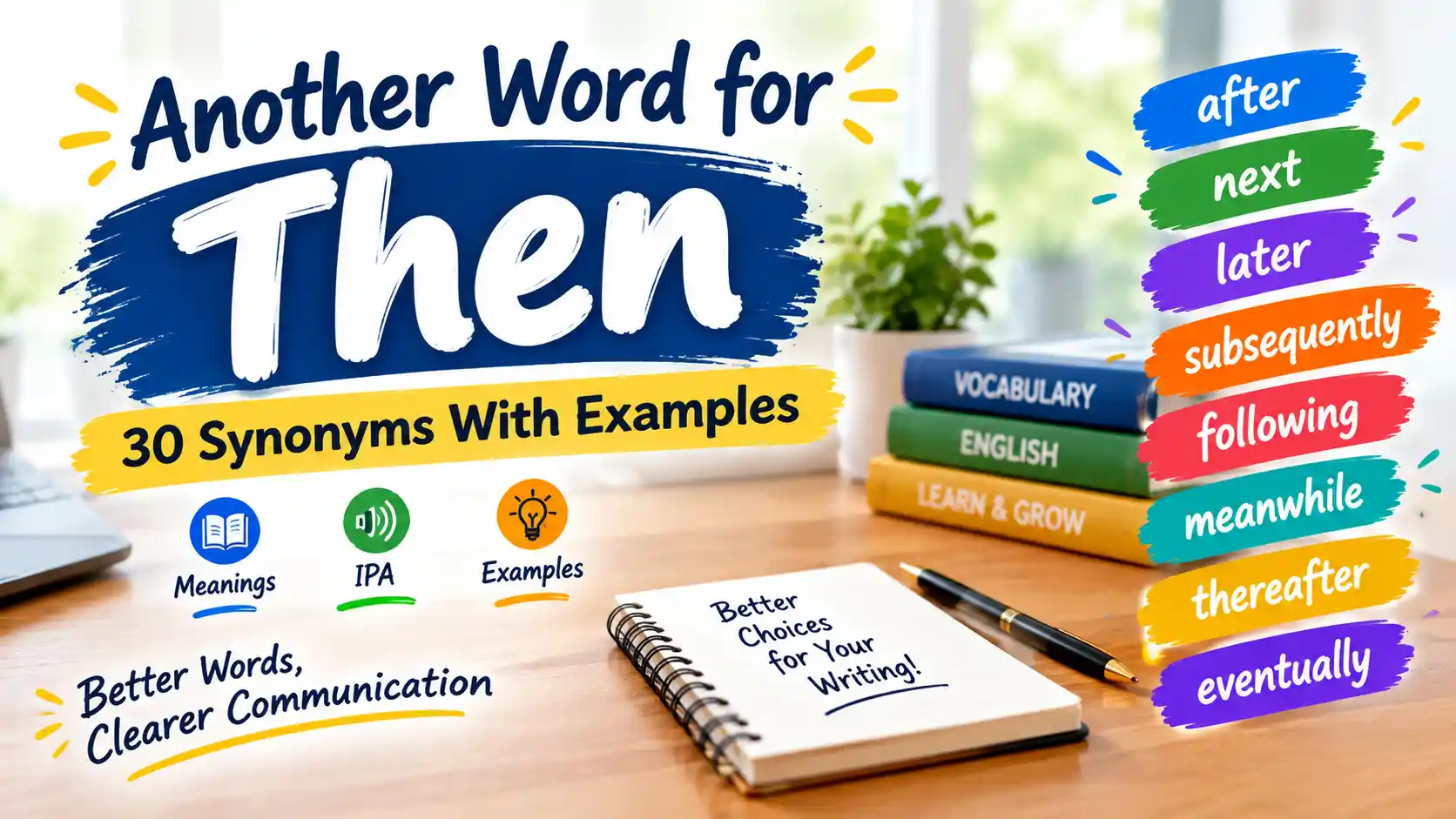
Another Word for Then: 30 Synonyms With Examples
Another word for then depends on how you use it. When “then” means “next,” good alternatives are next, after that, and afterward. If it means “at that time,” try at that time, at the time, or back then. When it means “as a result,” use so, therefore, or in that case.
There is no single synonym that works in every sentence. “Then” can point to a time, put steps in order, show a result, or add an extra point. It can also be an adjective, as in “the then president.” Choosing the right replacement means first deciding which of these jobs the word is doing.
Quick list: next, after that, afterward, later, at that time, back then, so, therefore, in that case, thus
This article looks at 30 alternatives to “then.” For each one you will find a meaning, US and UK pronunciation (IPA), a usage note, and an example. It also covers word pairs, common word partners, expressions, word history, and common mistakes.
At a Glance: Then Synonyms and Related Alternatives
| Alternative | Part of Speech | Meaning | Register / Tone | Ideal Context |
| at that time | adverb phrase | during the time already mentioned | neutral | past or future time references |
| back then | adverb phrase | at a time in the past | informal | memories, comparing past and present |
| next | adverb | coming right after in order | neutral | instructions, steps, stories |
| after that | adverb phrase | following what was just mentioned | neutral, everyday | sequences of events |
| afterward | adverb | at a later time than something just mentioned | neutral | stories, plans, reports |
| later | adverb | at a time after now or after the time mentioned | neutral | plans, general timing |
| so | conjunction / adverb | as a result | informal to neutral | cause and effect in speech |
| therefore | adverb | for that reason | formal to neutral | writing, arguments, reports |
| in that case | adverb phrase | if that is true or happens | neutral | replies, decisions |
| former | adjective | having been something earlier | neutral to formal | titles, roles (for the “then ” adjective) |
Which Word Should You Use?
| If you want to… | Use | Why |
| Talk about a time in the past | at that time, back then | They point clearly to a time already mentioned. |
| Give the next step in instructions | next, after that | They are short and clear for steps. |
| Put events in order in a formal report | subsequently, thereafter | They sound formal and exact. |
| Show a simple result | so | It is the most natural choice in speech and everyday writing. |
| Show a result in formal writing | therefore, consequently, accordingly | They sound more formal than “so.” |
| Reply to something someone just said | in that case, if so | They fit the “if that is true, then…” meaning. |
| Add one more point | besides, in addition | They match the “and then there’s…” meaning. |
| Describe someone’s earlier role | at the time, former | “The president at the time” says when. “Former” only says it is past. |
Exploring the Multiple Meanings of “Then”
1. At that time
- Meaning: At a time that has already been mentioned or understood, in the past or future.
- Explanation: This is the “time pointer” sense. The word refers to a specific time named earlier, so it needs context.
- Example: I was ten years old then.
2. Next in order
- Meaning: Soon after that; next in a sequence.
- Explanation: This sense puts events or steps in order. It is the one most people mean when they look for a replacement in instructions or stories.
- Example: Mix the flour and sugar, then add the eggs.
3. In that case; as a result
- Meaning: Following from what has been said; therefore.
- Explanation: This sense shows a result or conclusion. It often pairs with “if,” but “then” is often optional in the “if…then” pattern.
- Example: If you are tired, then you should rest.
4. Besides; in addition
- Meaning: Used to add another point.
- Explanation: This sense is less common. It usually appears in phrases like “and then there is…” to add another reason or item.
- Example: The trip is expensive, and then there is the time it takes.
5. Used in conversation to sum up or ask a follow up
- Meaning: A word added at the end of a remark to show a conclusion, an agreement, or a follow up question.
- Explanation: This is common in spoken English and is not always easy to replace. It often suggests “given what you just said.”
- Example: “I can’t come on Friday.” “Saturday, then?”
6. Adjective and noun uses
- Meaning: As an adjective, existing at that time. As a noun, that time.
- Explanation: The adjective appears before a noun, as in “the then president” or “the then president.” The noun appears after prepositions, as in “by then” or “since then.”
- Example: The then mayor opened the bridge.
Sources: Merriam Webster; Collins Dictionary; Etymonline.
Analyzing 30 Then Alternatives in Detail
Some alternatives below are direct synonyms for one sense of “then,” while others are related words that fit only certain contexts. The Usage note for each word says which is which.
Alternatives for “At That Time”
1. At that time
IPA: /æt ðæt taɪm/ (US and UK)
Definition: During the time that has been mentioned or understood.
- Usage: A direct synonym for the time sense. It is neutral and works for the past or the future.
- Example: We lived in Lahore at that time.
2. At the time
IPA: /æt ðə taɪm/ (US and UK)
Definition: During the period being talked about, usually in the past.
- Usage: A close synonym that is a little more casual than “at that time.” It often appears at the start or end of a sentence.
- Example: I didn’t understand the problem at the time.
3. Back then
IPA: /ˌbæk ˈðen/ (US and UK)
Definition: At an earlier time in the past.
- Usage: An informal synonym that works only for past times. It often suggests that things have changed since.
- Example: Phones were big and heavy back then.
4. In those days
IPA: US /ɪn ðoʊz deɪz/ · UK /ɪn ðəʊz deɪz/
Definition: During a past period, often a long time ago.
- Usage: A close synonym with a storytelling tone. It suggests a general period, not a single moment.
- Example: In those days, people wrote letters by hand.
5. At that point
IPA: /æt ðæt pɔɪnt/ (US and UK)
Definition: At that exact stage in an event or process.
- Usage: A related alternative. It stresses the stage something has reached, not a clock time.
- Example: At that point, the score was tied.
6. At that moment
IPA: US /æt ðæt ˈmoʊmənt/ · UK /æt ðæt ˈməʊmənt/
Definition: At that exact instant.
- Usage: A related alternative that replaces “then” in short, sudden events. It works like the phrase “just then.”
- Example: At that moment, the lights went out.
Alternatives for “Next” or “After That”
7. Next
IPA: /nekst/ (US and UK)
Definition: Coming immediately after in order or time.
- Usage: A direct synonym for the sequence sense. It is common in instructions and works at the start of a sentence.
- Example: Next, add the milk.
8. After that
IPA: US /ˈæftər ðæt/ · UK /ˈɑːftə ðæt/
Definition: Following what has just been mentioned.
- Usage: A direct, everyday synonym. It is clear and works well in speech and writing.
- Example: We had lunch, and after that we went to the park.
9. Afterward
IPA: US /ˈæftərwərd/ · UK /ˈɑːftəwəd/
Definition: At a later time; after something just mentioned.
- Usage: A direct synonym for the sequence sense. British English is often uses afterwards, and both forms are correct.
- Example: We watched the film and talked about it afterward.
10. Later
IPA: US /ˈleɪtər/ · UK /ˈleɪtə/
Definition: At a time after now or after the time mentioned.
- Usage: A related alternative. It is less exact than “then” because it does not say what comes immediately next.
- Example: She called me later that evening.
11. Subsequently
IPA: /ˈsʌbsɪkwəntli/ (US and UK)
Definition: After something else has happened.
- Usage: A formal synonym for sequence. It is common in reports, news, and biographies.
- Example: He joined the firm and subsequently became its manager.
12. Thereafter
IPA: US /ðerˈæftər/ · UK /ðeərˈɑːftə/
Definition: After that time or event.
- Usage: A formal synonym often found in legal and written English. It sounds stiff in casual speech.
- Example: Prices rose in 2020 and fell thereafter.
13. Thereupon
IPA: US /ˌðerəˈpɑːn/ · UK /ˌðeərəˈpɒn/
Definition: Immediately after that; sometimes, as a result of that.
- Usage: A formal, literary alternative that suggests quick action right after something. It is rare in everyday English.
- Example: The chairman called for a vote, and the group thereupon agreed.
14. Finally
IPA: /ˈfaɪnəli/ (US and UK)
Definition: At the end, after a long time or after all earlier steps.
- Usage: A related alternative. It marks the last step, so it is not a replacement for every “then.”
- Example: Finally, check your answers.
Alternatives for “As a Result”
15. So
IPA: US /soʊ/ · UK /səʊ/
Definition: For that reason; as a result.
- Usage: A direct synonym for the result sense. It is the most natural choice in speech and everyday writing.
- Example: It was late, so we went home.
16. Therefore
IPA: US /ˈðerfɔːr/ · UK /ˈðeəfɔː/
Definition: For that reason; as a result.
- Usage: A direct synonym that is more formal than “so.” It is common in essays, reports, and arguments.
- Example: The road was closed; therefore, we took another route.
17. Thus
IPA: /ðʌs/ (US and UK)
Definition: As a result; in this way.
- Usage: A formal synonym for result. It can also mean “in this way,” which is a different sense.
- Example: The bridge was damaged and thus closed to traffic.
18. Consequently
IPA: US /ˈkɑːnsɪkwentli/ · UK /ˈkɒnsɪkwəntli/
Definition: As a result of something.
- Usage: A formal synonym that stresses cause and effect.
- Example: He missed the bus and consequently arrived late.
19. As a result
IPA: /æz ə rɪˈzʌlt/ (US and UK)
Definition: Because of what has just been mentioned.
- Usage: A neutral synonym phrase for result. It works in most writing and is easy to understand.
- Example: She trained every day and, as a result, improved quickly.
20. Accordingly
IPA: US /əˈkɔːrdɪŋli/ · UK /əˈkɔːdɪŋli/
Definition: In a way that fits the situation; therefore.
- Usage: A formal, related alternative. It can mean “therefore,” but it also means “in the proper way,” so check the sentence.
- Example: The rules changed, and we adjusted our plans accordingly.
21. Hence
IPA: /hens/ (US and UK)
Definition: For this reason.
- Usage: A formal, slightly old fashioned synonym. It is often followed by a noun phrase and not a full clause.
- Example: The roads are narrow, hence the long delays.
Alternatives for “In That Case”
22. In that case
IPA: /ɪn ðæt keɪs/ (US and UK)
Definition: If that is true or happens.
- Usage: A direct synonym for the “then” in a reply or condition. It is neutral and very common in speech.
- Example: “I forgot my wallet.” “In that case, I’ll pay.”
23. In which case
IPA: /ɪn wɪtʃ keɪs/ (US and UK)
Definition: And if that happens.
- Usage: A related alternative that joins two clauses. It cannot start a reply the way “in that case” can.
- Example: We may be late, in which case we will call you.
24. In that event
IPA: /ɪn ðæt ɪˈvent/ (US and UK)
Definition: If that happens.
- Usage: A formal, related alternative for possible future events. It sounds stiffer than “in that case.”
- Example: It may rain; in that event, the match will move indoors.
25. If so
IPA: US /ɪf soʊ/ · UK /ɪf səʊ/
Definition: If that is true.
- Usage: A short, related alternative that follows a yes or no point. It cannot replace “then” in time or sequence senses.
- Example: Are you ready? If so, let’s begin.
Alternatives for “Besides” or “In Addition”
26. Besides
IPA: /bɪˈsaɪdz/ (US and UK)
Definition: In addition to what has been said.
- Usage: A related alternative that matches only the “and then there’s…” sense. It adds a further point or reason.
- Example: I don’t want to go. Besides, it’s late.
27. In addition
IPA: /ɪn əˈdɪʃən/ (US and UK)
Definition: As an extra point or item.
- Usage: A related, neutral alternative that adds another fact. It does not show time or result.
- Example: In addition, the hotel offers free breakfast.
28. Furthermore
IPA: US /ˈfɜːrðərmɔːr/ · UK /ˈfɜːðəmɔː/
Definition: Also; used to add a further point.
- Usage: A formal, related alternative common in essays and reports. It fits the “addition” sense of “then” only.
- Example: The plan is cheap; furthermore, it is fast.
Alternatives for the Adjective “Then”
29. Former
IPA: US /ˈfɔːrmər/ · UK /ˈfɔːmə/
Definition: Having been something in the past; earlier.
- Usage: A related alternative for the adjective use. “The then president” means the person who was president at that time. “Former president” says only that the role ended, so it is less exact.
- Example: She met the former mayor at the event.
30. Erstwhile
IPA: US /ˈɜːrstwaɪl/ · UK /ˈɜːstwaɪl/
Definition: Former; at an earlier time.
- Usage: A formal, literary, related alternative. It has the same limitation as “former” and is rare in everyday English.
- Example: The erstwhile champion lost in the first round.
Sources: Merriam Webster; Collins Dictionary.
Other Words for Then vs. Than
“Then” and “than” are among the most common mix ups for English learners. They sound similar, but they do different jobs.
| Word | Job | Example |
| then | time, order, or result | We ate, and then we left. |
| than | comparison | She is taller than her brother. |
Etymonline notes that the two words were once the same, from Old English þanne. They were not separated in spelling until about 1700. A simple way to remember: use then when you compare two things, and then for everything else.
Sources: Etymonline (entries for “then” and “than”).
Then and Opposite/Paired Word Pairs
| Word | Paired Word | Note |
| then | now | The natural opposite for the time sense. |
| back then | nowadays / these days | Contrasts past and present in informal speech. |
| first | then | A common sequence pair, as in “first… then….” |
| if | then | A common condition and result pair. |
| then | than | A confusable pair, not opposites. |
“Then” has a clear opposite only in its time sense, where “now” is the contrast. In other senses it works more as a partner word, joining with “first” in a sequence or “if” in a condition. The pair “then” and “than” is not a true contrast. It is included because learners often mix them up.
Sources: Merriam Webster; Collins Dictionary.
Common Word Partners of “Then”
| Pattern | Common Partners | Example |
| preposition + then | by then, until then, since then, before then | Since then, we have lived in Lisbon. |
| adverb + then | just then, only then, even then, back then | Just then, the phone rang. |
| and / but + then | and then, but then | He was late, but then he always is. |
| first … then | first… then… | First wash the rice, then rinse it again. |
| if … then | if… then… | If it rains, then we will stay home. |
| then + question | what then? | If we lose, what then? |
Sources: Merriam Webster; Collins Dictionary.
Idiomatic Phrases Featuring “Then”
These are established expressions that contain “then.” “Now and then” is the most idiomatic, while the others are fixed phrases used in set ways.
1. Now and then
- Meaning: Sometimes, but not often.
- Example: We eat out now and then, but usually we cook at home.
2. Then and there
- Meaning: At that exact time and place; immediately.
- Example: She decided then and there to quit her job.
3. Then again
- Meaning: A phrase used to add a thought that goes against what you just said.
- Example: The shoes are expensive. Then again, they will last for years.
4. Now then
- Meaning: A phrase used to get attention or move to the next point.
- Example: Now then, let’s look at the next question.
Sources: Merriam Webster; Collins Dictionary; Etymonline.
Word Formation of “Then”
Etymology & Structure
“Then” is a short, single syllable word with no prefix or suffix. It comes from Old English þanne, þænne, and þonne, from Proto Germanic thana . That form comes from a Proto Indo European demonstrative root , the same root behind “the.” Related words in other Germanic languages include Dutch dan and German dann. The word “than” developed from “then.”
Date and History
“Then” is recorded in Old English, so it is one of the oldest words in the language. According to Etymonline, “then” as an adjective (as in “then husband”) dates from the 1580s, and as a noun (as in “by then”) from the early 14th century. “Now and then” is attested from the 1550s, and “then and there” from the mid 15th century.
Word Class Variations
- Adverb: then (the main use)
- Adjective: then (as in “the then president”)
- Noun: then (as in “by then,” “since then”)
- Conjunction: some dictionaries also list a conjunction use
- Related word: thence (a formal, now rare word meaning “from that place”)
“Then” does not change its form. It has no plural, past tense, or comparative.
Sources: Etymonline (entry for “then”); Merriam Webster; Collins Dictionary.
Common Word Choice Mistakes
- She is taller than me: She is taller than me.
- First, mix the flour, then add the eggs: First, mix the flour, then add the eggs.
- I’ll call you subsequently: I’ll call you later. “Subsequently” is formal and describes things that already happened.
- After that, then we left: After that, we left. Use only one sequence word.
- We missed the bus, therefore, so we walked: Use one result word, therefore or so, not both.
- Mix the flour. Finally, add the eggs (when more steps follow): Mix the flour. Next, add the eggs. “Finally” marks the last step.
- I called her later: I called her later. “Latter” means the second of two things.
Frequently Asked Questions
What is the closest synonym for “then”?
It depends on the meaning. Next and after that fit sequence, at that time fits time, and so or therefore fits the result.
What is another word for “and then”?
After that, next, and afterward are the most common choices. Subsequently is a formal option.
What is another word for “back then”?
At that time, at the time, and in those days all work. “In those days” suits a longer past period.
What is another word for “then”?
Subsequently, thereafter, consequently, accordingly, and hence are all formal. Choose by meaning, because they cover different senses.
Can “so” replace “then”?
It can in the result sense, as in “It was late, so we left.” It cannot replace “then” for time or for steps in order.
Do I always need “then” after “if”?
No. “If you are ready, we can start” is correct without “then.” Adding it makes the result feel a little more emphasized.
What is the opposite of “then”?
In the time sense, the opposite is now. The other senses have no clear opposite.
Can “then” start a sentence?
Yes. “Then we went home” is correct. It is common in stories and instructions.
Is “the then president” correct?
Yes. Writers often use a hyphen, as in “the then president.” You can also write “the president at the time.”
Is “thence” another word for “then”?
Not usually. “Thence” means “from that place” and is formal and rare today.
Conclusion
The closest alternatives to “then” are next, after that, and afterward for sequence, at that time and back then for past time, and so, therefore, and in that case for result or condition. These cover most everyday uses.
Context matters because “then” does several jobs. A word that works for one job often fails in another. “Finally” marks a last step, “besides” adds a point, and “former” does not say when.
To choose the right word, first ask what “then” is doing in your sentence. Is it pointing to a time, giving the next step, or showing a result? Then pick the alternative that matches that job and the tone you want.

Noman is the founder and author of Factwy.com, where he shares informative, useful, and easy-to-understand content. With a passion for research and writing, he creates articles that simplify complex topics and provide valuable insights. His goal is to deliver clear, accurate, and reader-friendly information that helps visitors learn something new every day.