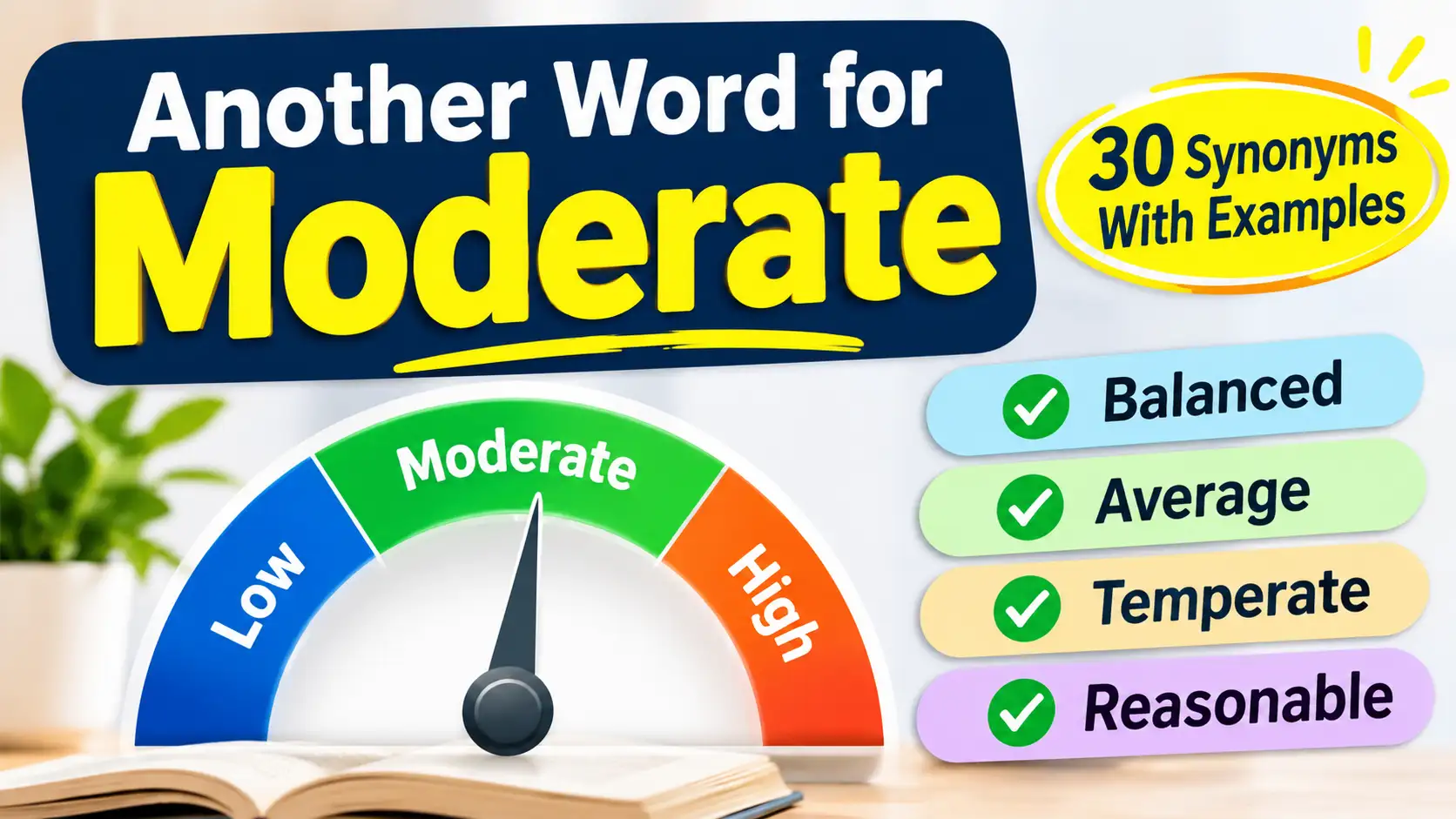
Another Word for Moderate: 30 Synonyms With Examples
The closest everyday alternatives to “moderate” are medium, average, reasonable, mild, and measured. Which one fits depends on the sense. “Moderate” can describe a middle level, a calm and controlled attitude, a political position between two sides, or a level of pain between mild and severe.
“Moderate” is also a verb. It can mean “make less extreme” (use ease, temper, or tone down) or “lead a discussion” (use chair or preside over).
Quick list: medium, average, reasonable, mild, measured, centrist, ease, temper, tone down, chair
This article looks at 30 alternatives, with meanings, IPA, usage notes, examples, and context. Some are direct synonyms. Others are related words that fit only one sense of “moderate,” and each entry says which kind it is.
At a Glance: Moderate Synonyms and Related Alternatives
| Alternative | Part of Speech | Meaning | Register / Tone | Ideal Context |
| Medium | Adjective | In the middle of a range | Neutral | Size, heat, strength, speed |
| Average | Adjective | Typical; neither high nor low | Neutral | Results, ability, cost |
| Reasonable | Adjective | Fair; not too much | Neutral | Prices, demands, requests |
| Mild | Adjective | Not strong or harsh | Neutral, gentle | Weather, taste, symptoms |
| Measured | Adjective | Careful and controlled | Neutral to formal | Tone, response, language |
| Centrist | Noun / Adjective | Holding middle political views | Neutral, political | Politics, policy |
| Ease | Verb | Make less painful or severe | Neutral | Pain, stress, pressure |
| Temper | Verb | Make less extreme by balancing | Formal | Anger, criticism, enthusiasm |
| Tone down | Phrasal verb | Make less harsh or strong | Informal to neutral | Speech, writing, colors |
| Chair | Verb / Noun | Lead a meeting | Neutral to formal | Meetings, panels, committees |
Which Word Should You Use?
| If you want to… | Use | Why |
| Describe a middle amount or level | medium | It is the plainest word for “in between.” |
| Describe a fair price or request | reasonable | It means fair and not too high or too demanding. |
| Describe a calm, controlled reply | measured | It suggests careful thought and no anger. |
| Describe a person with middle political views | centrist | It points directly to the political center. |
| Describe gentle weather or taste | mild | It means not harsh or strong. |
| Make pain or stress less intense | ease | It focuses on relief. |
| Make a speech or email less harsh | tone down | It sounds natural and informal. |
| Lead a meeting or debate | chair | It is the standard word for running a meeting. |
Exploring the Multiple Meanings of “Moderate”
1. Medium in Amount or Degree
- Meaning: Neither high nor low; of average size, strength, or level.
- Explanation: This is the most common adjective sense.
It describes measurable things, such as heat, speed, growth, or cost. It also describes weather that feels neither hot nor cold. - Example: The soup needs a moderate amount of salt.
2. Not Extreme or Excessive
- Meaning: Staying within sensible limits.
- Explanation: This sense describes behavior, habits, language, or demands. A “moderate drinker” does not drink too much, and “moderate language” avoids angry words.
- Example: She is a moderate eater who never overeats.
3. Holding Middle Views
- Meaning: Having opinions that are not extreme, especially in politics.
- Explanation: As an adjective, it describes views or policies. As a noun, it names a person who holds such views, often a position between two opposing sides.
- Example: The senator is a moderate who often works with both parties.
4. Between Mild and Severe
- Meaning: More serious than mild but less serious than severe.
- Explanation: Doctors, weather services, and other fields use “moderate” as the middle step on a scale. Here it does not mean “small” or “unimportant.”
- Example: The doctor said the injury was moderate and would need several weeks to heal.
5. To Make or Become Less Extreme
- Meaning: To reduce the strength, force, or intensity of something.
- Explanation: As a verb, “moderate” is often used with effects, demands, language, or behavior. It can also be used without an object: the wind moderated.
- Example: The coach asked the players to moderate their anger.
6. To Lead or Oversee a Discussion
- Meaning: To act as the person in charge of a debate, forum, or online space.
- Explanation: A moderator keeps a discussion fair and orderly. Online, it can also mean checking content and removing posts that break the rules.
- Example: A well known journalist will moderate the debate.
Sources: Merriam Webster; Collins Dictionary; Dictionary.com; Wiktionary
Analyzing 30 Moderate Alternatives in Detail
Some of these words are direct synonyms for one sense of “moderate,” while others are context specific related alternatives.
Group 1: Medium Degree Alternatives
1. Medium
IPA: /ˈmiːdiəm/ (US and UK)
Definition: Being in the middle between two extremes, such as large and small.
- Usage: A close, everyday synonym for the “middle amount” sense of “moderate.” It is plainer and more neutral. It does not describe behavior or political views.
- Example: Bake the cake at medium heat.
2. Average
IPA: /ˈævərɪdʒ/ (US and UK)
Definition: Typical or usual; neither especially good nor especially bad.
- Usage: A related alternative. It fits “moderate” when you mean a normal level, such as “moderate ability.” It does not work for behavior or politics.
- Example: Her test scores were average for the class.
3. Middling
IPA: /ˈmɪdlɪŋ/ (US and UK)
Definition: Of medium or only fair quality or size.
- Usage: A direct but informal synonym. It often sounds slightly unimpressed.
- Example: The restaurant got middling reviews.
4. Fair
IPA: US /fer/ · UK /feə/
Definition: Moderately good, but not excellent.
- Usage: A related alternative for the quality sense only. It does not suit mild weather or political views. It can also mean “just,” so context matters.
- Example: He is in fair health for his age.
5. Intermediate
IPA: US /ˌɪntərˈmiːdiət/ · UK /ˌɪntəˈmiːdiət/
Definition: Coming between two stages, levels, or positions.
- Usage: A related alternative. It names a position or level and does not mean “not extreme.” It is common for skill levels.
- Example: She joined an intermediate English class.
6. Modest
IPA: US /ˈmɑːdɪst/ · UK /ˈmɒdɪst/
Definition: Not large in size, amount, or value.
- Usage: A related alternative. It leans toward “small” rather than “middle,” so it is a weaker match than “medium.” It is common with income, growth, and goals.
- Example: The company reported modest growth this year.
Group 2: Reasonable and Restrained Alternatives
7. Reasonable
IPA: /ˈriːznəbl/ (US and UK)
Definition: Fair, sensible, and not too much.
- Usage: A strong synonym for “moderate” with prices, demands, and expectations. It can also describe a sensible person.
- Example: The hotel offers reasonable prices.
8. Restrained
IPA: /rɪˈstreɪnd/ (US and UK)
Definition: Kept under control; not showing strong feelings.
- Usage: A close synonym for “not extreme” behavior or style. It often describes tone, emotion, or design.
- Example: His reply was polite and restrained.
9. Measured
IPA: US /ˈmeʒərd/ · UK /ˈmeʒəd/
Definition: Done in a careful, controlled way.
- Usage: A good neutral to formal alternative for a calm response or tone. It suggests thought and self control.
- Example: She gave a measured answer to the angry question.
10. Balanced
IPA: /ˈbælənst/ (US and UK)
Definition: Fair and giving proper attention to different sides.
- Usage: A related alternative. It fits views, reports, and habits that avoid extremes. It does not mean “medium in amount.”
- Example: The article gave a balanced view of the issue.
11. Sensible
IPA: /ˈsensəbl/ (US and UK)
Definition: Showing good judgment; practical.
- Usage: A related alternative for choices, limits, and habits. It does not describe amounts or levels.
- Example: They made a sensible plan for spending.
12. Level headed
IPA: US /ˌlevəlˈhedɪd/ · UK /ˌlevl ˈhedɪd/
Definition: Calm and able to think clearly.
- Usage: A related alternative that describes people only. It matches the “not extreme” sense of a person’s character.
- Example: A level headed manager can solve problems under pressure.
Group 3: Political and Opinion Alternatives
13. Centrist
IPA: /ˈsentrɪst/ (US and UK)
Definition: A person or policy with views in the political center.
- Usage: The closest synonym for “moderate” in politics, as a noun and an adjective. It is more specific than “moderate.”
- Example: The candidate is a centrist who avoids strong party lines.
14. Middle of the road
IPA: US /ˌmɪdl əv ðə ˈroʊd/ · UK /ˌmɪdl əv ðə ˈrəʊd/
Definition: Avoiding extremes; taking a middle position.
- Usage: A direct but informal alternative. In politics it can be neutral, but about style or taste it often means “ordinary” or “unexciting.”
- Example: They chose a middle of the road plan that most people could accept.
15. Pragmatic
IPA: /præɡˈmætɪk/ (US and UK)
Definition: Focused on practical results rather than fixed ideas.
- Usage: A related alternative only. A pragmatic person is often moderate, but the word describes an approach, not a position on the political spectrum.
- Example: The mayor took a pragmatic approach to the budget.
Group 4: Mild and Weather Related Alternatives
16. Mild
IPA: /maɪld/ (US and UK)
Definition: Not strong, harsh, or severe.
- Usage: A common alternative for gentle weather, taste, or symptoms. On a medical scale, “mild” ranks below “moderate,” so the two are not interchangeable there.
- Example: We had a mild winter this year.
17. Gentle
IPA: /ˈdʒentl/ (US and UK)
Definition: Soft and not forceful.
- Usage: A related alternative for wind, heat, or touch. It is warmer in tone than “moderate” and does not suit prices or political views.
- Example: A gentle breeze came off the lake.
18. Temperate
IPA: /ˈtempərət/ (US and UK)
Definition: Not extreme in temperature or behavior.
- Usage: A direct synonym for “moderate” in weather and climate. It can also describe self control in formal writing.
- Example: The region has a temperate climate.
19. Clement
IPA: /ˈklemənt/ (US and UK)
Definition: Mild and pleasant, especially of weather.
- Usage: A formal, somewhat literary word for pleasant weather. It is not used for “moderate” in other senses.
- Example: The festival was held in clement weather.
Group 5: Verbs Meaning “Make Less Extreme”
These verbs describe ways to reduce the intensity, severity, or impact of something. They offer useful alternatives to moderate when discussing pain, emotions, behavior, risks, or difficult situations. Each word has a slightly different meaning, so choosing the right one helps make your writing clear and natural.
20. Ease
IPA: /iːz/ (US and UK)
Definition: To make something less painful, difficult, or severe.
Usage: Use “ease” when you want to describe relief from pain, stress, or pressure. It focuses on making a difficult situation more comfortable.
Example: The medicine eased his pain.
21. Temper
IPA: US /ˈtempər/ · UK /ˈtempə/
Definition: To make something less extreme by adding a balancing quality.
Usage: “Temper” is a formal alternative to “moderate.” Writers often use it with “with” to show how someone softens an opinion or reaction.
Example: She tempered her criticism with kind words.
22. Tone Down
IPA: US /ˌtoʊn ˈdaʊn/ · UK /ˌtəʊn ˈdaʊn/
Definition: To make something less harsh, strong, or noticeable.
Usage: This informal phrase works well when discussing language, colors, or behavior.
Example: Please tone down your language in the meeting.
23. Curb
IPA: US /kɜːrb/ · UK /kɜːb/
Definition: To limit or control something harmful or growing.
Usage: “Curb” suggests stronger control over negative things, such as costs or bad habits.
Example: The city wants to curb noise at night.
24. Lessen
IPA: /ˈlesn/ (US and UK)
Definition: To make or become smaller or less.
Usage: Use “lessen” when something decreases in amount, intensity, or effect.
Example: Regular exercise can lessen stress.
25. Restrain
IPA: /rɪˈstreɪn/ (US and UK)
Definition: To hold back or keep under control.
Usage: “Restrain” suggests actively controlling feelings or actions.
Example: He tried to restrain his anger.
26. Mitigate
IPA: /ˈmɪtɪɡeɪt/ (US and UK)
Definition: To make something less harmful or severe.
Usage: This formal verb is common in professional writing about risks, damage, and negative effects.
Example: Trees can help mitigate the effects of heat in cities.
Group 6: Verbs Meaning “Lead or Oversee”
27. Chair
IPA: US /tʃer/ · UK /tʃeə/
Definition: To lead a meeting or committee.
- Usage: The most common alternative for the verb “moderate” in the meeting sense. It suggests formal leadership of a group.
- Example: She will chair the meeting on Friday.
28. Preside over
IPA: US /prɪˈzaɪd ˈoʊvər/ · UK /prɪˈzaɪd ˈəʊvə/
Definition: To be in charge of a meeting or formal event.
- Usage: A formal alternative. It fits courts, councils, and ceremonies better than casual panels.
- Example: The judge presided over the hearing.
29. Mediate
IPA: /ˈmiːdieɪt/ (US and UK)
Definition: To help two sides reach an agreement.
- Usage: A related alternative only. A moderator keeps a discussion orderly, while a mediator tries to settle a disagreement. They are not the same job.
- Example: A neutral person mediated the dispute.
30. Supervise
IPA: /ˈsuːpərvaɪz/ (US and UK)
Definition: To watch over and direct people or activities.
- Usage: A related alternative. People use “supervise” to oversee online content or manage a group, but it has a broader meaning than “moderate” and does not mean leading a debate.
- Example: Teachers supervise students during lunch.
Sources: Merriam Webster; Collins Dictionary; Dictionary.com; Wiktionary
Moderate vs. Mild vs. Medium
These three words are often confused because each describes something that is not at either end of a scale.
| Word | Core Idea | Typical Use | Example |
| Mild | Low in strength; gentle | Weather, flavor, early symptoms | A mild cold |
| Moderate | Middle in strength; not extreme | Pain, risk, exercise, views | Moderate pain |
| Medium | Middle in size or amount | Sizes, heat levels, rankings | A medium shirt |
On a three-step scale, people usually rank the terms as mild, moderate, and severe. Among the three, “moderate” also commonly describes behavior, as in “a moderate approach,” and political views.
Sources: Merriam Webster; Collins Dictionary; Dictionary.com
Moderate and Opposite/Paired Word Pairs
| Word | Paired Word | Note |
| Moderate (adj.) | Extreme | The most natural opposite for amount, behavior, and views. |
| Moderate (adj.) | Excessive | Fits behavior, spending, and demands. |
| Moderate (adj.) | Immoderate | A formal opposite meaning “lacking restraint.” |
| Moderate (adj.) | Radical | The usual contrast in politics. |
| Moderate (adj.) | Severe | The next level up on a medical or weather scale. |
| Moderate (adj.) | Mild | The next level down on that scale. |
| Moderate (v.) | Intensify | Means to make stronger, the reverse of reducing intensity. |
| Moderate (v.) | Escalate | Fits conflict, anger, or costs that grow. |
Not every pair is a true opposite. “Mild” and “severe” sit on either side of “moderate” on a scale, so they are better described as neighbors than opposites. The verb “moderate” in the sense of leading a discussion has no natural opposite.
Sources: Merriam Webster; Collins Dictionary; Dictionary.com
Common Word Partners of “Moderate”
| Pattern | Common Partners | Example |
| moderate + noun (amount or level) | moderate exercise, moderate growth, moderate risk, moderate temperatures | Moderate exercise can improve sleep. |
| moderate + noun (price or income) | moderate prices, moderate income | The area has homes at moderate prices. |
| moderate + noun (person or view) | moderate voter, moderate view, moderate Republican | Moderate voters could decide the election. |
| moderate to + adjective | moderate to severe, moderate to heavy, moderate to high | The patient had moderate to severe pain. |
| moderately + adjective | moderately successful, moderately priced, moderately difficult | The test was moderately difficult. |
| moderate + object (verb) | moderate a debate, moderate comments, moderate the impact | The site will moderate comments before they appear. |
Sources: Merriam Webster; Collins Dictionary; Dictionary.com
- Meaning: Speak in a calmer, less angry way.
- Example: I asked him to moderate his tone with the customers.
3. Moderate a discussion (or debate)
- Meaning: Lead a discussion and keep it fair and orderly.
- Example: She was asked to moderate the panel on climate policy.
4. In moderation
- Meaning: In a limited, sensible amount. This phrase uses the noun “moderation,” not “moderate.”
- Example: Sweets are fine in moderation.
Sources: Merriam Webster; Collins Dictionary; Dictionary.com
Word Formation of “Moderate”
Etymology & Structure
“Moderate” comes from Latin moderatus, the past participle of moderari, meaning “to regulate or restrain.” The Latin verb is related to modus, meaning “measure.” The English word ends in ate, a suffix common in words taken from Latin participles.
Date and History
Etymonline dates the adjective to around 1400. Etymology references note that English later turned the participle into a verb in the 15th century. Etymonline dates the noun sense, a person with moderate opinions, to 1794, citing Edmund Burke.
Word Class Variations
- Adjective: moderate (US /ˈmɑːdərət/, UK /ˈmɒdərət/)
- Noun: moderate (a person with middle views)
- Verb: moderate (ends in the sound of “mate”)
- Adverb: moderately
- Related derivatives: moderation, moderator, moderateness, immoderate, moderatism
Sources: Etymonline; Dictionary.com; Wiktionary
Common Word Choice Mistakes
- A moderate shirt size: use “medium” for sizes, as in “a medium shirt.”
- Mild pain means the same as moderate pain: “moderate” ranks higher than “mild.”
- He mediated the debate: use “moderated” for leading a discussion. “Mediate” means helping two sides reach an agreement.
- A moderate income when you mean a small one: use “modest,” which leans toward “small.”
- She is moderate in the middle: say “She holds moderate views.” “Moderate” already means the middle.
- The tea moderated my headache: use “eased” or “relieved.” The verb “moderate” sounds stiff with pain.
- Moderately cold means very cold: “moderately” means to a medium degree.
Frequently Asked Questions
What is the closest synonym for “moderate”?
It depends on the sense. Use for a middle amount, use “medium.” For fair and not too much, use “reasonable.” For politics, use “centrist.”
What is a formal alternative to “moderate”?
“Measured” works for a careful tone, “temperate” for behavior or climate, and “mitigate” for reducing harm. “Preside over” fits formal meetings.
What is the difference between “moderate” and “mild”?
“Mild” means gentle or low in strength. “Moderate” means a middle level. On a scale, “mild” ranks below “moderate.”
What is the difference between “moderate” and “medium”?
“Medium” is plainer and usually describes size or amount. “Moderate” can also describe behavior, views, and a middle level on a scale.
Can “moderate” be used for people?
Yes. A person can be moderate in habits (“a moderate drinker”) or in political views (“a moderate voter”). As a noun, it names a person who holds such views.
Is “moderate” the same as “average”?
Not always. “Average” means typical, while “moderate” often means not too strong, not too weak, and not extreme. They overlap in phrases like “moderate ability.”
What is the opposite of “moderate”?
The main opposites are “extreme” and “excessive.” In politics, “radical” is common. The formal opposite is “immoderate.”
What is the nearest alternative to the verb “moderate”?
For reducing intensity, use “ease,” “temper,” or “tone down.” For leading a discussion, use “chair.”
Can “moderate” mean “lead a meeting”?
Yes. A moderator leads a discussion or debate and keeps it orderly. “Chair” is the closest everyday alternative.
Is “moderate” pronounced the same as a noun and a verb?
No. The adjective and noun end in a short “uht” sound. The verb ends with a long “ayt” sound, like “mate.”
Conclusion
The closest everyday alternatives to “moderate” are “medium,” “reasonable,” “mild,” “measured,” and “centrist.” For the verb, “ease,” “temper,” and “tone down” describe reducing something, while “chair” means leading a discussion.
Context matters because “moderate” has several senses. A moderate price, a moderate politician, moderate pain, and a moderate speech each need a different word. Words like “mild,” “modest,” and “mediate” look similar but change the meaning.
To choose the right alternative, first decide which sense you mean: a middle amount, a calm attitude, a political position, a level on a scale, a reduction, or leadership of a discussion. Then pick the word that fits that sense and the level of formality.

Noman is the founder and author of Factwy.com, where he shares informative, useful, and easy-to-understand content. With a passion for research and writing, he creates articles that simplify complex topics and provide valuable insights. His goal is to deliver clear, accurate, and reader-friendly information that helps visitors learn something new every day.