Another Word for However: 30 Synonyms With Examples
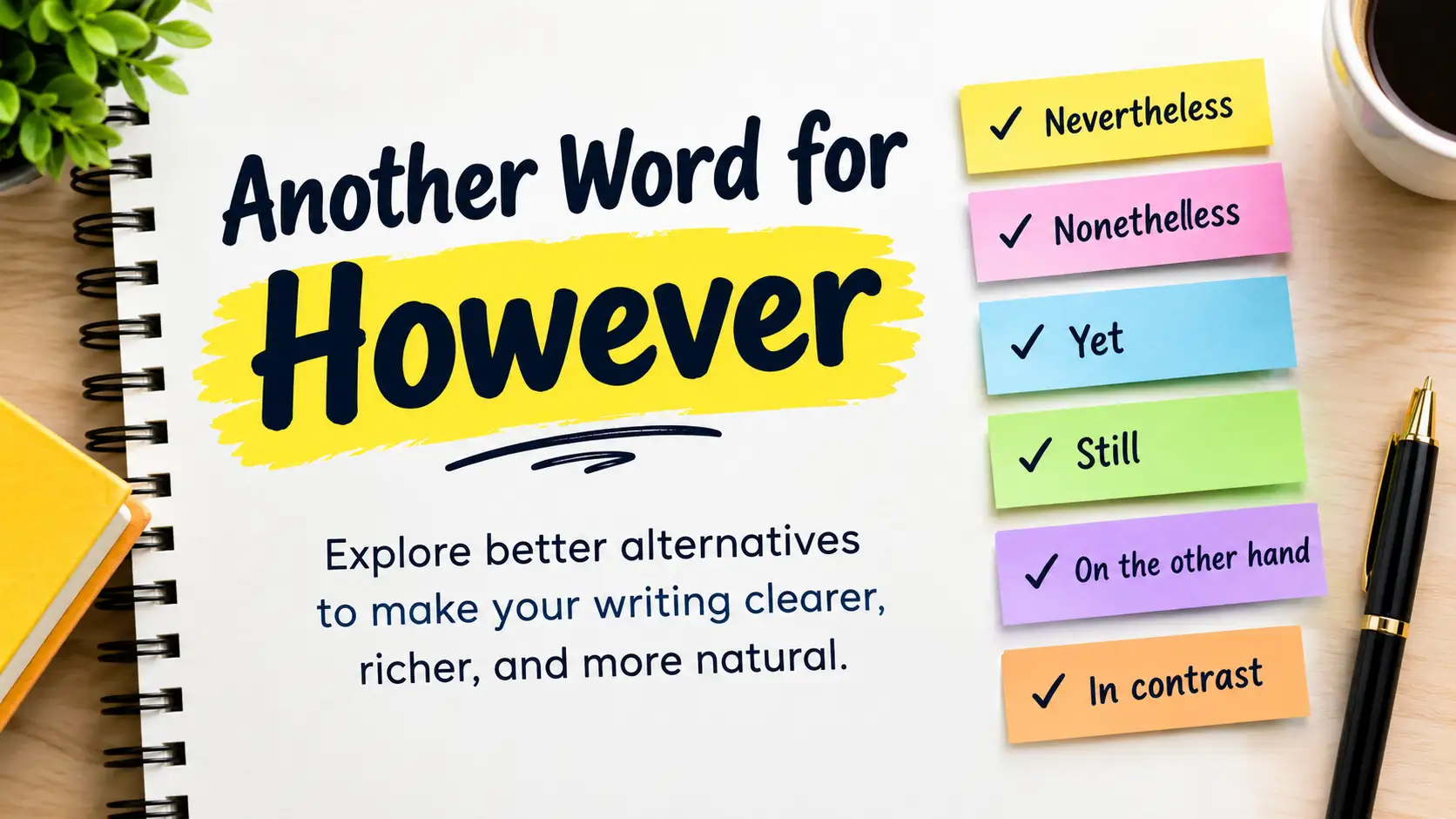
The closest everyday alternatives to “however” are but, yet, still, and though. They all show contrast. In more formal writing, nevertheless and nonetheless are the nearest matches. Each means “in spite of that.”
The best choice depends on how you use “however.” Most often it shows contrast between two ideas. It can also mean “in whatever way” or “no matter how,” as in “however you do it” or “however hard she tried.” Some alternatives fit only one of these meanings, and some change how the sentence is built or punctuated.
Quick list: but, yet, still, though, nevertheless, nonetheless, even so, that said, on the other hand, although.
This article looks at 30 alternatives to “however,” each with its meaning, IPA, usage note, and example. It also covers punctuation, word pairs, common partners, expressions, word history, and frequent mistakes.
At a Glance: However Synonyms and Related Alternatives
| Alternative | Part of Speech | Meaning | Register / Tone | Ideal Context |
| But | conjunction | Shows contrast | Neutral, very common | Speech, everyday writing |
| Yet | adverb / conjunction | In spite of that | Neutral | Writing and speech |
| Still | adverb | Even so | Neutral | Speech, informal writing |
| Though | adverb / conjunction | Despite that | Neutral, casual | Often at the end of a sentence |
| Nevertheless | adverb | In spite of that | Formal | Essays, reports |
| Nonetheless | adverb | In spite of that | Formal | Essays, reports |
| Even so | adverb phrase | Despite that fact | Neutral | Speech and writing |
| That said | phrase | Introduces a contrasting point | Conversational to neutral | Discussion, opinion |
| On the other hand | phrase | Presents the opposite side | Neutral | Comparing options |
| No matter how | phrase | To any degree or in any way | Neutral | “However hard” sentences |
Which Word Should You Use?
| If you want to… | Use | Why |
| Show a simple contrast in everyday speech | but | It is short, natural, and common. |
| Sound formal in an essay or report | nevertheless or nonetheless | Both are standard formal alternatives to “however.” |
| Join two contrasting ideas in one sentence | although or though | They keep the contrast inside a single sentence. |
| Compare two sides of a choice | on the other hand | It signals that you are weighing options. |
| Admit a point, then disagree | granted or that said | Both accept a fact before adding a different view. |
| Add a casual afterthought | then again or mind you | They sound natural in conversation. |
| Replace “however” meaning “no matter how” | no matter how | “However” and “no matter how” both introduce a degree or manner. |
| Write in a legal or very formal style | notwithstanding | It is typical of formal and legal writing. |
Exploring the Multiple Meanings of “However”
1. Contrast: “Nevertheless”
- Meaning: In spite of that; used to introduce a contrasting statement.
- Explanation: This is the most common use. “However” connects two ideas, and the second one is surprising or different from the first. It can open a sentence, sit in the middle, or come at the end, with commas around it.
- Example: The test was hard. However, most students passed.
2. In Whatever Way or Manner
- Meaning: In whatever way; by any method.
- Explanation: Here “however” works as a conjunction. It does not show contrast. It says the way something is done does not matter.
- Example: You can decorate the room however you like.
3. To Whatever Degree
- Meaning: No matter how; to whatever extent.
- Explanation: In this sense “however” comes before an adjective or adverb, such as “however hard” or “however small.” It stresses that something stays true even at an extreme level.
- Example: However hard she tried, the door would not open.
4. Surprised Question: “How Ever”
- Meaning: In what way; how (used to show surprise).
- Explanation: This sense is an intensive form of “how” in questions. Dictionaries often write it as two words, “however.” It is conversational and a little old fashioned.
- Example: However did you manage to fix it so quickly?
Sources: Merriam Webster; Collins English Dictionary; Cambridge Dictionary.
Analyzing 30 However Alternatives in Detail
Some of the alternatives below are close synonyms of “however.” Others fit only one sense or sentence pattern, and each usage note says which is which.
Group 1: Everyday Contrast Words
1. But
IPA: (US and UK) /bʌt/
Definition: Used to introduce an idea that contrasts with what was just said.
- Usage: The closest everyday alternative. Unlike “however,” it is a conjunction that joins two clauses, so it needs no semicolon. It is less formal.
- Example: I wanted to go, but I was too tired.
2. Yet
IPA: (US and UK) /jɛt/
Definition: In spite of that; nevertheless.
- Usage: A close synonym when used as a conjunction or sentence adverb. It adds a slightly stronger sense of surprise than “but.” It also has time meanings that do not match “however.”
- Example: The room was small, yet it felt comfortable.
3. Still
IPA: (US and UK) /stɪl/
Definition: Despite that; even so.
- Usage: A close synonym in speech and informal writing. It often follows a fact or concession. It also means “up to now,” which is a different sense.
- Example: It rained all day. Still, we had a great time.
4. Though
IPA: US /ðoʊ/ · UK /ðəʊ/
Definition: Despite that (as an adverb); in spite of the fact that (as a conjunction).
- Usage: A close synonym. As an adverb it usually comes at the end of a sentence, which is where “however” can also go but sounds more formal. It is casual.
- Example: The food was cheap. It wasn’t very good, though.
5. Even so
IPA: US /ˌiːvən ˈsoʊ/ · UK /ˌiːvən ˈsəʊ/
Definition: In spite of that fact.
- Usage: A close synonym. It begins a new sentence and works in both speech and writing.
- Example: I studied for weeks. Even so, I failed the exam.
6. All the same
IPA: US /ˌɔl ðə ˈseɪm/ · UK /ˌɔːl ðə ˈseɪm/
Definition: In spite of that; nevertheless.
- Usage: A close synonym with a friendly, spoken tone. It often follows a concession.
- Example: You may be right. All the same, I’d like to check.
7. That said
IPA: US /ˌðæt ˈsɛd/ · UK /ˌðæt ˈsed/
Definition: Used to introduce a point that contrasts with the one just made.
- Usage: A conversational alternative to “however.” It softens the shift in the discussion. It is a set phrase, not a single word.
- Example: The book is long. That said, it is easy to read.
Group 2: Formal Alternatives
8. Nevertheless
IPA: US /ˌnɛvərðəˈlɛs/ · UK /ˌnevəðəˈles/
Definition: In spite of what has just been said.
- Usage: A close, formal synonym. It fits essays, reports, and speeches. It can start a sentence or sit in the middle.
- Example: The plan was risky. Nevertheless, the board approved it.
9. Nonetheless
IPA: US /ˌnʌnðəˈlɛs/ · UK /ˌnʌnðəˈles/
Definition: In spite of that; nevertheless.
- Usage: A close, formal synonym. It is almost identical to “nevertheless.” Many writers choose between them only by sound.
- Example: The results were small but nonetheless important.
10. Notwithstanding
IPA: US /ˌnɑtwɪθˈstændɪŋ/ · UK /ˌnɒtwɪðˈstændɪŋ/
Definition: In spite of; nevertheless.
- Usage: A very formal word, common in legal and official writing. As an adverb it can replace “however.” As a preposition it comes before a noun, so it changes the sentence pattern.
- Example: The rule remains in force, notwithstanding the recent complaints.
11. Be that as it may
IPA: US /bi ðæt æz ɪt ˈmeɪ/ · UK /biː ðæt æz ɪt ˈmeɪ/
Definition: Used to accept a point but move on to a different one.
- Usage: A formal set phrase. It is related to “however,” but it carries a firmer sense of “I accept that, but it does not change my point.”
- Example: Be that as it may, we still need to finish the report today.
12. Regardless
IPA: US /rɪˈɡɑrdləs/ · UK /rɪˈɡɑːdləs/
Definition: Without being affected by what has been said or done; anyway.
- Usage: A related alternative. It suggests something continues despite an obstacle, so it is stronger than the simple contrast in “however.”
- Example: The weather was bad, but we went regardless.
Group 3: Alternatives That Compare Two Sides
13. On the other hand
IPA: US /ɑn ðə ˈʌðər hænd/ · UK /ɒn ðə ˈʌðə hænd/
Definition: Used to present a different point of view or an opposite fact.
- Usage: A related alternative. It fits comparisons of two options or views more than a surprise or exception.
- Example: The apartment is cheap. On the other hand, it is far from the city.
14. In contrast
IPA: US /ɪn ˈkɑntræst/ · UK /ɪn ˈkɒntrɑːst/
Definition: Showing a clear difference between two things.
- Usage: A related alternative. It compares two separate subjects, as in two groups or two years, rather than reversing one idea.
- Example: Sales rose in March. In contrast, they fell in April.
15. Conversely
IPA: US /kənˈvɜrsli/ · UK /ˈkɒnvɜːsli/
Definition: In a way that is the opposite or reverse.
- Usage: A related, formal alternative. It presents the mirror image of the previous point, not just a contrast.
- Example: High prices reduce demand. Conversely, low prices often raise it.
16. Then again
IPA: US /ðɛn əˈɡɛn/ · UK /ðen əˈɡen/
Definition: Used to add a point that makes you reconsider.
- Usage: A related, informal alternative. It sounds like thinking aloud, so it suits speech more than formal writing.
- Example: I might buy it. Then again, I don’t really need it.
17. Whereas
IPA: US /wɛrˈæz/ · UK /weərˈæz/
Definition: Used to compare two facts or ideas that are different.
- Usage: A related alternative. It joins two contrasting facts in one sentence, so it does not work as a separate sentence opener like “however.”
- Example: My brother loves loud music, whereas I prefer quiet.
Group 4: Conversational Alternatives
18. Anyway
IPA: US /ˈɛniˌweɪ/ · UK /ˈeniweɪ/
Definition: In spite of that; in any case.
- Usage: A related, informal alternative. It can mean “despite that,” and it can also change the subject in conversation, which “however” does not do.
- Example: It was a long way, but we went anyway.
19. Anyhow
IPA: US /ˈɛniˌhaʊ/ · UK /ˈenihaʊ/
Definition: In any case; in spite of that.
- Usage: A related, informal alternative. It is similar to “anyway” and sounds slightly more casual.
- Example: I wasn’t sure about it, but I tried anyway.
20. Mind you
IPA: US /ˈmaɪnd ju/ · UK /ˈmaɪnd juː/
Definition: Used to add a fact that qualifies what you just said.
- Usage: A related, informal phrase, especially common in British English. It adds a note that limits the earlier statement.
- Example: The hotel was noisy. Mind you, it was very cheap.
21. At the same time
IPA: (US and UK) /æt ðə ˈseɪm ˈtaɪm/
Definition: Used to add a balancing point to what has been said.
- Usage: A related alternative. It adds a second idea that must also be considered, so the contrast is gentler than in “however.”
- Example: She wants more freedom. At the same time, she is afraid to leave home.
22. Granted
IPA: US /ˈɡræntɪd/ · UK /ˈɡrɑːntɪd/
Definition: Used to admit that something is true before giving a different view.
- Usage: A related alternative. It usually comes first and is followed by a contrasting point.
- Example: Granted, the price is high, but the quality is excellent.
Group 5: Conjunction Style Alternatives
23. Although
IPA: US /ɔlˈðoʊ/ · UK /ɔːlˈðəʊ/
Definition: In spite of the fact that.
- Usage: A related alternative. It joins two clauses in one sentence, so you must rebuild the sentence. It cannot be used by itself like “however.”
- Example: Although it was late, we kept working.
24. Even though
IPA: US /ˌivən ˈðoʊ/ · UK /ˌiːvən ˈðəʊ/
Definition: In spite of the fact that (a stronger form of “although”).
- Usage: A related alternative. It stresses that the fact is true and surprising.
- Example: Even though he was tired, he finished the race.
25. Albeit
IPA: US /ɔlˈbiɪt/ · UK /ɔːlˈbiːɪt/
Definition: Although; even though (usually followed by a word or phrase, not a full clause).
- Usage: A related, formal word. It adds a limiting detail inside a sentence.
- Example: She finished the course, albeit slowly.
26. Despite this
IPA: (US and UK) /dɪˈspaɪt ðɪs/
Definition: Without being stopped or changed by what was just mentioned.
- Usage: A related alternative. “Despite” is a preposition, so it needs “this,” “that,” or a noun after it. It fits written English.
- Example: The team lost two players. Despite this, they won.
Group 6: Alternatives for “However” Meaning “No Matter How”
27. No matter how
IPA: US /noʊ ˈmætər haʊ/ · UK /nəʊ ˈmætə haʊ/
Definition: To any degree; regardless of how much.
- Usage: A close match for “however” in the “to whatever degree” sense. It is natural in speech and writing.
- Example: No matter how hard he tried, he could not remember her name.
28. In whatever way
IPA: US /ɪn wʌtˈɛvər weɪ/ · UK /ɪn wɒtˈevə weɪ/
Definition: By any method or in any manner.
- Usage: A close match for the “manner” sense. It is slightly longer and more formal than “however.”
- Example: Please solve the problem in whatever way works best.
29. Regardless of how
IPA: US /rɪˈɡɑrdləs əv haʊ/ · UK /rɪˈɡɑːdləs əv haʊ/
Definition: Without being affected by the way or degree.
- Usage: A related alternative for both the manner and degree senses. It is slightly formal.
- Example: Regardless of how you look at it, the plan has risks.
30. Whichever way
IPA: US /wɪtʃˈɛvər weɪ/ · UK /wɪtʃˈevə weɪ/
Definition: In any of the possible ways.
- Usage: A related alternative. It fits when there are a few known options, while “however” covers any possible way. It is common in speech.
- Example: Whichever way you choose, the result will be the same.
Sources: Merriam Webster; Collins English Dictionary; Dictionary.com; Cambridge Dictionary; Oxford Learner’s Dictionaries.
However vs. But vs. Although: Grammar and Punctuation
The main problem with “however” is not meaning but punctuation. “However” is an adverb, not a joining word like “but.” That changes how you write the sentence.
| Word | Type | How to punctuate | Example |
| however | adverb | Period or semicolon before; comma after | I was tired. However, I kept going. / I was tired; however, I kept going. |
| but | coordinating conjunction | Comma before when joining two full clauses | I was tired, but I kept going. |
| although | subordinating conjunction | Comma when the clause comes first | Although I was tired, I kept going. |
| though | adverb or conjunction | Comma before it at the end of a sentence | I was tired. I kept going, though. |
Using only a comma to join two full sentences with “however” is a mistake called a comma splice. “I was tired, however I kept going” is incorrect. Use a period or semicolon before “however,” and a comma after it. When “however” sits in the middle of a clause, put commas on both sides: “The plan, however, was never approved.”
Sources: Merriam Webster; Collins English Dictionary; Purdue Online Writing Lab (Purdue OWL).
However and Opposite/Paired Word Pairs
| Word | Paired Word | Note |
| however | therefore | Contrast versus result: “It was cold; therefore, we stayed in.” |
| however | moreover | Contrast versus addition: moreover adds a supporting point. |
| however | similarly | Shows difference versus likeness. |
| however | likewise | Used when the idea is the same, not the opposite. |
| however | whatever | Both belong to the ” ever” family and mean “no matter” in some uses. |
| however | whenever | Same family: “whenever” means “at any time that.” |
| however | wherever | Same family: “wherever” means “in any place that.” |
“However” does not have a true single opposite, because it is a connecting word. The closest pairs are words that link ideas in the opposite direction: “therefore” (result), “moreover” (addition), and “similarly” or “likewise” (likeness). In its “no matter how” sense, “however” also belongs to a family of words that end in ” ever,” such as “whatever,” “whenever,” and “wherever.”
Sources: Merriam Webster; Collins English Dictionary; Cambridge Dictionary.
Common Word Partners of “However”
| Pattern | Common Partners | Example |
| However, + clause | However, there is … / However, it is … | However, there is one problem. |
| ; however, | after a semicolon | The offer was good; however, we declined. |
| noun, however, verb | mid sentence with commas | The weather, however, improved later. |
| however + adjective | hard, small, long, difficult, much | However small the gift, she was thankful. |
| however + many/much | many, much | However much you earn, you can still save. |
| however + you/they + verb | like, want, choose, look at it | However you look at it, the result is the same. |
| however long | it takes, the delay | We will wait however long it takes. |
Sources: Oxford Collocations Dictionary; Collins English Dictionary; Merriam Webster.
Idiomatic Phrases Featuring “However”
“However” has no true idioms of its own. The expressions below are established fixed phrases, not idioms. They are common and have steady meanings.
1. However you look at it
- Meaning: From any point of view; no matter how you think about it.
- Example: However you look at it, the plan is expensive.
2. However that may be
- Meaning: Whatever the truth of that is; used to move on to a different point. It is formal and a little old fashioned.
- Example: However that may be, we must decide today.
3. However long it takes
- Meaning: No matter how much time is needed.
- Example: I will finish the course, however long it takes.
4. However you like
- Meaning: In whatever way you prefer.
- Example: Cook the eggs however you like.
Sources: Merriam Webster; Collins English Dictionary; Cambridge Dictionary.
Word Formation of “However”
Etymology & Structure
“However” is a compound of two words: how and ever. “Ever” adds the meaning “in any case” or “at any time,” which is why “however” can mean “in whatever way.” Other words follow the same pattern: whatever, whenever, wherever, whoever, and whichever.
Date and History
Merriam Webster places the first known use of “however” in the 14th century. It started in the sense of “in whatever manner” and later developed the use of “nevertheless,” which is now the most common.
Word Class Variations
- Adverb: however (contrast, “to whatever degree,” or “in what way” in questions)
- Conjunction: however (in the sense “in whatever manner”)
- Related words: how, ever, whatever, whenever, wherever, whoever, whichever
Sources: Etymonline; Merriam Webster; Oxford English Dictionary.
Common Word Choice Mistakes
- I wanted to go, however I was tired: I wanted to go; however, I was tired. (Or: I wanted to go. However, I was tired.)
- However, it was late: But it was late. / However, it was late. (Use one, not both.)
- Although it was late, we kept working: Although it was late, we kept working.
- Even though it rains tomorrow, we will go: Even if it rains tomorrow, we will go. (“Even if” is for something that may happen.)
- Despite the rain: Despite the rain. / In spite of the rain.
- On the other hand: On the other hand.
- However hard he tries, but he fails: However hard he tries, he fails.
Frequently Asked Questions
1. What is the closest synonym for “however”?
“Nevertheless” and “nonetheless” are the closest formal matches. In everyday speech, “but,” “yet,” and “still” are the most common.
2. Can I start a sentence with “however”?
Yes. It is standard when “however” means “nevertheless.” Put a comma after it.
3. How do I punctuate “however” in the middle of a sentence?
If it joins two full clauses, use a semicolon before it and a comma after it. If it interrupts one clause, put commas on both sides.
4. What is the difference between “however” and “but”?
“But” is a conjunction that joins two clauses in one sentence. “However” is an adverb that is more formal and can move around within a sentence.
5. Is “nevertheless” the same as “nonetheless”?
They have almost the same meaning and use. The choice usually comes down to sound and style.
6. Can “however” go at the end of a sentence?
Yes, with a comma before it, as in “I couldn’t go, however.” This is less common than at the start, and “though” is more natural for this position in speech.
7. What is the difference between “however” and “although”?
“Although” joins two clauses and cannot stand alone as a sentence opener. “However” connects two separate sentences or sits inside one with commas.
8. What can I say instead of “however” in an essay?
Use “nevertheless,” “nonetheless,” “on the other hand,” “in contrast,” or “conversely.” The right choice depends on whether you are showing contrast, comparison, or a reversal.
9. What does “however you like” mean?
It means “in whatever way you prefer.” Here “however” is not about contrast. It is a conjunction of manners.
10. Is “however” the opposite of “therefore”?
Not exactly, but they point in different directions. “However” signals contrast, while “therefore” signals a result.
Conclusion
The most common alternatives to “however” are but, yet, still, and though in everyday writing, and nevertheless and nonetheless in formal writing. Phrases such as on the other hand and that said also work well when you need to compare or soften a point.
The alternatives are not always interchangeable. Some, like although and whereas, change the sentence pattern. Others, like conversely and in contrast, show comparison rather than a simple turn. For the “no matter how” sense, only phrases such as no matter how and in whatever way work.
To choose the right word, first decide what “however” is doing: showing contrast, comparing two sides, or meaning “no matter how.” Then pick a word that fits your tone and sentence structure, from casual but to formal nevertheless.

Noman is the founder and author of Factwy.com, where he shares informative, useful, and easy-to-understand content. With a passion for research and writing, he creates articles that simplify complex topics and provide valuable insights. His goal is to deliver clear, accurate, and reader-friendly information that helps visitors learn something new every day.