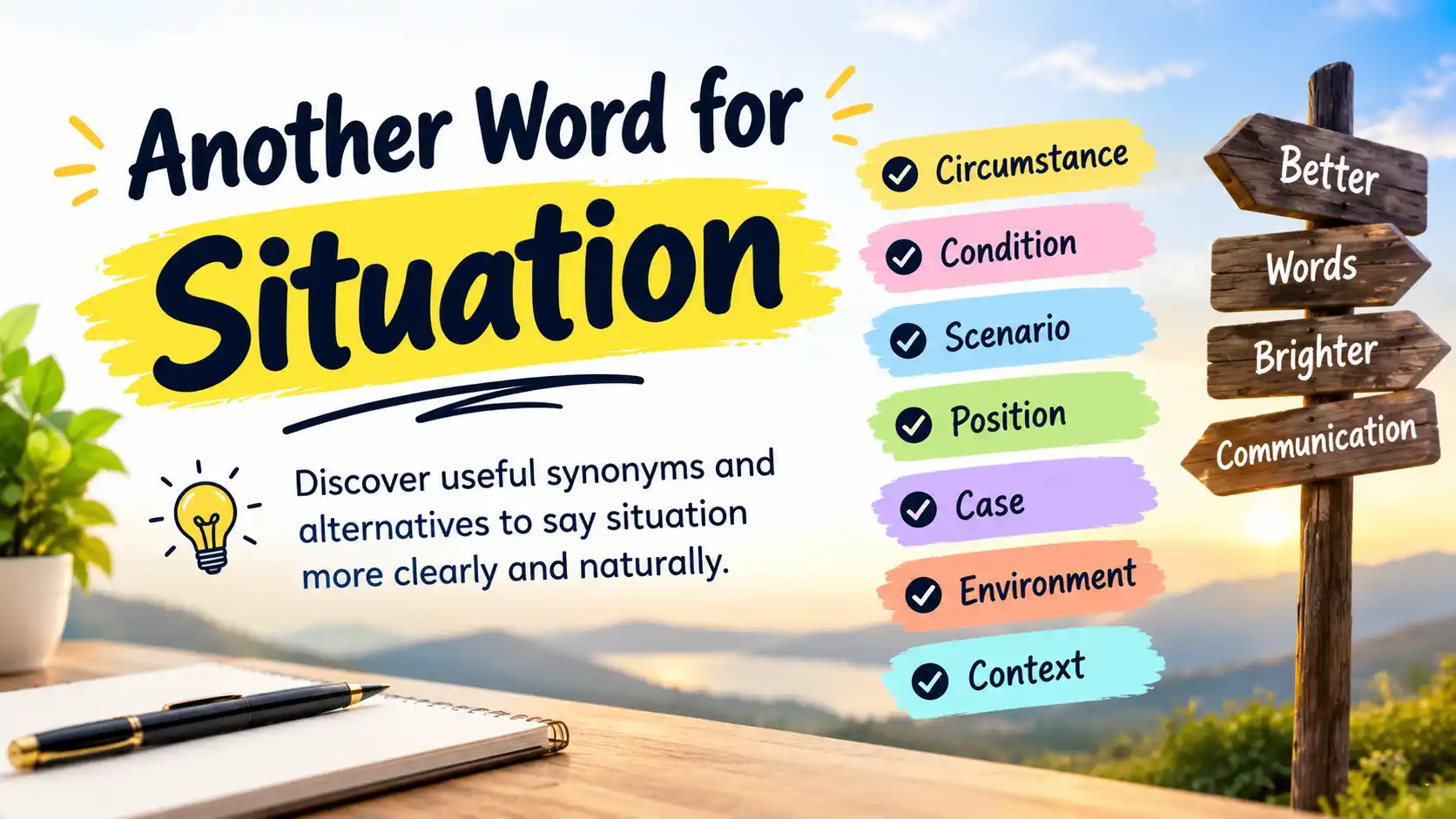
Another Word for Situation: 30 Synonyms With Examples
Another word for situation is most often circumstances, position, state of affairs, or scenario. For a problem, you can say predicament, plight, or fix. The best choice depends on whether you mean the facts at a given time, the background of an event, a difficulty, a place, or an imagined case.
“Situation” covers several areas of meaning. It can describe how things stand (“the economic situation”), a tricky problem (“we have a situation”), a setting (“the situation of the house”), or a job (an older sense). Each area has its own better word.
Quick list: circumstances, position, state of affairs, scenario, context, predicament, condition, case, status, setting
This article looks at 30 alternatives, with meanings, IPA, usage notes, examples, and context, so you can choose the word that fits.
At a Glance: Situation Synonyms and Related Alternatives
| Alternative | Part of Speech | Meaning | Register / Tone | Ideal Context |
| Circumstances | noun (plural) | The facts and conditions around an event or person | Neutral to formal | Explaining why something happened or what limits a choice |
| Position | noun | The state someone is in relative to others or to events | Neutral | Personal or business choices (“in a strong position”) |
| State of affairs | noun phrase | The general way things are at a time | Neutral to formal | Describing a broad, current condition |
| Scenario | noun | An imagined or possible sequence of events | Neutral | Planning, risk talk, “what if” cases |
| Context | noun | The surrounding facts that give something meaning | Neutral to formal | Explaining words, actions, or events |
| Predicament | noun | A difficult situation that is hard to escape | Neutral to formal | Awkward or troubling problems |
| Condition | noun | The state of a person, thing, or system | Neutral | Health, repair, and general state |
| Case | noun | A particular instance or set of facts | Neutral | Specific examples, legal or professional talk |
| Fix | noun | A difficult situation (informal) | Informal | Spoken English about trouble |
| Setting | noun | The place and conditions where something happens | Neutral | Stories, workplaces, events |
Which Word Should You Use?
| If you want to… | Use | Why |
| Describe the facts around an event | circumstances | It stresses the conditions that shaped what happened. |
| Describe how things stand overall | state of affairs | It sounds broad and slightly formal. |
| Talk about a hard problem | predicament | It suggests a tricky situation with no easy way out. |
| Talk about a “what if” case | scenario | It means an imagined sequence of events. |
| Explain the background of a statement | context | It points to the surrounding facts, not the event itself. |
| Describe someone’s standing in a choice | position | It shows where a person stands in relation to others or to events. |
| Sound casual about trouble | fix, jam, pickle | These are informal words for difficulty. |
| Talk about the place where something is | location | It is more natural than “situation” for places today. |
Exploring the Multiple Meanings of “Situation”
1. The Circumstances at a Given Time
- Meaning: The combination of facts and conditions that exist at a particular moment.
- Explanation: This is the most common sense. It refers to how things stand, such as the weather, money, politics, or relationships, rather than to one event.
- Example: The economic situation has improved since last year.
2. A Difficult or Unusual Problem
- Meaning: A critical, awkward, or troubling state of affairs.
- Explanation: In speech, “situation” can mean a problem without naming it. “We have a situation” suggests something serious or unusual that needs attention.
- Example: There’s a situation in the kitchen, so please come quickly.
3. Location or Site
- Meaning: The place where something is located.
- Explanation: This sense is older and now rare in everyday English. It still appears in descriptions of buildings and land. Most people now say “location.”
- Example: The house enjoys a quiet situation near the river.
4. A Job or Paid Position
- Meaning: A post of employment.
- Explanation: This sense is dated. You may see it in older texts or in the phrase “situations vacant,” meaning job openings. Modern English prefers “job” or “position.”
- Example: She found a situation as a teacher in a country school.
5. A Dramatic or Story Situation
- Meaning: The set of circumstances that drives the plot of a story, play, or comedy.
- Explanation: In writing and drama, the situation is the setup the characters face. This is why “situation comedy” (sitcom) has that name.
- Example: The story’s central situation is two strangers stuck in a lift.
Sources: Merriam Webster; Collins English Dictionary; Dictionary.com
Analyzing 30 Situation Alternatives in Detail
Some of these words are close synonyms of “situation,” while others fit only one sense or context, and the Usage notes say which is which.
1. Common Synonyms for Situation
If you need another word for situation, these common synonyms can help you choose the right word for different contexts.
1. Circumstances
IPA: US /ˈsɜːrkəmˌstænsɪz/ · UK /ˈsɜːkəmstənsɪz/
Definition: The facts, events, or conditions that affect a person, event, or action.
- Usage: Circumstances is a close synonym for situation. Use it when you mean the conditions surrounding an event. It is usually plural and sounds slightly more formal than situation.
- Example: Given the circumstances, we made the best choice we could.
2. Case
IPA: US and UK /keɪs/
Definition: A particular example, instance, or set of facts related to a matter.
- Usage: Case is related to situation, but it is not an exact synonym. Use it when referring to a specific instance or matter, especially in phrases such as in this case.
- Example: In this case, the delay was caused by bad weather.
3. State of Affairs
IPA: US /ˌsteɪt əv əˈfɛrz/ · UK /ˌsteɪt əv əˈfeəz/
Definition: The general condition of things at a particular time.
- Usage: State of affairs is a close alternative to situation. It works well when describing the overall condition of a matter. It is common in formal, news, and opinion writing.
- Example: This state of affairs cannot continue much longer.
4. Condition
IPA: US and UK /kənˈdɪʃən/
Definition: The particular state or quality of a person, thing, or system.
- Usage: Condition is a related synonym that focuses on how something is at a specific time. The plural conditions can refer to the circumstances surrounding an event, such as working conditions.
- Example: The condition of the road is poor after the rain.
5. State
IPA: US and UK /steɪt/
Definition: The way a person or thing exists or appears at a particular time.
- Usage: State is a related alternative to situation. It describes the condition of something at a specific moment. It often appears in phrases such as state of mind or state of the economy.
- Example: The state of the economy worries many families.
Group 2: Context and Setting Alternatives
6. Context
IPA: US /ˈkɑːntɛkst/ · UK /ˈkɒntɛkst/
Definition: The surrounding facts or conditions that help explain something.
- Usage: A related alternative. It does not mean the situation itself but the background that gives it meaning. It is common in analysis and explanation.
- Example: You need to understand the context before you judge her reply.
7. Setting
IPA: (US and UK) /ˈsɛtɪŋ/
Definition: The place, time, and conditions in which something happens.
- Usage: A related alternative for the physical or social surroundings of an event. It is common in stories, workplaces, and events. It is narrower than “situation.”
- Example: A quiet setting helps students focus on their reading.
8. Scenario
IPA: US /səˈnɛrioʊ/ · UK /sɪˈnɑːriəʊ/
Definition: An imagined or projected sequence of events.
- Usage: A related alternative, close to “situation” when you describe a possible or imagined case. It is common in planning and risk talk. It is not normally used for a real, present problem.
- Example: In the worst case scenario, the flight will be cancelled.
9. Environment
IPA: (US and UK) /ɪnˈvaɪrənmənt/
Definition: The surroundings or conditions in which a person lives or works.
- Usage: A related alternative for the overall surroundings, especially at work or school. It does not mean a specific event or problem.
- Example: The team works in a friendly environment.
10. Backdrop
IPA: US /ˈbækdrɑːp/ · UK /ˈbækdrɒp/
Definition: The background against which events take place.
- Usage: A related, somewhat literary alternative for the conditions behind an event. It works when the events are framed by larger conditions.
- Example: The talks took place against a backdrop of rising prices.
Group 3: Difficult or Problem Situations
11. Predicament
IPA: (US and UK) /prɪˈdɪkəmənt/
Definition: A difficult, unpleasant, or embarrassing situation from which it is hard to escape.
- Usage: A close synonym for a troublesome situation. It is neutral to formal and suggests a lack of easy choices.
- Example: He was in a predicament when he lost his passport abroad.
12. Plight
IPA: (US and UK) /plaɪt/
Definition: A bad, sad, or difficult condition or situation.
- Usage: A close synonym for a serious or sorrowful situation. It often describes people in hardship and is stronger than “predicament.”
- Example: The charity highlights the plight of homeless families.
13. Dilemma
IPA: (US and UK) /dɪˈlɛmə/
Definition: A situation in which a person must choose between two or more unwelcome options.
- Usage: A related alternative, not an exact synonym. It names a situation of difficult choice, not any problem. Use it only when a choice is involved.
- Example: She faced a dilemma: take the new job or stay near her family.
14. Fix
IPA: (US and UK) /fɪks/
Definition: (Informal) A difficult or awkward situation.
- Usage: An informal synonym for a tight spot, usually with “in a.” It is common in speech. Avoid it in formal writing.
- Example: We’re in a real fix because the keys are locked inside.
15. Bind
IPA: (US and UK) /baɪnd/
Definition: (Informal) A difficult situation, especially one in which you feel trapped.
- Usage: A related informal alternative, mostly in the phrase “in a bind.” It suggests a person is limited, often by money or time.
- Example: I’m in a bind because the report is due and I’m sick.
Group 4: Formal and Official Alternatives
16. Status
IPA: US /ˈstætəs/ or /ˈsteɪtəs/ · UK /ˈsteɪtəs/
Definition: The current position or state of something, such as a project or case.
- Usage: A related alternative when you mean the current stage or standing of something specific, such as an order or application. It is not a general replacement for “situation.”
- Example: Please check the status of your application online.
17. Juncture
IPA: US /ˈdʒʌŋktʃər/ · UK /ˈdʒʌŋktʃə/
Definition: A particular point in time, especially a critical one.
- Usage: A related formal alternative. It means a moment or point in events, usually in the phrase “at this juncture.” It is less about the conditions and more about the timing.
- Example: At this juncture, we should review our budget.
18. Contingency
IPA: (US and UK) /kənˈtɪndʒənsi/
Definition: A possible future event or situation that must be planned for.
- Usage: A related alternative for a possible, uncertain situation. It is formal and common in planning. It is not for present facts.
- Example: The company has a plan for every contingency.
19. Standing
IPA: (US and UK) /ˈstændɪŋ/
Definition: A person’s or group’s position or reputation in relation to others.
- Usage: A related alternative, not a synonym of “situation.” It refers to rank or reputation, not circumstances. Use it only for that sense.
- Example: The scandal damaged the firm’s standing with customers.
20. Stage
IPA: (US and UK) /steɪdʒ/
Definition: A particular point or step in a process or development.
- Usage: A related alternative for the point something has reached over time. It fits changing situations, such as projects and illnesses.
- Example: The project is still at an early stage.
Group 5: Informal and Spoken Alternatives
21. Set up
IPA: (US and UK) /ˈsɛtʌp/
Definition: The way something is arranged or organized.
- Usage: A related informal alternative for how an arrangement or situation is organized. It is common in spoken English, as in “What’s the set up here?”
- Example: I like the set up in this office; everyone has space.
22. Scene
IPA: (US and UK) /siːn/
Definition: The place or setting where something happens, or a particular area of activity.
- Usage: A related alternative. In informal speech it can mean a social situation (“not my scene”). It does not replace “situation” in general use.
- Example: The police arrived at the scene within minutes.
23. Pickle
IPA: (US and UK) /ˈpɪkəl/
Definition: (Informal) A difficult or unpleasant situation.
- Usage: An informal, slightly humorous synonym for a tight spot, usually in the phrase “in a pickle.” It sounds light and playful.
- Example: We’re in a pickle: the guests arrive at six, and dinner hasn’t started.
24. Mess
IPA: (US and UK) /mɛs/
Definition: A confused, untidy, or troublesome state of affairs.
- Usage: A related informal alternative for a situation that is confused or badly handled. It is more negative and critical than “situation.”
- Example: The schedule is a mess after the last minute changes.
25. Jam
IPA: (US and UK) /dʒæm/
Definition: (Informal) A difficult situation.
- Usage: An informal synonym used mainly in “in a jam.” It is mostly American English and is not used in formal writing.
- Example: Can you help me? I’m in a bit of a jam.
Group 6: Position, Place, and Job Senses
26. Position
IPA: (US and UK) /pəˈzɪʃən/
Definition: The state of being in particular circumstances, or a person’s situation relative to others.
- Usage: A close synonym in the sense of “the situation someone is in.” It is common in “in a difficult position.” It can also mean a job, which links to the older meaning of “situation.”
- Example: I’m not in a position to help you right now.
27. Location
IPA: US /loʊˈkeɪʃən/ · UK /ləʊˈkeɪʃən/
Definition: A place where someone or something is found.
- Usage: The modern word for the place sense of “situation.” It is not a synonym for the circumstances or problem senses.
- Example: The hotel’s location is close to the beach.
28. Site
IPA: (US and UK) /saɪt/
Definition: The place where something is, was, or will be built or located.
- Usage: A related alternative for the place sense only. It suggests a plot of land or an area used for something.
- Example: The site of the new school is next to the park.
29. Post
IPA: US /poʊst/ · UK /pəʊst/
Definition: A job or official position.
- Usage: A related alternative for the old employment sense of “situation.” It is formal and often used for official or senior roles.
- Example: She accepted a post at the university.
30. Job
IPA: US /dʒɑːb/ · UK /dʒɒb/
Definition: A paid position of regular employment.
- Usage: The ordinary modern word for the employment sense of “situation.” It does not mean circumstances or a problem.
- Example: He found a job at a local bakery.
Sources: Merriam Webster; Collins English Dictionary and Collins Thesaurus; Dictionary.com; Cambridge Dictionary
Situation vs. Circumstance vs. Condition vs. Position
These four words overlap but are not interchangeable.
| Word | Focus | Typical Pattern | Example |
| Situation | The overall state of things at a time | “the current situation” | The situation at the border is tense. |
| Circumstances | The facts and conditions around an event | “under the circumstances” | Under the circumstances, the delay is understandable. |
| Condition | How something is, especially its quality or health | “in good condition” | The car is in good condition. |
| Position | Where someone stands relative to others or events | “in a strong position” | They are in a strong position to win. |
A simple rule: use situation for the whole picture, circumstances for the facts that shape it, condition for how a thing is, and position for someone standing in it.
Sources: Merriam Webster; Collins English Dictionary; Cambridge Dictionary
Situation and Opposite/Paired Word Pairs
| Word | Paired Word | Note |
| win win situation | lose lose situation | Both sides gain or both sides lose. |
| win win situation | no win situation | A no win situation has no good outcome for anyone. |
| stable situation | unstable situation | Describes whether conditions are likely to change. |
| best case scenario | worst case scenario | The two ends of what could happen. |
| temporary situation | permanent situation | Describes how long a situation lasts. |
| calm situation | tense situation | Describes the mood or risk. |
“Situation” has no true single opposite because it describes a state, not a quality. The pairs above are contrasts made with adjectives or fixed expressions. Natural contrasts usually come from the words used with “situation,” not from a separate antonym.
Sources: Merriam Webster; Collins English Dictionary; Cambridge Dictionary
Common Word Partners of “Situation”
| Pattern | Common Partners | Example |
| adjective + situation | difficult, tricky, awkward, tense, current, financial, emergency | The financial situation of the club is difficult. |
| verb + situation | handle, assess, improve, explain, resolve, deal with, understand | She handled the situation calmly. |
| situation + noun | situation room, situation report, situation comedy | The officials met in the situation room. |
| in / into + situation | in a situation, find yourself in a situation | I never want to be in that situation again. |
| situation + verb | arise, change, get worse, improve | The situation changed quickly overnight. |
Sources: Collins English Dictionary; Cambridge Dictionary; Merriam Webster
Idiomatic Phrases Featuring “Situation”
“Situation” appears in few true idioms. The items below are established fixed expressions, and the last two are best understood as expressions, not classic idioms.
1. Win win situation
- Meaning: A situation in which everyone involved benefits.
- Example: The new agreement is a win-win situation for both companies.
2. No win situation
- Meaning: A situation in which there is no good outcome, whatever you do.
- Example: Being asked to choose between two friends is a no win situation.
3. Situation normal (SNAFU)
- Meaning: Originally military slang, from the acronym SNAFU, meaning “situation normal, all fouled up.” It describes a confused situation. It is informal and is sometimes spelled out in a stronger version.
- Example: The trains are late again, so it’s SNAFU as usual.
4. Sticky situation
- Meaning: An awkward or difficult situation that is hard to get out of. This is an informal expression and a fairly fixed pairing.
- Example: She found herself in a sticky situation at the meeting.
Sources: Merriam Webster; Collins English Dictionary; Cambridge Dictionary
Word Formation of “Situation”
Etymology & Structure
“Situation” comes from Medieval Latin situatio, from situare (“to place”), which comes from Latin situs (“place, position”). The English word is built from the stem situate plus the suffix ion, which forms nouns of action or state. The original meaning was about place, which explains the older location sense.
Date and History
The word entered English in the late Middle English period, in the 1400s. It first meant a place or position. The sense of “circumstances” developed later and became the main meaning. Dictionary sources differ slightly in how they date the earliest uses, so treat the century as approximate.
Word Class Variations
- Noun: situation
- Verb: situate (“to place in a certain position”)
- Adjective: situational, situated
- Adverb: situationally
- Related compound: sitcom (short for situation comedy)
Sources: Etymonline; Merriam Webster; Collins English Dictionary
Common Word Choice Mistakes
- She was in a difficult situation: She found herself in a difficult situation.
- I am in a dilemma: I am in a dilemma.
- Under this situation: In this situation. (Under the circumstances is the fixed phrase.)
- In the current circumstance: In the current circumstances. (The plural is normal.)
- The situation of the hotel is lovely: The location of the hotel is lovely.
- He got a good situation at a bank: He got a good job at a bank.
- A state of affair: A state of affairs.
Frequently Asked Questions
What is the closest synonym for situation?
“Circumstances” is the closest in most contexts. “State of affairs” works for broad, general conditions.
What is a formal alternative to the situation?
“Circumstances,” “state of affairs,” and “juncture” sound formal. “Contingency” is formal but refers to a possible future situation.
What is a casual alternative to this situation?
“Fix,” “jam,” “pickle,” and “bind” are informal words for a difficult situation. “Set up” is a casual word for how something is arranged.
What is the difference between situation and circumstances?
“Situation” is the overall state of things. “Circumstances” are the facts and conditions that shape it, and the word is usually plural.
Is the scenario the same as the situation?
Not quite. A scenario is usually imagined or possible, while a situation is usually real and current.
What word means a difficult situation?
“Predicament” and “plight” are the most common. “Dilemma” fits only when you must choose between two unwelcome options.
Can a situation mean a job?
Yes, but this sense is dated. Today, people say “job,” “post,” or “position.”
Can a situation mean a place?
It can be in older or formal writing, usually for the setting of a building or land. In modern English, “location” is more natural.
What is the opposite of this situation?
There is no single opposite, because “situation” describes a state. You can contrast types of situations, such as “stable” and “unstable,” or “win win” and “lose lose.”
What does “situation room” mean?
It is a room where officials gather to follow and respond to an urgent event. It is a fixed compound noun, not an idiom.
Conclusion
The closest everyday alternatives to “situation” are “circumstances,” “state of affairs,” and “position.” For difficult situations, “predicament,” “plight,” and “fix” are common choices, while “scenario” suits imagined cases.
Context decides which word works. “Context” and “setting” describe the background, “condition” describes how something is, and “location” and “job” cover the place and employment senses. These words overlap with “situation” without matching it fully.
To choose the right word, ask what you mean: the facts, a problem, a place, a job, or an imagined case. Match your word to that meaning, then check its tone, since some options are formal and others are casual.

Noman is the founder and author of Factwy.com, where he shares informative, useful, and easy-to-understand content. With a passion for research and writing, he creates articles that simplify complex topics and provide valuable insights. His goal is to deliver clear, accurate, and reader-friendly information that helps visitors learn something new every day.