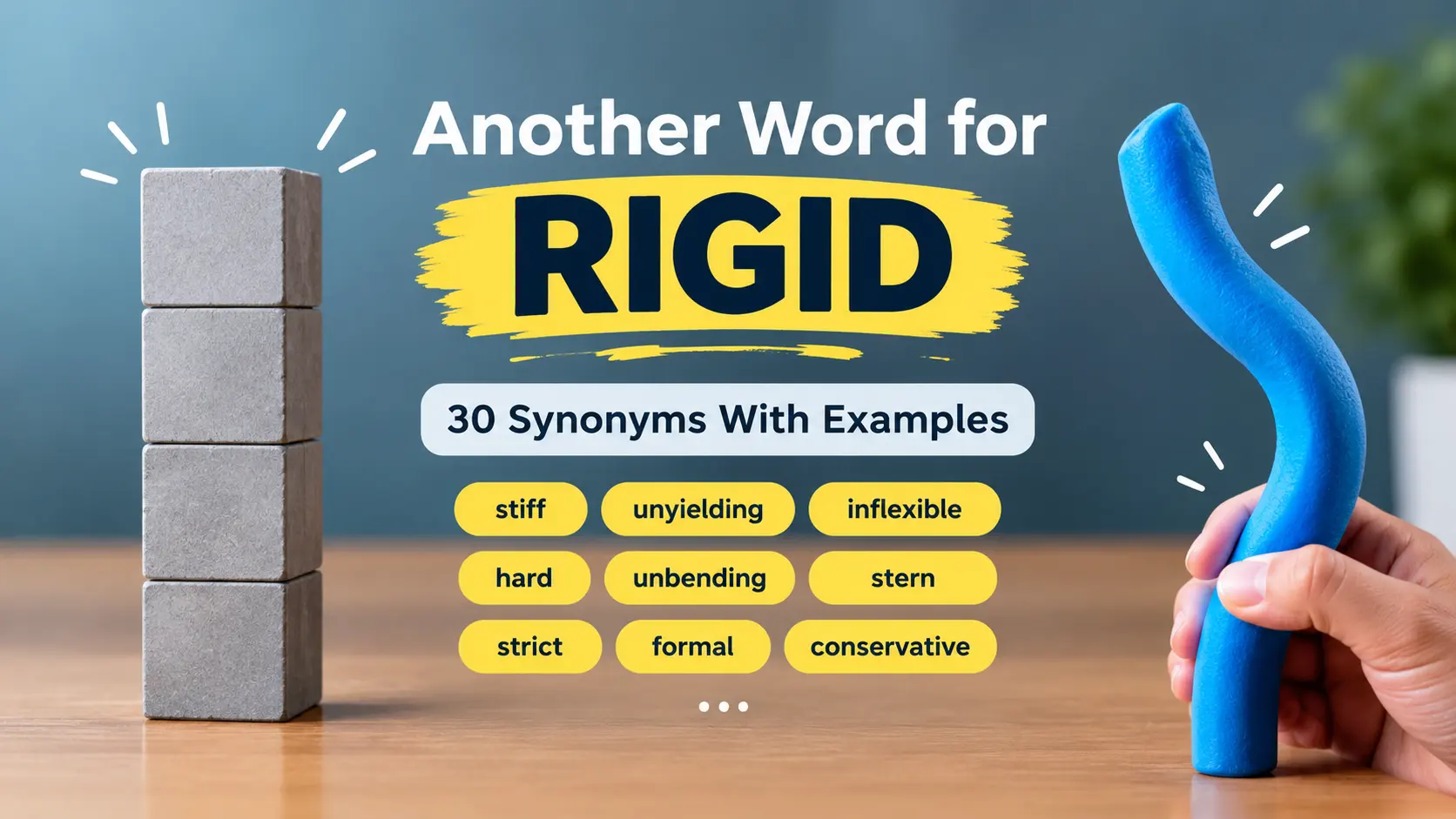
Another Word for Rigid: 30 Synonyms With Examples
Another word for rigid is stiff when you mean something that does not bend, and inflexible or strict when you mean a rule, plan, or person that will not change. Other close options are unbending, unyielding, and firm. Each one covers a slightly different part of what “rigid” can mean.
The best alternative depends on context. “Rigid” can describe a material (a rigid frame), a rule (rigid discipline), a person (a rigid thinker), or a body held tight with fear or pain. A word that fits one of these often sounds wrong in another.
Quick list: stiff, inflexible, unbending, unyielding, firm, strict, stringent, stubborn, fixed, hard
This article looks at 30 alternatives to “rigid.” Each entry gives a meaning, IPA pronunciation, usage note, and example, so you can pick the word that fits your sentence.
At a Glance: Rigid Synonyms and Related Alternatives
| Alternative | Part of Speech | Meaning | Register / Tone | Ideal Context |
| Stiff | Adjective | Hard to bend or move | Neutral, everyday | Materials, muscles, paper, fabric |
| Inflexible | Adjective | Not able or not willing to change | Neutral to formal | Rules, schedules, people |
| Unbending | Adjective | Not giving way | Slightly formal | Will, attitude, principles |
| Unyielding | Adjective | Refusing to give way | Formal, strong | Resistance, demands, materials |
| Firm | Adjective | Solid; steady in decision | Neutral, often positive | Surfaces, decisions, leaders |
| Strict | Adjective | Requiring close obedience | Neutral | Rules, parents, teachers |
| Stringent | Adjective | Very strict and demanding | Formal | Laws, standards, regulations |
| Stubborn | Adjective | Refusing to change one’s mind | Informal to neutral, negative | People, habits |
| Fixed | Adjective | Set and not changeable | Neutral | Dates, plans, prices |
| Tense | Adjective | Tight from stress or fear | Neutral | Muscles, bodies, moments |
Which Word Should You Use?
| If you want to… | Use | Why |
| Describe a material that will not bend | stiff, hard | Both describe physical resistance to bending |
| Describe a rule with no exceptions | strict, hard and fast | They focus on rules that must be followed |
| Describe very demanding standards or laws | stringent, rigorous | They suggest tough, carefully enforced requirements |
| Describe someone who will not change their mind | stubborn, obstinate | They focus on the person’s will |
| Describe a firm decision in a positive way | firm | It sounds steady, not unreasonable |
| Describe a body tight with fear or stress | tense, taut | They describe muscles or nerves pulled tight |
| Describe awkward, overly formal speech or manner | stilted, starchy | They describe stiffness in style or behavior |
| Describe a plan or date that cannot move | fixed, set | They stress that something is already decided |
| Describe a cruel, extreme law | draconian | It adds the idea of harshness |
Exploring the Multiple Meanings of “Rigid”
1. Not Able to Bend
- Meaning: Stiff and resistant to bending or changing shape.
- Explanation: This is the basic physical sense. It applies to objects such as metal, plastic, or a frame. It is the sense where “stiff,” “hard,” and “inflexible” fit best.
- Example: The shelf is made of rigid plastic, so it will not sag under the books.
2. Strict and Hard to Change
- Meaning: Applied without flexibility or exceptions.
- Explanation: Here “rigid” describes rules, systems, schedules, or controls. It often suggests that something is too strict to work well in real life, though it can also be neutral.
- Example: The company follows a rigid dress code.
3. Unwilling to Adapt
- Meaning: Describing a person who will not change opinions, habits, or methods.
- Explanation: This sense is about attitude. It is usually negative, because it suggests a person is closed minded or hard to work with. “Stubborn” is close, but “rigid” often sounds more about habit and method than about temper.
- Example: My manager is too rigid to try a new way of working.
4. Stiff From Fear, Pain, or Shock
- Meaning: Held tight and unmoving because of strong emotion or physical discomfort.
- Explanation: The word often appears in the pattern “rigid with” plus an emotion. It describes a body, face, or posture, not a rule or a mind.
- Example: She stood rigid with fear as the dog moved closer.
5. Having a Fixed Structure
- Meaning: Keeping its shape because of a frame or hard structure.
- Explanation: This is a technical sense used in fields such as boating, aviation, and physics. A rigid inflatable boat has a hard hull. A rigid airship has an internal frame. A “rigid body” in physics does not change shape.
- Example: The rescue crew used a rigid inflatable boat to reach the swimmers.
Sources: Merriam Webster (rigid); Dictionary.com (rigid); Wiktionary (rigid, noun sense in aviation).
Analyzing 30 Rigid Alternatives in Detail
Some of these words are close synonyms of “rigid,” while others only match one of its senses, so each Usage note says which is which.
Core Synonyms for Rigid
The word rigid describes something that cannot bend easily or a person, rule, or system that resists change. Depending on the context, several synonyms can express physical stiffness, firm decisions, or an unwillingness to compromise. Understanding these differences helps you choose the most accurate word for your sentence.
1. Stiff
Meaning: Not easily bent or moved.
Usage: Stiff is a common everyday synonym for rigid when describing physical objects, muscles, joints, or materials. It emphasizes difficulty bending or moving rather than resistance to changing an opinion.
Example: The new leather boots were stiff at first.
2. Inflexible
Meaning: Unable to bend or unwilling to change.
Usage: Inflexible is one of the closest general synonyms for rigid. It works for physical objects as well as rules, plans, schedules, and people. It often describes situations where adjustments are difficult or impossible.
Example: The airline has an inflexible baggage policy.
3. Unbending
Meaning: Not giving way or changing.
Usage: Unbending usually describes a person’s attitude, principles, or determination. It suggests refusing to reconsider a position and sounds slightly formal or literary.
Example: He remained unbending in his support of the old rules.
4. Unyielding
Meaning: Refusing to give way or give in.
Usage: Unyielding is a strong synonym that describes firm resistance, demands, or hard materials. It suggests determination that cannot easily be overcome.
Example: The union took an unyielding position on wages.
5. Firm
Meaning: Solid, steady, or not easily changed.
Usage: Firm is a related alternative that often sounds more positive than rigid. It emphasizes confidence, stability, and determination without necessarily suggesting unreasonable strictness.
Example: The teacher was firm but never unkind.
6. Hard
Meaning: Solid and difficult to bend, press, or break.
Usage: Hard is suitable when rigid refers to a solid physical object. However, hardness concerns resistance to pressure or damage, whereas rigidity specifically concerns resistance to bending.
Example: The soil was too hard to dig.
These six words cover several common meanings of rigid, from physical stiffness to firm attitudes. Choose the synonym that best matches the object, person, or situation you are describing.
Physical Tension and Movement
When rigid describes a body, muscle, rope, or movement, the best alternative depends on whether the subject is stiff, tightly stretched, tense, or unable to move. These related words describe different physical conditions, so they are not always interchangeable with rigid.
7. Taut
Meaning: Pulled tight with no slack.
Usage: Taut describes ropes, strings, muscles, or other things stretched tightly. Unlike rigid, it emphasizes tension caused by pulling rather than resistance to bending.
Example: The rope grew taut as the boat drifted away.
8. Tense
Meaning: Tight or stiff because of stress, fear, or strain.
Usage: Tense commonly describes muscles, shoulders, facial expressions, or bodies affected by nervousness. It can also describe an anxious atmosphere, but it does not usually describe strict rules or inflexible materials.
Example: His neck was tense after the long drive.
9. Wooden
Meaning: Stiff or unnatural in movement or manner.
Usage: Wooden is a figurative alternative for rigid when someone moves, speaks, or performs awkwardly. It often suggests a lack of natural expression or ease, particularly in acting and public speaking.
Example: The actor’s wooden delivery made the scene hard to believe.
10. Immobile
Meaning: Not moving or unable to move.
Usage: Immobile describes a person, animal, or object that remains still. It focuses on the absence of movement rather than an inability to bend, making it a related alternative rather than an exact synonym.
Example: The deer stood immobile in the headlights.
Choosing the Right Physical Synonym
Use taut when something is stretched tightly, tense when muscles or emotions are strained, wooden when movement or speech seems unnatural, and immobile when something cannot move. Use rigid when the main idea is resistance to bending or flexibility.
These distinctions make your writing more precise and help readers understand the exact physical condition you intend to describe.
Strict Rules and Control
When rigid describes rules, regulations, standards, or expectations, it often suggests that little room exists for exceptions. The following synonyms communicate different levels of strictness, precision, and severity. Some are close alternatives, while others express related ideas that require careful use.
11. Strict
Meaning: Requiring close obedience to rules.
Usage: Strict is a common synonym for rigid when discussing rules, schools, authorities, or systems. It can be positive when consistency is important, although excessive strictness may seem unreasonable.
Example: The school has strict rules about phones.
12. Stringent
Meaning: Very strict and demanding, especially about standards.
Usage: Stringent is a formal alternative commonly used for regulations, requirements, inspections, and safety standards. It emphasizes demanding conditions that must be followed carefully.
Example: The factory must meet stringent safety standards.
13. Rigorous
Meaning: Thorough, careful, and demanding.
Usage: Rigorous is related to rigid but does not usually mean unwilling to change. It describes detailed procedures, demanding tests, or careful analysis rather than inflexible attitudes.
Example: The team ran a rigorous review of the data.
14. Exacting
Meaning: Demanding great care, effort, or accuracy.
Usage: Exacting describes tasks, standards, or people that require a high level of precision. It is appropriate when expectations are demanding, rather than when someone simply refuses to adapt.
Example: She is an exacting editor who checks every comma.
15. Uncompromising
Meaning: Unwilling to make concessions.
Usage: Uncompromising is a close synonym for figurative rigid. It describes people, principles, or positions that leave little room for negotiation. Depending on the situation, it can suggest admirable determination or excessive inflexibility.
Example: The coach was uncompromising about early practice.
16. Hard and Fast
Meaning: Fixed and not open to change.
Usage: This expression usually describes established rules or limits. It frequently appears in the phrase “no hard and fast rule,” meaning that no single rule applies in every situation.
Example: There is no hard and fast rule for how long to boil the eggs.
17. Draconian
Meaning: Extremely harsh or severe.
Usage: Draconian is a stronger, negative alternative used for unusually harsh laws, penalties, or restrictions. It should not replace rigid when a rule is merely strict or consistently enforced.
Example: Critics called the new penalties draconian.
How to Choose the Best Synonym
Use strict for obedience, stringent for demanding requirements, rigorous for thorough processes, and exacting for high standards. Choose uncompromising when negotiation is refused, hard and fast for fixed rules, and draconian for excessively harsh measures.
Stubborn Attitudes
When rigid describes someone’s personality, beliefs, or opinions, it often means that the person is unwilling to reconsider a position. The following synonyms range from common everyday expressions to formal words used in serious discussions, politics, and literature.
18. Stubborn
Meaning: Refusing to change one’s mind or behavior.
Usage: Stubborn is a common everyday synonym for rigid when describing a person who insists on doing things their own way. It can also describe persistent problems, such as stains that are difficult to remove.
Example: He is too stubborn to ask for directions.
19. Obstinate
Meaning: Unreasonably determined to maintain an opinion or course of action.
Usage: Obstinate is more formal and often stronger than stubborn. It suggests that someone refuses to listen to reasonable arguments or reconsider a decision, even when changing course might help.
Example: The obstinate owner refused every offer to settle.
20. Intransigent
Meaning: Unwilling to change a position or reach an agreement.
Usage: Intransigent is a formal word frequently used in political discussions, negotiations, and disputes. It describes people or groups that refuse to compromise.
Example: Talks failed because both sides remained intransigent.
21. Dogmatic
Meaning: Insisting that one’s beliefs are correct and unquestionable.
Usage: Dogmatic describes someone who treats personal beliefs as unquestionable truths. It focuses on fixed opinions rather than physical stiffness and generally carries a negative meaning.
Example: He is dogmatic about how history should be taught.
22. Hidebound
Meaning: Stuck in old ideas and unwilling to accept change.
Usage: Hidebound is a figurative synonym for rigid when describing traditional attitudes, institutions, or organizations that resist new approaches. It is relatively uncommon in everyday conversation.
Example: The hidebound committee rejected every new idea.
23. Adamant
Meaning: Firmly refusing to change one’s mind.
Usage: Adamant describes a strong, definite position or decision. Unlike stubborn, it does not necessarily suggest unreasonable behavior. It often appears in expressions such as “adamant that.”
Example: She was adamant that she would not sign the contract.
24. Obdurate
Meaning: Stubbornly unwilling to change or be persuaded.
Usage: Obdurate is a formal, relatively uncommon word suggesting resistance to arguments, appeals, or emotional persuasion. It is particularly useful in serious or literary writing.
Example: The obdurate judge ignored every plea for mercy.
Which Word Best Describes a Rigid Attitude?
Use stubborn for everyday situations, obstinate for unreasonable resistance, and intransigent for refusal to negotiate. Choose dogmatic for unquestionable beliefs, hidebound for outdated thinking, adamant for a firm position, and obdurate for persistent resistance to persuasion.
Fixed and Unchangeable
Rigid can also describe something that remains fixed, follows an established arrangement, or cannot easily be modified. However, fixed, set, immutable, and inelastic have distinct meanings. Choosing the correct term helps distinguish a settled arrangement from something that genuinely cannot change.
25. Fixed
Meaning: Set in place or not changing.
Usage: Fixed is a related synonym for rigid when describing dates, prices, schedules, positions, or arrangements. It indicates stability but does not necessarily suggest strictness or physical stiffness.
Example: The meeting is at a fixed time each week.
26. Set
Meaning: Established, settled, or difficult to change.
Usage: Set is a versatile, everyday alternative that often describes habits, routines, and plans. The expression “set in one’s ways” refers to someone who prefers familiar habits and resists doing things differently.
Example: My grandfather is set in his routine.
27. Immutable
Meaning: Unable to be changed.
Usage: Immutable is a formal word for principles, facts, or conditions considered unchangeable. It is stronger than rigid because it emphasizes the impossibility of change rather than resistance to it.
Example: The rules were treated as immutable by the organization.
28. Inelastic
Meaning: Not able to stretch or adjust easily.
Usage: Inelastic is a technical term used for materials that do not stretch easily and for economic situations in which demand changes relatively little in response to price changes. It is not generally used to describe stubborn people.
Example: Demand for basic medicine can be inelastic.
Understanding the Differences
Use fixed for established arrangements, set for settled plans or habits, and immutable for things regarded as impossible to change. Choose inelastic when discussing elasticity in materials or economics.
Although these words overlap with rigid, they emphasize different qualities. A fixed appointment may be rescheduled, a set routine may eventually change, and an immutable principle is considered unchangeable. An inelastic material, meanwhile, concerns stretching rather than a person’s attitude.
Selecting the right synonym improves clarity and prevents readers from confusing physical stiffness with resistance to change.
Stiff in Manner and Style
29. Stilted
IPA: /ˈstɪltɪd/ (US and UK)
Definition: Stiff and unnatural in speech or writing.
- Usage: A related alternative. It describes language or conversation that sounds forced, not objects or rules.
- Example: Their stilted conversation made the dinner awkward.
30. Starchy
IPA: US /ˈstɑːrtʃi/ · UK /ˈstɑːtʃi/
Definition: Stiffly formal in manner.
- Usage: A related alternative for people who seem overly formal and distant. It is informal and somewhat old fashioned, and it does not describe rules or materials.
- Example: The new principal seemed starchy at first.
Sources: Merriam Webster; Dictionary.com; Wiktionary; Etymonline.
Rigid vs. Stiff vs. Strict vs. Rigorous
These four words overlap, but each has a different center of meaning.
| Word | Core Idea | Best For | Example |
| Rigid | Will not bend or change | Objects, rules, attitudes | A rigid schedule |
| Stiff | Hard to bend or move | Objects, muscles, manner | A stiff collar |
| Strict | Must be obeyed closely | Rules, teachers, parents | Strict rules |
| Rigorous | Careful and demanding | Tests, studies, training | A rigorous study |
“Rigid” is the broadest of the four, because it works for objects, rules, and people. Merriam Webster groups “rigid,” “rigorous,” “strict,” and “stringent” together as words for extreme severity, and says “rigid” stresses a refusal to compromise. “Rigorous” is often a compliment about quality, while “rigid” about a person is often a criticism.
Sources: Merriam Webster (rigid, synonym discussion); Etymonline (rigor, rigidity).
Rigid and Opposite/Paired Word Pairs
| Word | Paired Word | Note |
| Rigid | Flexible | The most direct opposite, for objects, rules, and people |
| Rigid | Pliable | Describes materials that bend easily |
| Rigid | Elastic | Describes things that stretch and return to shape |
| Rigid | Adaptable | Describes people or systems that adjust |
| Rigid | Lenient | Opposite of “rigid” in the sense of strict rules |
| Rigid | Open minded | Opposite of a rigid thinker |
| Rigidity | Flexibility | Noun pair, in both physical and figurative use |
The best opposite depends on the sense. “Flexible” works in most cases. “Pliable” and “elastic” fit materials, “lenient” fits discipline, and “adaptable” or “open minded” fit people.
Sources: Merriam Webster; Dictionary.com; Etymonline (rigidity).
Common Word Partners of “Rigid”
| Pattern | Common Partners | Example |
| rigid + noun | structure, frame, rules, schedule, control | The tent has a rigid frame. |
| rigid + noun (ideas) | thinking, routine, system, hierarchy | The firm has a rigid hierarchy. |
| adverb + rigid | too, overly, extremely, perfectly, completely | The rules are too rigid for a small team. |
| verb + rigid | go, become, stay, hold | His shoulders went rigid when she walked in. |
| rigid + about / in | about rules, in his views | She is rigid about deadlines. |
Sources: Merriam Webster (example sentences); Dictionary.com (example sentences).
Idiomatic Phrases Featuring “Rigid”
“Rigid” appears in few true idioms. The items below are established expressions and fixed terms, not figurative idioms.
1. Rigid with fear
- Meaning: Frozen or stiff because of fear, shock, or pain. The same pattern works with other strong feelings.
- Example: He stood rigid with fear as the lights went out.
2. Rigid body
- Meaning: A physics term for an object that does not change shape, however much force is applied to it.
- Example: The textbook explains how a rigid body spins around its center.
3. Rigid inflatable boat
- Meaning: A boat with an inflatable tube around a hard hull. It is often shortened to RIB.
- Example: The coast guard reached the sailors in a rigid inflatable boat.
4. Rigid airship
- Meaning: An airship whose shape is held by a frame, not by gas pressure alone.
- Example: Early rigid airships could carry more passengers than other types.
Sources: Merriam Webster; Wiktionary (rigid, noun sense in aviation).
Word Formation of “Rigid”
Etymology & Structure
“Rigid” comes into English through Middle English from the Latin rigidus, meaning stiff, which comes from the verb rigēre, meaning to be stiff. Wiktionary also notes that it merged with an unrelated Middle English word meaning upright or ridged. It is related to rigor, as in rigor mortis. The word has a simple structure: a root with the adjective ending id.
Date and History
Merriam Webster dates the first known use of “rigid” to the 15th century. The noun rigidity is recorded from the 1620s, and rigidness from the 1640s, according to Etymonline. The sense of strictness developed in the 1650s, though Etymonline notes that “rigidity” leans toward physical stiffness and “rigor” toward active or moral severity.
Word Class Variations
- Adjective: rigid (more rigid, most rigid)
- Adverb: rigidly
- Noun: rigidity, rigidness; also rigid as a noun for a type of airship
- Verb: rigidify (to make or become rigid)
- Noun (from the verb): rigidification
Sources: Merriam Webster (rigid); Wiktionary (rigid); Etymonline (rigidity, rigor).
Common Word Choice Mistakes
- “The metal is rigid to bend”: say “The metal is hard to bend” or “stiff.”
- “A rigid study”: say “a rigorous study” when you mean careful and thorough.
- “A stubborn schedule”: say “a rigid” or “strict” schedule. “Stubborn” describes people or stains, not plans.
- “A stringent person”: say “a strict person.” “Stringent” fits rules and standards, not people.
- “A draconian teacher” for a teacher who is merely strict: say “strict.” “Draconian” suggests cruelty.
- “A hidebound shoulder”: say “a stiff” or “tense” shoulder. “Hidebound” describes attitudes and institutions.
- “She is a rigid leader” when you want to praise her: say “firm” or “steady.” “Rigid” usually sounds critical.
Frequently Asked Questions
What is the closest synonym for rigid?
“Inflexible” is the closest all purpose synonym, because it works for objects, rules, and people. “Stiff” is closest for physical use, and “strict” for rules.
What is another word for rigid when describing a person?
Use “inflexible,” “stubborn,” “uncompromising,” or “set in their ways.” “Obstinate” is stronger.
What is the difference between rigid and stiff?
“Stiff” mostly describes physical resistance to bending, such as a stiff neck. “Rigid” is broader and also covers rules, attitudes, and systems.
Is rigid always negative?
Not always. In engineering, a rigid frame is a good thing. About people or rules, though, it often suggests a lack of willingness to adjust.
What is the difference between rigid and strict?
“Strict” means rules must be followed closely, and it can be positive. “Rigid” suggests that nothing will bend, even when it should.
What is a formal alternative to rigid?
“Inflexible,” “unyielding,” and “stringent” are formal options. “Intransigent” is common in politics.
What is a better word for rigid in a positive sense?
“Firm” and “steadfast” can sound positive. They suggest strength without the unreasonable quality of “rigid.”
What is the opposite of rigid?
“Flexible” is the usual opposite. “Pliable” and “elastic” fit materials, and “lenient” fits strict rules.
Can rigid describe a face or body?
Yes. A face or body can be rigid with fear, shock, or pain, meaning it is stiff and still.
Is rigorous a synonym for rigid?
Not exactly. The words share a root, but “rigorous” usually means careful and demanding, while “rigid” means unbending.
Conclusion
The most useful alternatives to “rigid” are stiff, inflexible, unbending, unyielding, and strict. “Stiff” suits physical things, “inflexible” works almost everywhere, and “strict” suits rules.
Context matters because “rigid” has several senses. A rigid frame, a rigid rule, a rigid person, and a body rigid with fear each call for a different word. Related words such as “tense,” “stubborn,” “stringent,” and “stilted” each fit only one of these meanings.
To choose the right word, first decide what is rigid: an object, a rule, a person, or a body. Then decide If you want a neutral, formal, positive, or critical tone. If you are unsure, “inflexible” is the safest replacement.

Noman is the founder and author of Factwy.com, where he shares informative, useful, and easy-to-understand content. With a passion for research and writing, he creates articles that simplify complex topics and provide valuable insights. His goal is to deliver clear, accurate, and reader-friendly information that helps visitors learn something new every day.