Another Word for Risk: 30 Synonyms With Examples
Another word for risk is usually danger, hazard, or chance. Use “danger” for a general chance of harm, “hazard” for a source of harm, and “chance” or “possibility” when the outcome could go either way. When risk is something you do on purpose, gamble and venture fit better. As a verb, endanger and jeopardize are common choices.
The best word depends on meaning and context. “Risk” can describe a possible harm, a person or thing that causes harm, a money or insurance exposure, or the act of putting something in danger. Each of these senses has its own natural alternatives.
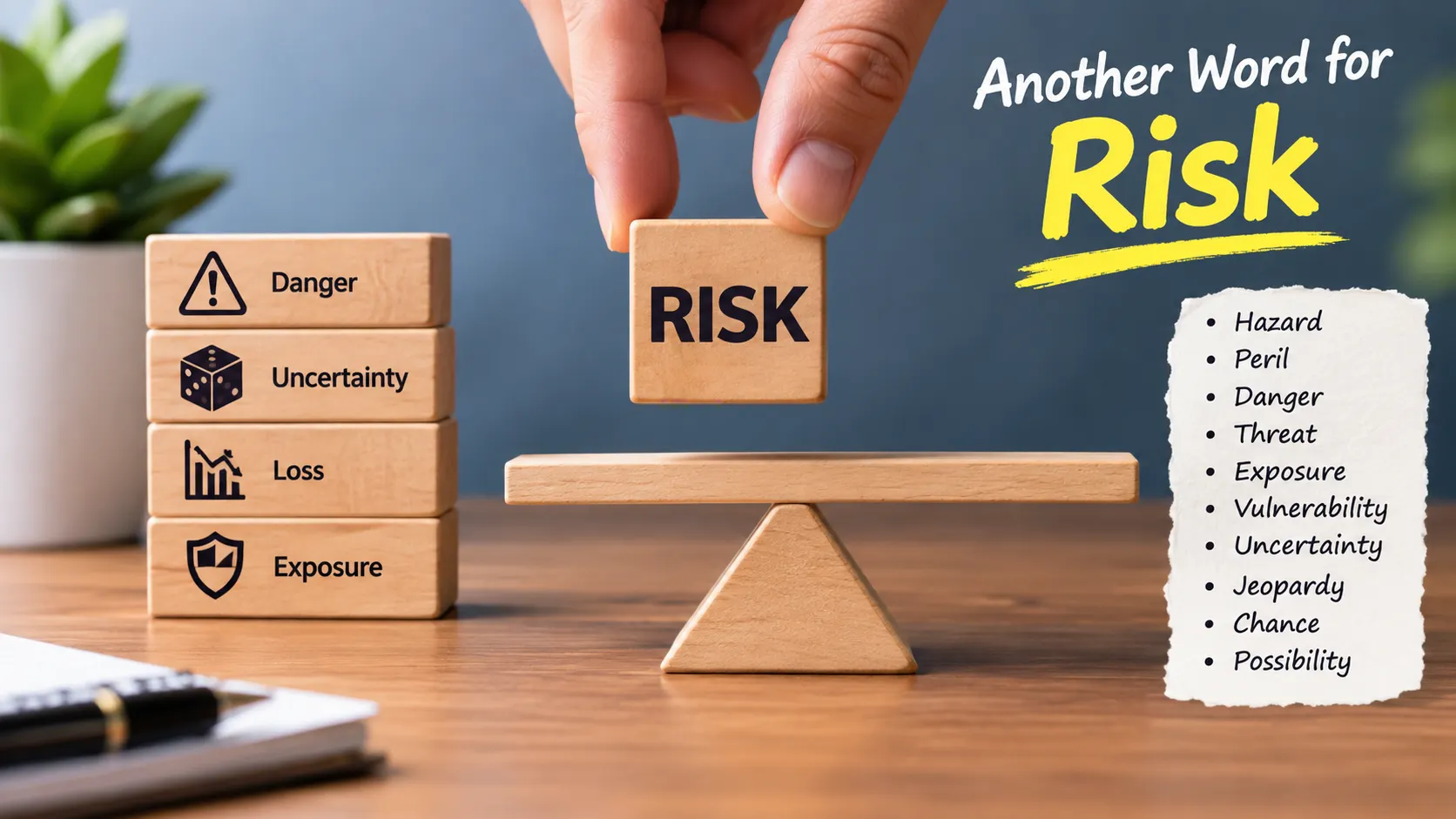
Quick list: danger, hazard, peril, threat, jeopardy, chance, exposure, gamble, venture
Below, you will find 30 alternatives with meanings, IPA, usage notes, and example sentences. The article also covers word partners, idioms, word history, and common mistakes.
At a Glance: Risk Synonyms and Related Alternatives
| Alternative | Part of Speech | Meaning | Register / Tone | Ideal Context |
| Danger | noun | the chance of harm or loss | neutral | everyday warnings and safety |
| Hazard | noun | something that can cause harm | neutral to formal | workplaces, roads, safety rules |
| Peril | noun | serious, close danger | formal, literary | stories, news, dramatic writing |
| Threat | noun | something likely to cause harm | neutral | security, health, environment |
| Chance | noun | the possibility that something will happen | neutral | everyday talk about outcomes |
| Possibility | noun | something that may happen | neutral to formal | reports, planning |
| Exposure | noun | the state of being open to loss or harm | formal | finance, health, insurance |
| Gamble | noun, verb | a risky action taken for a possible reward | informal to neutral | business, sport, daily choices |
| Endanger | verb | to put in danger | neutral to formal | wildlife, safety, health |
| Jeopardize | verb | to put something at risk of loss or damage | formal | careers, plans, relationships |
Which Word Should You Use?
| If you want to… | Use | Why |
| Talk about a general chance of harm | danger | It is the most common and flexible choice. |
| Name something that can cause harm | hazard | It points to the source, such as a wet floor. |
| Stress serious, close danger | peril | It sounds dramatic and fits formal or literary writing. |
| Warn about harm that may come soon | threat | It suggests something is likely to cause harm. |
| Mention an outcome that could be good or bad | chance or possibility | Neither word suggests harm by itself. |
| Describe money open to loss | exposure | It is the standard term in finance and insurance. |
| Describe a bold choice with an uncertain result | gamble | It suggests hoping for a reward. |
| Say someone puts something in danger | endanger or jeopardize | They work as verbs and sound more formal than “risk.” |
Exploring the Multiple Meanings of “Risk”
1. The Possibility of Harm or Loss
- Meaning: The chance that something bad will happen.
- Explanation: This is the main noun sense. It usually points to a future harm, not a harm that has already happened. It can be countable (“a risk”) or uncountable (“There is risk in every investment”).
- Example: There is a small risk of fire if the wires are not replaced.
2. A Person or Thing That Causes Danger
- Meaning: A source of danger or possible loss.
- Explanation: Here “risk” names the thing, not the chance. It often follows a descriptive word, as in “security risk” or “fire risk.” Compare this with sense 1, where the focus is on the chance.
- Example: The old bridge is a safety risk, so the city closed it.
3. Exposure to Loss in Business or Insurance
- Meaning: The chance of financial loss, or a type of danger covered by insurance.
- Explanation: In finance and insurance, “risk” is a technical term. It appears in phrases such as “credit risk” and “market risk,” where people often measure the chance of loss.
- Example: The bank checks each borrower to reduce credit risk.
4. To Expose Something to Danger or Loss (Verb)
- Meaning: To put something you value in a position where it could be harmed or lost.
- Explanation: The object is usually something valuable, such as life, money, or reputation. The risk is often taken on purpose, with a possible reward in mind.
- Example: Firefighters risk their lives to save others.
5. To Take the Chance of Something Bad Happening (Verb)
- Meaning: To do something even though a bad result may follow.
- Explanation: In this sense, “risk” is followed by an ing form, not “to + verb.” It often shows a choice made with the possible downside in mind.
- Example: If you leave late, you risk missing the train.
Sources: Dictionary.com; Merriam Webster; Collins Dictionary
Analyzing 30 Risk Alternatives in Detail
Some of the words below are close synonyms of “risk,” while others are related alternatives that fit only one sense or context. The Usage note for each word says which.
Group 1: Synonyms for Risk Related to Danger and Harm
1. Danger
IPA: US /ˈdeɪndʒər/ · UK /ˈdeɪndʒə/
Meaning: The possibility of harm, injury, or loss.
Usage: Danger is a common synonym for risk when something may cause harm. However, danger describes a harmful situation, while risk emphasizes the possibility of a negative outcome.
Example: The hikers faced danger when the storm moved in.
2. Hazard
IPA: US /ˈhæzərd/ · UK /ˈhæzəd/
Meaning: Something that can cause harm or injury.
Usage: Hazard works well when discussing workplace safety, health, or environmental concerns. It identifies the source of potential harm rather than the likelihood of harm occurring.
Example: Loose cables on the floor create a tripping hazard.
3. Peril
IPA: US and UK /ˈpɛrəl/
Meaning: Serious or immediate danger.
Usage: Peril is a formal synonym for risk that emphasizes severe danger. Writers often use it in dramatic, literary, or serious contexts rather than everyday conversation.
Example: The ship was in grave peril as the waves grew higher.
4. Threat
IPA: US and UK /θrɛt/
Meaning: A person, thing, or situation that may cause harm or damage.
Usage: Threat suits situations involving potential harm to people, property, or the environment. Unlike risk, it often suggests a more direct source of danger.
Example: Pollution poses a serious threat to the river’s fish.
5. Menace
IPA: US and UK /ˈmɛnɪs/
Meaning: A person or thing that causes or threatens harm.
Usage: Menace is a stronger, more emotional alternative to risk. It often describes something dangerous or troublesome.
Example: Reckless drivers are a menace on busy roads.
6. Jeopardy
IPA: US /ˈdʒɛpərdi/ · UK /ˈdʒepədi/
Meaning: Exposure to danger, loss, or failure.
Usage: Jeopardy is a formal alternative commonly used in the phrase in jeopardy to describe something at risk.
Example: The financial crisis put many jobs in jeopardy.
Chance and Uncertainty
7. Chance
IPA: US /tʃæns/ · UK /tʃɑːns/
Definition: The possibility that something will happen.
- Usage: A related alternative. Unlike “risk,” “chance” is neutral and can be good or bad, so “a chance of rain” and “a chance to win” both work. It matches risk only when the outcome is bad, as in “a chance of failure.”
- Example: There is a chance the flight will be delayed.
8. Possibility
IPA: US /ˌpɑːsəˈbɪləti/ · UK /ˌpɒsəˈbɪləti/
Definition: Something that may happen or be true.
- Usage: A related, neutral alternative. It is a bit more formal than “chance” and works well in reports and plans. It does not suggest harm unless the sentence makes the harm clear.
- Example: We cannot rule out the possibility of a data leak.
9. Likelihood
IPA: (US and UK) /ˈlaɪklihʊd/
Definition: The chance that something will happen; probability.
- Usage: A related alternative. It is neutral and formal, and it often appears in risk assessment, where risk is described by likelihood and effect. It does not mean “danger” on its own.
- Example: The likelihood of a delay increases in winter.
10. Probability
IPA: US /ˌprɑːbəˈbɪləti/ · UK /ˌprɒbəˈbɪləti/
Definition: The degree to which something is likely to happen, often shown as a number.
- Usage: A related technical alternative. It is neutral and used in science, statistics, and finance. It describes how likely an event is, not how harmful it would be.
- Example: The test showed a low probability of infection.
11. Uncertainty
IPA: US /ʌnˈsɜːrtnti/ · UK /ʌnˈsɜːtnti/
Definition: The state of not being sure what will happen.
- Usage: A related alternative. Uncertainty is the doubt that makes risk possible, but it is not the same as risk. It can describe an unknown outcome with no clear harm.
- Example: Uncertainty about prices made the company cautious.
Weak Points and Downsides
12. Vulnerability
IPA: (US and UK) /ˌvʌlnərəˈbɪləti/
Definition: The state of being open to harm, attack, or damage.
- Usage: A related alternative. It describes a weakness that makes harm possible, not the harm itself. It is common in security, health, and emotional contexts.
- Example: The test revealed a vulnerability in the website’s login page.
13. Pitfall
IPA: (US and UK) /ˈpɪtfɔːl/
Definition: A hidden danger or difficulty.
- Usage: A related alternative. It points to a problem that is easy to miss, so it is common in advice, such as “common pitfalls.” It is not suitable for obvious or physical danger.
- Example: One pitfall of working from home is never switching off.
14. Downside
IPA: (US and UK) /ˈdaʊnsaɪd/
Definition: The negative side of something.
- Usage: A related, informal to neutral alternative. It describes a disadvantage or possible bad outcome in a plan. It matches risk when you weigh benefits against costs.
- Example: The downside of the cheap flight is the long wait in the airport.
15. Liability
IPA: (US and UK) /ˌlaɪəˈbɪləti/
Definition: Something that is likely to cause trouble or disadvantage; legal or financial responsibility.
- Usage: A related alternative that matches risk in sense 2 when it means a person or thing that causes problems. It is mostly formal. In law and business, it also means responsibility for debt or damage, which is a different sense.
- Example: The slow software became a liability for the team.
Business and Finance
16. Exposure
IPA: US /ɪkˈspoʊʒər/ · UK /ɪkˈspəʊʒə/
Definition: The state of being open to harm, loss, or a risky condition.
- Usage: A close alternative in finance, insurance, and health. It describes how much is open to loss (“exposure to risk”). It is formal, and it is not a general replacement for “risk.”
- Example: The fund reduced its exposure to oil prices.
17. Volatility
IPA: US /ˌvɑːləˈtɪləti/ · UK /ˌvɒləˈtɪləti/
Definition: The tendency to change quickly and unpredictably, especially in price.
- Usage: A related financial term. It describes sudden price swings, which are one source of financial risk. It is not a synonym for risk in general.
- Example: Investors worried about the volatility of the market.
18. Speculation
IPA: (US and UK) /ˌspɛkjuˈleɪʃn/
Definition: The act of making risky investments in the hope of a large profit.
- Usage: A related alternative for risky financial activity. It can sound negative. It also has an unrelated sense of “guessing,” so check the context.
- Example: Land speculation drove prices up and then crashed them.
19. Contingency
IPA: (US and UK) /kənˈtɪndʒənsi/
Definition: A possible future event or problem that you should plan for.
- Usage: A related alternative, formal and mostly used in planning. It names the possible event, not the chance of loss. It appears in phrases such as “contingency plan.”
- Example: The budget includes money for unexpected contingencies.
Bold Choices and Ventures
20. Gamble
IPA: (US and UK) /ˈɡæmbl/
Definition: An action with an uncertain result that you take hoping for a good outcome.
- Usage: A close alternative when risk is taken on purpose. It is informal to neutral and stresses the hoped for reward. It also works as a verb meaning “to take a risk.”
- Example: Moving to a new city was a gamble, but it paid off.
21. Venture
IPA: US /ˈventʃər/ · UK /ˈventʃə/
Definition: A risky or daring project; to dare to do something risky.
- Usage: A related alternative. As a noun, it is mostly used for business projects, and as a verb, it suggests daring to go or say something. It does not mean “danger.”
- Example: The new restaurant was a risky venture.
22. Wager
IPA: US /ˈweɪdʒər/ · UK /ˈweɪdʒə/
Definition: A bet; to bet money or something valuable on an outcome.
- Usage: A related alternative that is more formal than “bet.” It matches the sense of putting something valuable at stake. It is not used for general danger.
- Example: He made a wager that the team would win.
23. Stake
IPA: (US and UK) /steɪk/
Definition: Something you could gain or lose depending on the result.
- Usage: A related alternative. It names what is at risk, not the chance of loss. It is most common in phrases such as “at stake” and “high stakes.”
- Example: The stakes were high because the company’s future depended on the deal.
Verbs That Mean to Put at RiskGroup 5: Verbs That Mean to Risk or Endanger
24. Endanger
IPA: US /ɪnˈdeɪndʒər/ · UK /ɪnˈdeɪndʒə/
Meaning: To put someone or something in danger.
Usage: Endanger is a close verb synonym for risk when an action threatens people, animals, or the environment. It emphasizes the possibility of harm.
Example: Dumping toxic waste endangers local wildlife.
25. Jeopardize
IPA: US /ˈdʒɛpərdaɪz/ · UK /ˈdʒepədaɪz/
Meaning: To put something at risk of loss, damage, or failure.
Usage: Jeopardize is a formal alternative to risk, especially when discussing jobs, relationships, plans, or future success. It highlights the possibility of an unfavorable outcome.
Example: Missing the deadline could jeopardize the entire project.
26. Imperil
IPA: US and UK /ɪmˈpɛrəl/
Meaning: To put someone or something in serious danger.
Usage: Imperil is a formal, literary synonym for endanger. Writers often use it to describe serious threats to lives, communities, or important resources.
Example: The spreading fire imperiled the historic village.
27. Expose
IPA: US /ɪkˈspoʊz/ · UK /ɪkˈspəʊz/
Meaning: To leave someone or something vulnerable to harm or danger.
Usage: Expose works as a related alternative when describing vulnerability to threats. It commonly appears in the phrase expose someone to danger.
Example: Working outdoors without protection exposes workers to harmful sunlight.
28. Dare
IPA: US /dɛr/ · UK /deə/
Meaning: To have the courage to attempt something difficult or risky.
Usage: Dare emphasizes courage and willingness rather than the possibility of harm. It works best when describing bold decisions or challenging actions.
Example: She dared to challenge the unpopular decision.
29. Brave
IPA: US and UK /breɪv/
Meaning: To face something difficult or dangerous with courage.
Usage: Brave is a related verb rather than an exact synonym for risk. It emphasizes facing danger or hardship instead of accepting the possibility of loss.
Example: The fans braved the heavy rain to watch the match.
30. Compromise
IPA: US /ˈkɑːmprəmaɪz/ · UK /ˈkɒmprəmaɪz/
Meaning: To weaken or endanger something’s safety, quality, or effectiveness.
Usage: Compromise is useful when an action threatens security, safety, or trust. Unlike risk, it often suggests weakening something that should remain protected.
Example: Cutting corners could compromise the building’s structural safety.
Risk vs. Danger vs. Hazard vs. Peril vs. Threat
These five words overlap, but each one points to a slightly different part of the same idea.
| Word | Main idea | Typical use |
| Risk | a chance that something bad may happen, often one you may choose to accept | “a risk of failure,” “take a risk” |
| Danger | a general chance of harm or injury | “in danger,” “a danger to others” |
| Hazard | a thing or condition that can cause harm | “fire hazard,” “health hazard” |
| Peril | serious, close danger | “in peril,” “at your peril” |
| Threat | something likely to cause harm, or a sign that harm may come | “a threat to security” |
A simple way to remember them: a hazard is the thing, danger is the state of being exposed to harm, and risk is the chance that the harm will happen. A threat is something that points toward harm, and peril is danger at its most serious.
Sources: Dictionary.com; Merriam Webster; Collins Dictionary
Risk and Opposite/Paired Word Pairs
| Word | Paired Word | Note |
| risk | safety | The most natural opposite for the noun. |
| risk | security | Common in finance and everyday talk about being protected from loss. |
| risk | certainty | Contrasts a chance of loss with a sure outcome. |
| risk | reward | Not an opposite, but a common pair: people weigh one against the other. |
| high risk | low risk | A natural contrast used in finance, health, and safety. |
| risk averse | risk taking | Describes people who avoid risk and people who accept it. |
“Risk” has no single perfect opposite, because its meaning changes with the context. “Safety” is the best opposite when risk means danger. “Certainty” works better when risk means an unknown outcome. “Reward” is often paired with risk, but it is a partner, not an opposite.
Sources: Dictionary.com; Merriam Webster; Collins Dictionary
Common Word Partners of “Risk”
| Pattern | Common Partners | Example |
| verb + risk | take, run, pose, reduce, increase, avoid, minimize | Smoking increases the risk of heart disease. |
| adjective + risk | high, low, serious, real, calculated, financial, health | Investors face a high financial risk. |
| noun + risk | fire, security, credit, health, flight, safety | The package was treated as a security risk. |
| risk + noun | assessment, management, factor, appetite, profile | The team completed a risk assessment. |
| risk of + noun or ing | infection, failure, loss, being late | There is a risk of infection. |
| preposition phrase | at risk, at your own risk | Children are most at risk. |
| risk + ing (verb) | risk losing, risk missing, risk being | He did not want to risk losing his job. |
Sources: Dictionary.com; Merriam Webster; Collins Dictionary; Wiktionary (collocation listings)
Idiomatic Phrases Featuring “Risk”
1. At risk
- Meaning: In a situation where harm or loss is possible.
- Example: Many small shops are at risk of closing.
2. At your own risk
- Meaning: Accepting responsibility for any harm that may follow.
- Example: You can swim here, but it is at your own risk.
3. Risk life and limb
- Meaning: To put yourself in serious physical danger.
- Example: Rescue workers risked life and limb to reach the trapped miners.
4. Risk your neck
- Meaning: To put yourself in danger, usually for someone or something.
- Example: I’m not going to risk my neck for a job that pays so little.
Sources: Dictionary.com; Merriam Webster; Collins Dictionary
Word Formation of “Risk”
Etymology & Structure
“Risk” is a single base word with no clear prefix or suffix. It came into English from French risque, which came from Italian risco or riscio (now rischio). The Italian word is linked to riscare, meaning “to run into danger.” Its deeper origin is uncertain. A popular story says it comes from a word meaning “to dare,” but the Oxford English Dictionary, as quoted by writer Jason Zweig, calls that explanation unsupported by documentary evidence.
Date and History
Etymonline dates the noun to the 1660s, meaning “hazard, danger, peril, exposure to mischance or harm.” The commercial sense, the danger of loss to a ship or goods, is recorded in 1719. The verb appears in the 1680s, and the sense “to venture on” is recorded in 1705. Some well known compounds are also dated: risk taker (1892), risk factor (1906), risk aversion (1942), and risk management (1963).
Word Class Variations
- Noun: risk, risks
- Verb: risk, risks, risked, risking
- Adjective: risky; also compound adjectives such as risk free, risk averse, and high risk
- Adverb: riskily
- Related nouns: riskiness, risk taker
Sources: Etymonline; Dictionary.com; Merriam Webster; Jason Zweig, “Why Investors Can’t Escape ‘Risk'” (quoting the OED)
Common Word Choice Mistakes
- Make a risk: take a risk or run a risk.
- In risk: at risk.
- Risk to fall: risk falling.
- It is very risky: it is very risky.
- A risk of winning: a chance of winning, because “risk” suggests something bad.
- He jeopardized losing his job: he jeopardized his job, or he risked losing his job.
- At your own risks: at your own risk.
Frequently Asked Questions About Risk and Its Synonyms
1. What is the closest synonym for risk?
Danger is the closest everyday synonym for risk. Hazard also works when referring to something that can cause harm.
2. What is a formal synonym for risk?
Peril, jeopardy, and exposure are formal alternatives. In financial contexts, exposure is especially common.
3. What is the difference between risk and danger?
Danger describes a situation where harm may occur, while risk emphasizes the possibility of a negative outcome that people can sometimes measure or accept.
4. What is the difference between risk and hazard?
A hazard is something that can cause harm, such as a wet floor. Risk refers to the likelihood of someone getting hurt because of that hazard.
5. What is another word for taking a risk?
Gamble and venture describe taking a chance, while endanger and jeopardize mean putting someone or something in danger.
6. What is the opposite of risk?
Safety is a common opposite of risk. Depending on the context, security and certainty may also express the opposite idea.
7. Is risk the same as chance?
No. Chance can refer to positive or negative outcomes, while risk usually emphasizes the possibility of loss, harm, or an undesirable result.
8. Can risk be used as a verb?
Yes. Risk means exposing something to possible harm or accepting the possibility of a negative outcome, as in “She risked missing the bus.”
9. What does at risk mean?
At risk means facing the possibility of harm, damage, or loss. For example, homes near a river may be at risk of flooding.
10. What is a risk factor?
A risk factor is something that increases the likelihood of an undesirable outcome. For example, smoking is a risk factor for several serious health conditions.
Conclusion
The closest everyday alternatives to “risk” are “danger” and “hazard.” “Chance” and “possibility” work when the outcome is open, and “gamble” or “venture” fit when someone takes a risk on purpose. As a verb, “endanger” and “jeopardize” are the most useful choices.
Context makes the difference. “Peril” is stronger and more formal than “danger,” “threat” suggests harm that is likely, and “exposure” belongs mainly to finance and insurance. Some words, such as “chance,” “uncertainty,” and “dare,” only overlap with “risk” in certain senses.
To choose the right word, first decide which sense of “risk” you mean: the chance, the source, the money exposed, or the action. Then pick the word that matches that sense and the tone of your writing..

Noman is the founder and author of Factwy.com, where he shares informative, useful, and easy-to-understand content. With a passion for research and writing, he creates articles that simplify complex topics and provide valuable insights. His goal is to deliver clear, accurate, and reader-friendly information that helps visitors learn something new every day.