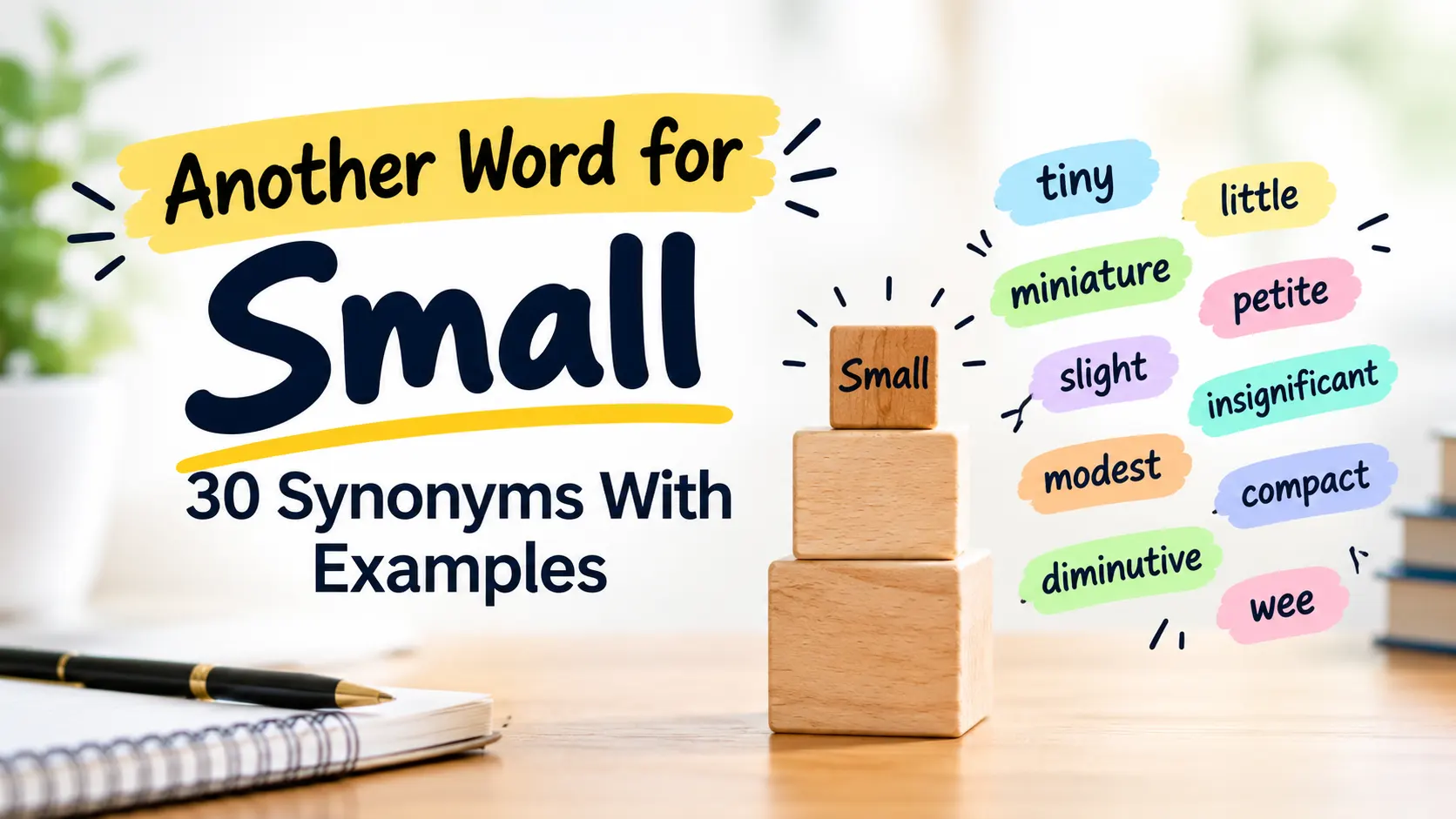
Another Word for Small: 30 Synonyms With Examples
The closest everyday alternative to small is little. For something very small, use tiny. If you mean small in importance, use minor, and if you mean a small amount, use slight or scant. The best choice depends on whether you mean size, amount, importance, age, or scale.
Some words, like tiny and miniature, are about size. Others, like minor and trivial, are about value. Words like petite and dainty describe people and objects, and modest and humble describe scale or status.
Quick list: little, tiny, mini, compact, minute, miniature, slight, modest, minor, petite
This article looks at 30 alternatives to small. Each has a meaning, IPA, a usage note, and an example, so you can see which ones are close synonyms and which fit only certain contexts.
At a Glance: Small Synonyms and Related Alternatives
| Alternative | Part of Speech | Meaning | Register / Tone | Ideal Context |
| little | adjective | Small in size or amount | Neutral, often warm | Everyday speech, children, animals |
| tiny | adjective | Very small | Neutral to informal | Emphasizing smallness |
| minuscule | adjective | Extremely small | Formal to neutral | Amounts, sizes, differences |
| miniature | adjective | A very small version of something | Neutral | Models, toys, replicas |
| compact | adjective | Small and neatly designed | Neutral | Cars, devices, rooms |
| petite | adjective | Small and slim, usually of a woman | Neutral to fashion | Clothing, body size |
| slight | adjective | Small in degree or build | Neutral to formal | Changes, differences, people |
| modest | adjective | Fairly small or limited | Neutral to formal | Money, goals, results |
| minor | adjective | Small in importance | Neutral to formal | Problems, changes, roles |
| trivial | adjective | Of very little importance | Neutral, sometimes critical | Details, complaints |
Which Word Should You Use?
| If you want to… | Use | Why |
| Say “small” in a plain, friendly way | little | It sounds natural and often warm. |
| Stress that something is very small | tiny | It is stronger than small. |
| Describe a smaller copy of something | miniature | It means a small version of a larger thing. |
| Describe a small but well designed object | compact | It suggests the size is practical, not just small. |
| Describe a small amount | slight, scant | Slight is gentle; scant suggests barely enough. |
| Describe a small problem | minor | It says the problem is not serious. |
| Describe a slim, small woman | petite | It is common in fashion and everyday description. |
| Describe a room that feels too small | cramped | It adds the idea of too little space. |
Exploring the Multiple Meanings of “Small”
1. Little in Physical Size
- Meaning: Not large; of less than usual size.
- Explanation: This is the most common sense. It is neutral and can describe almost anything, including objects, places, animals, and people.
- Example: We rented a small apartment near the station.
2. Little in Number, Amount, or Degree
- Meaning: Not many, not much, or not great in degree.
- Explanation: Here small is about quantity, not physical size. It is common with words like number, amount, chance, and change.
- Example: There is only a small chance of rain tomorrow.
3. Of Little Importance
- Meaning: Not serious, major, or significant.
- Explanation: This sense is about value. Small here is close to minor, but it often sounds softer and more conversational.
- Example: Don’t worry about that. It’s a small matter.
4. Young
- Meaning: Not yet grown up.
- Explanation: Small is used before words such as child and children to describe young age. It can also describe how someone felt as a child.
- Example: She read stories to the small children every afternoon.
5. Limited in Scale or Operation
- Meaning: Operating on a modest scale, with limited size, resources, or reach.
- Explanation: This sense is common in business and community contexts. The thing may be successful, but it is not large.
- Example: My uncle runs a small business selling spices.
6. A Narrow or Slender Part (noun)
- Meaning: The narrow part of something, especially the lower back.
- Explanation: This is an older sense of the word. It survives in a fixed phrase, and it matches the original Old English meaning of “narrow” or “slender.”
- Example: He felt a sharp pain in the small of his back.
Sources: Merriam Webster and Collins Dictionary entries for small; Etymonline, “small.”
Analyzing 30 Small Alternatives in Detail
Some of these words are direct synonyms of small, while others are related alternatives that fit only one sense, such as amount, importance, or scale.
Everyday Size Alternatives
1. Little
IPA: /ˈlɪtl/ (US and UK)
Definition: Small in size, amount, or degree.
- Usage: This is the closest everyday synonym. It often sounds warmer or more emotional than small, so it is common with children and animals. It is used mostly before a noun.
- Example: They have a little house by the river.
2. Tiny
IPA: /ˈtaɪni/ (US and UK)
Definition: Very small.
- Usage: It is a direct synonym, but stronger than small. It stresses how little something measures, and it is neutral or slightly informal.
- Example: A tiny bird landed on the windowsill.
3. Mini
IPA: /ˈmɪni/ (US and UK)
Definition: Much smaller than others of its type.
- Usage: It is informal and often used before a noun or in compounds like mini fridge. It is a related alternative for products and versions, not a general word for small.
- Example: She keeps a mini fridge in her dorm room.
4. Compact
IPA: /kəmˈpækt/ (US and UK)
Definition: Small and arranged to use little space.
- Usage: It is a related alternative. It suggests that the small size is neat and practical, so it is common for cars, cameras, kitchens, and devices.
- Example: The compact kitchen had everything we needed.
5. Bite sized
IPA: /ˈbaɪt saɪzd/ (US and UK)
Definition: Small enough to be eaten in one bite, or easy to handle.
- Usage: This is a related alternative. It is literal for food and figurative for short, manageable pieces of information.
- Example: The lessons are divided into bite sized parts.
Very Small and Technical Alternatives
6. Minute
IPA: US /maɪˈnuːt/ · UK /maɪˈnjuːt/
Definition: Extremely small, often so small that it is hard to notice.
- Usage: It is a formal synonym. It is not pronounced like the unit of time, and it often describes details, amounts, or traces.
- Example: The test found minute traces of lead in the soil.
7. Minuscule
IPA: /ˈmɪnəskjuːl/ (US and UK)
Definition: Extremely small.
- Usage: It is a strong synonym, often used for amounts and differences as well as physical size.
- Example: The team won by a minuscule margin.
8. Microscopic
IPA: US /ˌmaɪkrəˈskɑːpɪk/ · UK /ˌmaɪkrəˈskɒpɪk/
Definition: Too small to be seen without a microscope.
- Usage: In science, this is literal. In everyday speech it is an exaggeration for something very small, so it is a related alternative.
- Example: The medicine fights microscopic organisms.
9. Miniature
IPA: US /ˈmɪniətʃɚ/ · UK /ˈmɪnətʃə/
Definition: Much smaller than normal, especially as a small copy of something.
- Usage: It is a related alternative. It usually describes a scaled down version, such as a model or a breed.
- Example: He collects miniature trains.
10. Diminutive
IPA: US /dɪˈmɪnjətɪv/ · UK /dɪˈmɪnjʊtɪv/
Definition: Notably small, especially in height or size.
- Usage: It is a formal synonym that often appears in writing. It can describe people, but it sometimes sounds slightly critical or old fashioned.
- Example: The diminutive chef was well known in the city.
11. Wee
IPA: /wiː/ (US and UK)
Definition: Very small.
- Usage: It is a direct synonym, but informal. It is strongly linked with Scottish and Irish English and sounds playful elsewhere.
- Example: Would you like a wee bit of cake?
Small in Amount or Degree
12. Slight
IPA: /slaɪt/ (US and UK)
Definition: Small in degree or amount; also lightly built.
- Usage: It is a related alternative for sense 2, not for object size. It is common with change, chance, and difference.
- Example: There was a slight change in the schedule.
13. Modest
IPA: US /ˈmɑːdɪst/ · UK /ˈmɒdɪst/
Definition: Not large or extreme in size, amount, or value.
- Usage: It is a related alternative. It often suggests the amount is reasonable or limited, and it can sound polite or positive.
- Example: They live on a modest income.
14. Limited
IPA: /ˈlɪmɪtɪd/ (US and UK)
Definition: Small in number, amount, or range.
- Usage: It is a related alternative. It suggests there is a boundary or not enough, and is neutral in tone.
- Example: We have limited space in the office.
15. Scant
IPA: /skænt/ (US and UK)
Definition: Barely enough, or less than needed.
- Usage: It is a related alternative with a negative feel, because it suggests not enough. It is usually formal and often used in writing.
- Example: There is scant evidence for that claim.
16. Meager
IPA: US /ˈmiːɡɚ/ · UK /ˈmiːɡə/
Definition: Small in amount and not satisfying.
- Usage: It is a related alternative. The British spelling is meagre, and the word often suggests poor quality as well as low quantity.
- Example: The farmers had a meager harvest.
17. Negligible
IPA: /ˈneɡlɪdʒəbl/ (US and UK)
Definition: So small that it is not worth considering.
- Usage: It is a formal related alternative. It describes amounts, costs, or effects, and it is not used for physical size.
- Example: The cost of the repair was negligible.
Small in Importance
18. Minor
IPA: US /ˈmaɪnɚ/ · UK /ˈmaɪnə/
Definition: Less important, serious, or large than others.
- Usage: It is the closest alternative for sense 3. It is common with problems, injuries, changes, and roles.
- Example: He played a minor role in the film.
19. Trivial
IPA: /ˈtrɪviəl/ (US and UK)
Definition: Of very little value or importance.
- Usage: It is a related alternative and stronger than minor. It can sound critical, as if the thing is not worth attention.
- Example: They argued over a trivial detail.
20. Petty
IPA: /ˈpɛti/ (US and UK)
Definition: Small and unimportant; also showing small minded behavior.
- Usage: It is a related alternative. About people or behavior it is negative, but in set terms like petty cash it is neutral.
- Example: The office is full of petty rules.
21. Insignificant
IPA: /ˌɪnsɪɡˈnɪfɪkənt/ (US and UK)
Definition: Too small or unimportant to matter.
- Usage: It is a related alternative. It can describe size, but it is mostly used for importance or effect.
- Example: The difference between the two prices was insignificant.
22. Paltry
IPA: /ˈpɔːltri/ (US and UK)
Definition: Small and not worth much, especially of an amount.
- Usage: It is a related alternative. It is critical in tone and usually describes money or rewards.
- Example: She was paid a paltry sum for the work.
23. Token
IPA: US /ˈtoʊkən/ · UK /ˈtəʊkən/
Definition: Small and symbolic, with little real effect.
- Usage: It is a related alternative, used before a noun. It suggests a small gesture made for show or courtesy.
- Example: The company made a token effort to fix the problem.
Small in Build or Body
24. Petite
IPA: /pəˈtiːt/ (US and UK)
Definition: Small and slim, usually of a woman or girl.
- Usage: It is a related alternative. It is common in fashion and everyday description, and it is usually positive.
- Example: She bought a petite dress in a size 4.
25. Dainty
IPA: /ˈdeɪnti/ (US and UK)
Definition: Small, delicate, and pretty.
- Usage: It is a related alternative. It adds the idea of delicacy, so it is not a plain word for small size.
- Example: She sipped tea from a dainty cup.
26. Pint sized
IPA: /ˈpaɪnt saɪzd/ (US and UK)
Definition: Small, especially of a person; also small compared with others of its kind.
- Usage: It is an informal related alternative, often playful. Be careful with adults, because it can sound teasing.
- Example: The pint sized striker scored twice.
Small in Scale or Status
27. Small scale
IPA: /ˌsmɔːl ˈskeɪl/ (US and UK)
Definition: Limited in size, scope, or operation.
- Usage: It is a related alternative for sense 5, common in business, farming, and research.
- Example: The group started as a small scale project.
28. Humble
IPA: /ˈhʌmbl/ (US and UK)
Definition: Simple, plain, and of low rank or importance; also not proud.
- Usage: It is a related alternative. It can describe small or simple places, such as a humble home, but it also suggests modesty and low status.
- Example: He grew up in a humble house in the village.
29. Cramped
IPA: /kræmpt/ (US and UK)
Definition: Too small for the people or things inside.
- Usage: It is a related alternative. It always suggests discomfort, so it is not neutral like small.
- Example: Six of us shared a cramped room.
30. Intimate
IPA: /ˈɪntɪmət/ (US and UK)
Definition: Small and private in a way that feels close or personal.
- Usage: It is a related alternative. It describes small places or groups, such as an intimate café, and the tone is usually positive.
- Example: The wedding was an intimate event with twenty guests.
Sources: Merriam Webster, Collins Dictionary, and Dictionary.com entries for the words listed.
Small vs. Little vs. Tiny
These three words overlap more than any others in this article, but they do not feel the same.
| Word | Typical Feel | Works Best With | Example |
| small | Neutral and factual | Sizes, amounts, businesses, details | We need a small table. |
| little | Warmer, more emotional | Children, animals, homes, personal feelings | What a sweet little puppy! |
| tiny | Stronger, even surprising | Very small objects, amounts, details | There was a tiny crack in the glass. |
Little is also used for amounts, as in little time and a little water. Small does not work that way. Small also has the regular forms smaller and smallest.
Sources: Merriam Webster and Collins Dictionary entries for small, little, and tiny.
Small and Opposite/Paired Word Pairs
| Word | Paired Word | Note |
| small | large | The most common formal opposite, especially for size. |
| small | big | The most common everyday opposite. |
| tiny | huge | Both are strong, extreme words. |
| minor | major | Both are used for importance. |
| small scale | large scale | Both are used for projects and operations. |
| slight | considerable | Both are used for degree or amount. |
| small | medium / large | These form the common size scale for clothing and products. |
The right opposite depends on the sense. Small has many opposites, such as large, big, major, and great, so choose the pair that matches the meaning.
Sources: Merriam Webster and Collins Dictionary entries for small.
Common Word Partners of “Small”
| Pattern | Common Partners | Example |
| small + noun | business, town, number, amount, chance, child | A small number of students joined late. |
| small + noun (set terms) | change, print, talk | Always read the small print. |
| adverb + small | very, quite, fairly, relatively, extremely | The room is relatively small. |
| make / keep + small | make small, keep small | We want to keep the team small. |
| feel / look + small | feel small, look small | Standing next to the giant tree, I felt small. |
| a small + noun of + noun | a small piece of, a small bit of | She ate a small piece of cake. |
| think / write small | think small, write small | Please write small so it fits on the card. |
Sources: Collins Dictionary and Merriam Webster entries for small.
Idiomatic Phrases Featuring “Small”
1. Small talk
- Meaning: Light, polite conversation about unimportant things.
- Example: We made small talk about the weather while we waited.
2. Small fry
- Meaning: People or things considered unimportant.
- Example: The police were after the boss, not the small fry.
3. Small potatoes
- Meaning: Something unimportant, especially an amount of money.
- Example: Compared with their profits, the fine was small potatoes.
4. In the small hours
- Meaning: In the early hours after midnight.
- Example: The baby cried until the small hours.
Sources: Etymonline, “small”; Merriam Webster and Collins Dictionary entries for the expressions.
Word Formation of “Small”
Etymology & Structure
Small is a native English word. According to Etymonline, it comes from Middle English smal and Old English smæl, meaning “thin, slender, narrow, fine.” It goes back to Proto Germanic roots linked to a small animal or something small. Cognates like German schmal still mean “narrow,” which shows that the English meaning widened over time. It is a simple word with no prefix or suffix.
Date and History
The word is recorded in Old English. Etymonline traces the general sense of “not large” to Old English, and it dates the noun phrase “small of the back to the 1530s. Several related terms are later: smallness is attested in the late 14th century, small pokkes (smallpox) in the 1510s, and small talk in 1751. Etymonline also reports small fry by the 1690s for little fish and by 1885 for unimportant people.
Word Class Variations
- Adjective: small, smaller, smallest, smallish
- Noun: small (as in the small of the back), smallness, smalls (informal British English for small items of clothing)
- Adverb: small, as in write small, think small
- Compounds: small scale, small time, small town, smallpox, small minded
Sources: Etymonline, “small” and “smallness”; Merriam Webster and Collins Dictionary entries for small.
Common Word Choice Mistakes
- Small amount of people: use small numbers of people. Use an amount for things you cannot count.
- A trivial car: use a small car. Trivial means unimportant, not small in size.
- A slight house: use a small house. Slight usually describes degree, amount, or a thin build.
- A petite man: petite usually describes women, so use short or slim for most men.
- Miniscule: minuscule is the standard spelling. Miniscule is a common variant that many editors correct.
- She has little friends / I have a little time (when you mean almost none): little means “almost none,” while a little means “some.” Choose carefully.
- A humble salary meaning small: humble suggests simple or low status, so use modest or small.
Frequently Asked Questions
1. What is the closest synonym for small?
Little is the closest everyday synonym. Tiny is closest when you mean very small.
2. What is the difference between small and little?
Small is neutral and factual, while little often adds warmth or emotion. Little also works with uncountable amounts, as in little time.
3. What is a formal word for small?
Diminutive, minute, and minuscule are common formal choices. Modest and limited work well for amounts and scale.
4. What is a word for extremely small?
Minuscule and microscopic are stronger than tiny. Microscopic is literal in science and exaggerated in everyday speech.
5. What is the opposite of small?
Large and big are the most common opposites. For importance, the opposite is major.
6. Can small mean unimportant?
Yes. Small matter, small detail, and small potatoes all show this meaning. Minor and trivial are the closest alternatives.
7. What word means a small amount?
Slight, scant, and modest fit different situations. Scant suggests barely enough, and modest sounds reasonable.
8. Is wee a real word for small?
Yes. It is informal and strongly linked with Scottish and Irish English.
9. Is petite the same as small?
Not exactly. Petite usually describes a small, slim woman and is common in clothing, while small works for almost anything.
10. What word describes a small, comfortable place?
Intimate and compact both work. Intimate suggests a close, private feeling, while compact suggests efficient use of space.
Conclusion
The closest alternatives to small are little and tiny. Little is warmer and more common in friendly speech, and tiny is stronger. For very small things, minuscule and microscopic go further, and miniature describes a small version of something larger.
Context matters because small can mean size, amount, importance, age, or scale. Minor and trivial fit importance, slight and scant fit amount, and petite fits a slim build. Cramped and humble add tone, so they are not neutral replacements.
To choose the right word, first decide which sense of small you mean. Then check the tone you want, such as warm, formal, or critical. If you are unsure, small or little is usually safe.

Noman is the founder and author of Factwy.com, where he shares informative, useful, and easy-to-understand content. With a passion for research and writing, he creates articles that simplify complex topics and provide valuable insights. His goal is to deliver clear, accurate, and reader-friendly information that helps visitors learn something new every day.